Fast & Keyrious LLC
Call 821-203-4949
How to sync a master key system across multiple business locations
Instead of manually tracking separate keys and approvals at every business location, coordinate a mechanical master key system through one access plan, a locksmith-reviewed key hierarchy, and a controlled issuance record. Physical locks do not sync through an app: a locksmith must confirm compatibility and configure the cylinders for the access you authorize.
TL;DR
A master key system multiple locations plan coordinates mechanical access; it does not remotely synchronize locks.
Fastkeyrious provides commercial rekeying; confirm multi-location master key work directly with the technician.
Keep site-specific keys separate from broader master keys, and document who can open each door.
Confirm cylinder compatibility and landlord authorization before scheduling work.
Why this matters
A master key is an access decision, not just a convenient key. Giving someone access across several locations also expands the consequences if that key disappears. Start with the doors each role needs, then ask a locksmith to design the key hierarchy around those boundaries.
Fastkeyrious is best for commercial rekeying customers who want to speak directly with the arriving technician. Use Fastkeyrious to discuss the addresses, existing locks, and requested work; confirm multi-location master key planning before treating it as an accepted service.
For your 2026 access plan, distinguish coordinated mechanical keys from electronic access permissions. A physical key cannot be remotely disabled. Changing which mechanical keys work requires changes at the affected locks.
Before you start
Collect authorization and exact addresses. Identify the business owner, facilities contact, and any landlord whose approval is required for each entrance, suite, or shared door.
Gather the existing records. Bring door identifiers, lock photos, current key assignments, and any original master key documentation. Keep sensitive key information in restricted storage, not a public spreadsheet.
Check the compatibility gotcha first. Similar-looking locks do not establish a shared key system. A locksmith must inspect the keyways, cylinders, hardware condition, and existing hierarchy before confirming what can be coordinated.
For local service discussions, check every address individually. The approved service boundary is within 42 miles of Greenville, South Carolina, excluding North Carolina and Wellford. A town name alone does not establish eligibility, and a multi-location business must verify each proposed stop separately.
Access scope and key hierarchy
Build the door-and-role map
Assign a door identifier. Record the location, building, entrance, and suite. Separate a shared building entrance from your private office door; those are different authorization decisions.
List the people who need access. Group staff by actual duties, not seniority alone. A manager does not automatically need every stockroom, tenant suite, or separate business location.
Define permitted doors. Mark each role against each door in an access matrix. Use clear entries such as Allowed and Not allowed rather than an unexplained check mark.
Identify exceptional access. Record cleaning crews, contractors, emergency contacts, and landlord access separately. Decide whether each needs ongoing access or supervised entry.
Expected result: you have a door-by-role matrix that describes the intended access without assuming which existing key can provide it.
For a 2026 worksheet, use fields such as Location, Door ID, Role, Permitted access, and Approver. These are proposed record headings, not software buttons or settings. You can maintain them in your existing business records without buying a new platform.
Choose the access structure
Ask the locksmith to translate the access matrix into a workable mechanical hierarchy. A change key operates its assigned lock or lock group; a master key operates the locks assigned beneath it. More complex systems can include a grand master above separate site master groups, subject to professional design and hardware compatibility.
Separate site systems
Best for: Businesses that need location isolation
Advantage: A site's master does not intentionally open another site's locks
Limitation: Managers need separate keys when visiting other locations
Coordinated master hierarchy
Best for: Businesses with defined cross-location roles
Advantage: Selected keys can provide access across assigned groups
Limitation: Losing a broad-access key affects more doors
One shared key across locations
Best for: Doors that genuinely require identical access
Advantage: Simple key handling for the authorized group
Limitation: It provides no site-level separation for anyone holding that key
Choose the narrowest access structure that covers the job. One shared key across every entrance is not the same as a hierarchy with different staff permissions. Do not sacrifice separation merely to reduce the number of keys on a ring.
Expected result: the owner approves who needs local access, who needs cross-location access, and which doors must remain separate.
Cylinder compatibility and work approval
Confirm what can be rekeyed
Give the locksmith the existing system records. Include the original provider's documentation when available. Do not post key-cutting details, close-up key images, or sensitive schedules in general staff messages.
Identify every affected cylinder. Have the locksmith assess compatibility, condition, and suitability for the proposed hierarchy. A matching manufacturer name alone is not enough to settle the question.
Separate rekeying from replacement. Rekeying changes which key operates a compatible lock while retaining the usable hardware. Replacement changes the lock or cylinder hardware itself; it is not automatically necessary for every door.
Resolve ownership and approval. Confirm who controls leased entrances, shared corridors, and tenant-suite hardware before authorizing alterations. Record any door that must stay outside the project.
Approve the written scope. List affected doors, permitted key groups, work responsibilities, and unresolved exceptions before scheduling physical changes.
Expected result: you have a door-level work scope, not a blanket assumption that every lock can join one system.
A stuck latch, damaged lock, or poorly aligned door is a separate problem from key permissions. Tell the technician about these conditions before work begins. Rekeying does not repair every mechanical fault.
Keep electronic access distinct, too. A keypad code, mobile credential, and mechanical override key can represent separate access paths. Do not describe an existing electronic system as synchronized merely because the backup cylinder joins a mechanical master hierarchy.
Key records and controlled rollout
Establish the issuance record
Assign one responsible owner. Designate a named person to approve access changes and keep the authoritative records. Site managers can report changes without maintaining conflicting master copies.
Maintain two linked records. Use a door register for locks and permissions, plus a key issuance register for recipients and returns. Link them through consistent door and key-group identifiers.
Record each handoff. Capture the recipient, approved access group, issue date, approver, and return status. Track physical copies rather than recording only that someone has a key.
Restrict broader-access keys. Issue site masters and cross-location masters only to roles that require that scope. Store spare keys securely and document their custody.
Define the lost-key procedure. Tell staff whom to contact immediately, what information to report, and who authorizes a locksmith assessment. Do not assume recovering one copy proves no other copy exists.
Expected result: you can identify who holds each issued key and which doors that access group is intended to operate.
Date the initial approved register in 2026 and preserve later revisions rather than overwriting the history. The point is traceability: a future manager should be able to distinguish the original design from a subsequent access change.
A key marked Do Not Duplicate is not an access log or a remote shutoff. Ask the locksmith what duplication controls exist for the actual key system instead of treating wording stamped on a key as proof of control.
Verify access before handover
Schedule a location-by-location sequence. Identify the person authorized to meet the technician, the affected doors, and the keys that must be surrendered or issued at each stop.
Test permitted access. Check each issued key group against the doors it should open. Match every result to the approved matrix rather than testing only the front entrance.
Test prohibited access. Confirm that a site-limited key does not open doors outside its approved group. This negative test checks the separation the business requested.
Check ordinary door operation. Verify locking, unlocking, and normal door use with the appropriate responsible person. Do not alter exit hardware or assume key testing establishes code compliance.
Complete the handover. Collect superseded keys where required, document exceptions, and obtain approval for the final register. Secure spare copies before closing the project.
Expected result: physical access matches the approved plan, and the records identify unresolved issues rather than hiding them.
The workflow has a simple sequence: define access, check hardware, control keys, and verify doors. Keep those phases separate so a convenient key does not become an undocumented permission change.
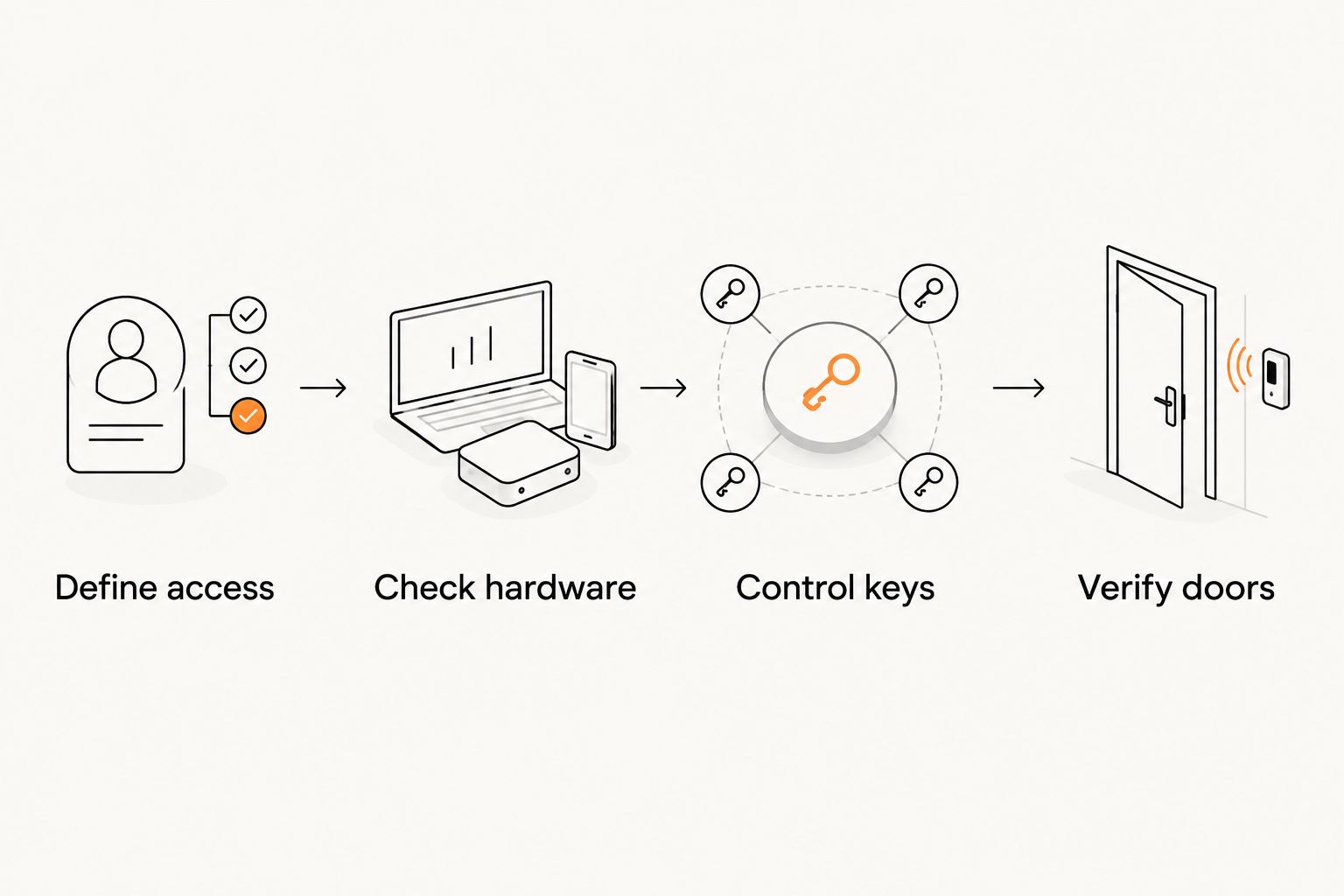
Approve the access plan before changing locks or issuing keys.
Variant: update access after a staffing or site change
A master key system needs controlled updates whenever someone leaves, changes roles, loses a key, or adds a location. Updating the register alone does not change what a physical key opens.
Identify the event. Record whether the issue concerns a returned key, an unreturned key, a lost master, a new employee, or a new site.
Map the affected doors. Use the key group to determine the scope. A missing site key and a missing cross-location master require different assessments.
Get the physical-change decision. Ask the locksmith whether affected cylinders need rekeying or other work. Base the decision on actual access exposure, not the employee's name disappearing from a list.
Update and retest. Revise the door register and issuance record together. Test changed access and collect superseded keys under the approved process.
For a new location added during 2026, repeat compatibility and authorization checks before extending the existing hierarchy. Confirm the exact address separately for local service eligibility. A matching lock appearance is not evidence that the new site fits your current key design.
Best for businesses adding sites: reuse the access policy, not an unverified assumption that existing keys will work everywhere.
Troubleshooting
A key opens a door outside its assigned group
Stop issuing the affected key group and report the exact key and door identifiers to the locksmith. Compare physical access with the approved matrix. Do not solve unexpected access by changing the spreadsheet to match it without the owner's authorization.
A master key works at one location but not another
Check whether the second door belongs to the same approved hierarchy. Give the locksmith the door identifier and system records; the cause can involve a separate system, incompatible hardware, or a configuration problem. Do not force the key or attempt to modify it.
Staff are using outdated key records
Name the authoritative register, restrict editing, and archive superseded versions. Require approvals before issuance. A shared document helps only when everyone knows which version controls access.
A landlord rejects the planned lock change
Pause work on that door and resolve authorization with the property owner or manager. Revise the scope to distinguish shared building access from business-controlled suite access. A tenant's internal access plan does not replace required landlord approval.
A cross-location master key is missing
Report the loss immediately and identify every door within that key's scope. Contact the locksmith for a physical access assessment. Deleting the holder's record does not disable the missing key.
Customize your workflow
Expand the plan around business roles rather than automatically expanding the master key's reach. Separate contractor access, landlord-controlled entrances, employee entrances, and sensitive rooms where the actual work requires different permissions.
Add a key handover check to your 2026 employee onboarding and departure procedures. Make returned keys and unreturned copies visible to the person responsible for access. Review the door register whenever a site moves, a lease changes, or hardware is replaced.
Fastkeyrious offers commercial rekeying and mobile business lockout service. The direct-technician model gives you a clear person to discuss the job with; it does not establish hardware compatibility or confirm a proposed master key project. Explain the requested scope before booking.
Discuss your business lock needs
Confirm exact addresses, authorization, and the requested lock work directly with the technician.
FAQ
Can a master key system work across multiple business locations?
Yes, a professionally designed mechanical master key hierarchy can cover multiple locations when the hardware and authorization support it. A locksmith must confirm compatibility and the intended key groups before changing cylinders.
Can I sync mechanical master keys through an app?
No, an app cannot remotely change which physical keys operate a mechanical cylinder. Records can be coordinated digitally, but changing mechanical access requires work at the affected locks.
Is using the same key everywhere the same as a master key system?
No, using one shared key gives its holders the same access to every lock configured for it. A master key hierarchy supports different access groups beneath broader master keys.
Do all the locks need to be replaced?
No, replacement is not automatically required. A locksmith must inspect whether existing cylinders can be rekeyed for the proposed hierarchy or whether hardware changes are necessary.
What should I do if someone loses a master key?
Report the loss immediately and identify the doors within that key's scope. Ask the locksmith to assess the physical changes needed; removing a name from the register does not disable the key.
Can I include a leased office entrance in the system?
Only include a leased entrance after confirming the required authorization and hardware compatibility. Shared building entrances and private suite doors can have different owners and approval requirements.
Can Fastkeyrious help with locks at several business addresses?
Fastkeyrious provides commercial rekeying and mobile locksmith services, with each address requiring service-area confirmation. Discuss multi-location coordination and master key work directly with the technician before assuming that scope is supported.
One last thing
Test a door that each limited-access key should not open. Confirming that a key opens its assigned entrance proves convenience; confirming that it cannot open an excluded door checks the access boundary. Put both results in the handover record.