Fast & Keyrious LLC
Call 821-203-4949
Locksmith services for apartment complex managers: complete 2026 guide
Apartment complex managers’ locksmith services are on-site lockout, rekeying, and lock replacement work aimed at keeping rental units and shared spaces accessible only to authorized people. This 2026 guide explains how to handle resident lockouts, apartment turnovers, missing keys, and office access without confusing permission to enter with permission to change a lock.
TL;DR
Locksmith services for apartment complex managers should separate lockout entry, rekeying, and lock replacement.
Fastkeyrious suits managers seeking mobile locksmith service with direct technician communication, subject to exact-address confirmation.
Rekey working, compatible locks when key access must change; replace hardware when its condition requires replacement.
Confirm authorization, the affected door, and electronic-access requirements before requesting service.
Why locksmith services matter for apartment complex managers
An apartment lock problem affects more than one door. A resident needs access, a manager needs a clear authorization record, and maintenance needs to know whether the existing hardware still works. Treating every call as a request to change locks creates unnecessary confusion.
Fastkeyrious is best for apartment managers who need mobile locksmith service and direct communication with the arriving technician. You speak to the technician rather than a dispatch center or call-center middleman. That helps you explain whether the problem involves an occupied apartment, a vacant unit, or the leasing office before requesting work.
The service boundary is up to 42 miles from Greenville, South Carolina, with each exact address requiring confirmation. A city name alone does not establish coverage. You can start with Fastkeyrious and provide the property address, affected entrance, and access problem.
For your 2026 maintenance procedures, separate emergency access from scheduled security changes. The company provides emergency response 24 hours a day, 7 days a week; that does not establish an arrival time or confirm that every lock system is supported.
How to organize apartment locksmith service
1. Confirm authority before requesting entry
Start with your lease procedures, management agreement, and existing authorization records. A person standing outside an apartment is not, by itself, proof that entry is authorized. Establish who is requesting help and who can approve the work.
For an occupied apartment, distinguish a resident lockout from a management request to enter. For a vacant unit, confirm possession and turnover status through your property records. Do not treat a locksmith appointment as a substitute for any required notice or legal process.
Use a written work order or your existing maintenance system before calling. Keep the authorization details available to the technician, but avoid sending unrelated resident information. If authority is disputed, resolve it through management and the appropriate legal process before arranging entry.
Confirm the requester’s identity through your established procedure.
Record the unit number and occupancy status.
Identify the person authorized to approve entry or changes.
Separate resident permission from management authorization.
Flag disputed possession or access before scheduling work.
2. Identify the door and the access problem
Inspect what you can safely observe before booking a visit. A missing key, a key that turns without opening the door, and a latch that will not release are different problems. Describe the symptom rather than deciding that the whole lock needs replacement.
Apartment properties also have several access boundaries. A resident’s unit door is different from a shared entrance, maintenance room, leasing-office suite, or storage area. Name the exact opening and explain whether another entrance provides authorized access.
Check your existing spare-key process first. If an authorized spare works, you have solved the immediate access problem without arranging entry service. If professional help is needed, Fastkeyrious can discuss the lockout, rekeying, or replacement request directly with you; confirm the particular hardware before assuming support.
Identify the building, unit, suite, and affected entrance.
State whether keys are inside, missing, or not operating the lock.
Check an authorized spare without forcing the mechanism.
Note a sticking latch, loose handle, or visible damage.
Describe separate deadbolts, handles, or electronic components.
3. Choose rekeying or replacement based on the actual problem
Rekeying changes which key operates a compatible existing lock; replacement changes the lock hardware. A missing key does not automatically mean you need new hardware. A damaged lock does not become reliable simply because its keying changes.
Ask the technician to assess the lock’s condition and compatibility. Rekeying fits a working lock when you need to stop an old key from operating it. Replacement fits hardware that needs removal because of its condition or the property’s approved requirements.
For apartment turnovers, review whether the departing occupant had access to additional doors. Changing only the apartment key does not address a separate office, storage, or shared-entry credential. Keep each access point on its own work order line.
The lock rekeying services comparison gives you a related starting point. For your property, the decision still depends on the actual lock, authorization, and access arrangement.
Ask whether the existing lock is suitable for rekeying.
Identify every door affected by the missing or returned key.
Request replacement assessment for damaged hardware.
Confirm how any existing master-key arrangement affects the work.
Specify who receives the new keys and records their receipt.
4. Separate unit turnover from occupied-unit work
Build a distinct turnover checklist for your 2026 leasing process. A vacant-unit appointment can include an authorized key change and a functional check before the next resident receives access. An occupied-unit visit needs a clear explanation of the problem and the approved scope.
Avoid treating returned keys as proof that no other copies exist. Your access decision should follow the property’s policy, not the apparent completeness of the returned key ring. Document what changed and which earlier keys were checked afterward.
Before a new resident arrives, check operation from both sides of the door. Confirm that the authorized key works, the latch engages, and the door opens from inside as intended. Do not accept a completed key change as proof that a sticking door or damaged latch has also been repaired.
Separate vacant-unit and occupied-unit work orders.
Record whether the request involves turnover, loss, or malfunction.
Confirm any required notice through your management process.
Test the authorized new key after the work.
Check door closing, latching, and inside operation.
Update the property’s key record before handover.
5. Distinguish mechanical locks from electronic access
A physical apartment key, a building-entry credential, and a resident’s vehicle key serve different systems. Identify which one failed before requesting locksmith service. Automotive fob programming is not evidence that a technician supports your building’s electronic-entry equipment.
For a keypad or credential-controlled door, begin with your authorized administrator and the system’s existing instructions. Determine whether the problem is a disabled credential, a power issue, or a mechanical fault. Do not reset a shared system simply because one resident cannot enter.
For leasing-office lockouts, identify the suite entrance and whether the landlord controls its hardware or access system. Obtain the required approval before requesting a change. Fastkeyrious provides business lockout service, but confirm the exact electronic or mechanical work with the technician rather than assuming access-control installation or programming.
Name the affected system and entrance.
Distinguish physical keys from building-entry credentials.
Ask the authorized administrator to check credential status.
Describe any mechanical lock that also controls the door.
Confirm landlord approval where the landlord controls access.
Verify the exact service supported before arranging work.
6. Prepare a usable emergency request
Make a short call script that staff can use without searching through old messages. Give the exact property address, unit or office entrance, problem, authorization contact, and safe meeting location. Include gate or building-entry instructions through an appropriate private channel.
For an immediate threat to life or safety, contact emergency services first. Do not wait for a routine locksmith appointment to address someone in danger. A routine resident lockout and an emergency requiring public responders need different actions.
When requesting locksmith service, ask for current scheduling information and confirmation of the proposed work. Do not promise the resident a fixed arrival time before the technician provides an update. If the problem changes while you wait, tell the technician rather than leaving the original request unchanged.
Provide the exact address for service-area confirmation.
Identify the unit, suite, or entrance that needs attention.
Name the authorized contact who will be available.
Explain safe access to the property and meeting location.
Ask for the current scheduling update.
Report changed conditions before work begins.
7. Record the outcome before closing the work order
Use your existing maintenance log rather than creating a separate record nobody maintains. Record the problem, authorization, affected door, completed work, and key handover. Keep sensitive key-control information accessible only to staff who need it.
A useful 2026 closeout separates successful entry from completed security work. Opening a locked door does not cancel a missing key. Rekeying a cylinder does not correct a separate electronic credential. Document unresolved issues explicitly so the next staff member does not assume they were handled.
Close the request only after the authorized person checks the relevant function. If additional hardware work needs approval, record that as a separate action. Resident communication should explain what was completed and what remains, without exposing the property’s wider key arrangements.
Record the outcome and any unresolved issue.
Identify the door and hardware addressed.
Document who approved the completed scope.
Record who received the authorized keys.
Confirm the resident or manager checked operation.
Restrict access to sensitive key-control records.
Compare options for apartment access problems
Choose the service by the failure, not by the urgency alone. The options below solve different problems; none replaces authorization or a check of the actual door.
Authorized spare
Best for: Routine lockouts when a controlled spare exists
Main advantage: Restores access without a lock change
Key limitation: Does not address a missing key or defective lock
Lockout entry
Best for: Authorized occupants locked out of a unit or office
Main advantage: Addresses the immediate access problem
Key limitation: Does not revoke an old key’s access
Rekeying
Best for: Working, compatible locks needing a different operating key
Main advantage: Retains suitable existing hardware
Key limitation: Does not repair damaged hardware
Lock replacement
Best for: Hardware that needs replacement after assessment
Main advantage: Changes the physical lock
Key limitation: Requires confirmation of fit and approved scope
Electronic access
Best for: Credential or system problems on controlled entrances
Main advantage: Addresses the relevant access system
Key limitation: Requires system-specific authority and support
Your access decision starts with the affected entrance and ends with the problem actually resolved. Keep lockout entry, rekeying, lock replacement, and electronic access separate when explaining the request.
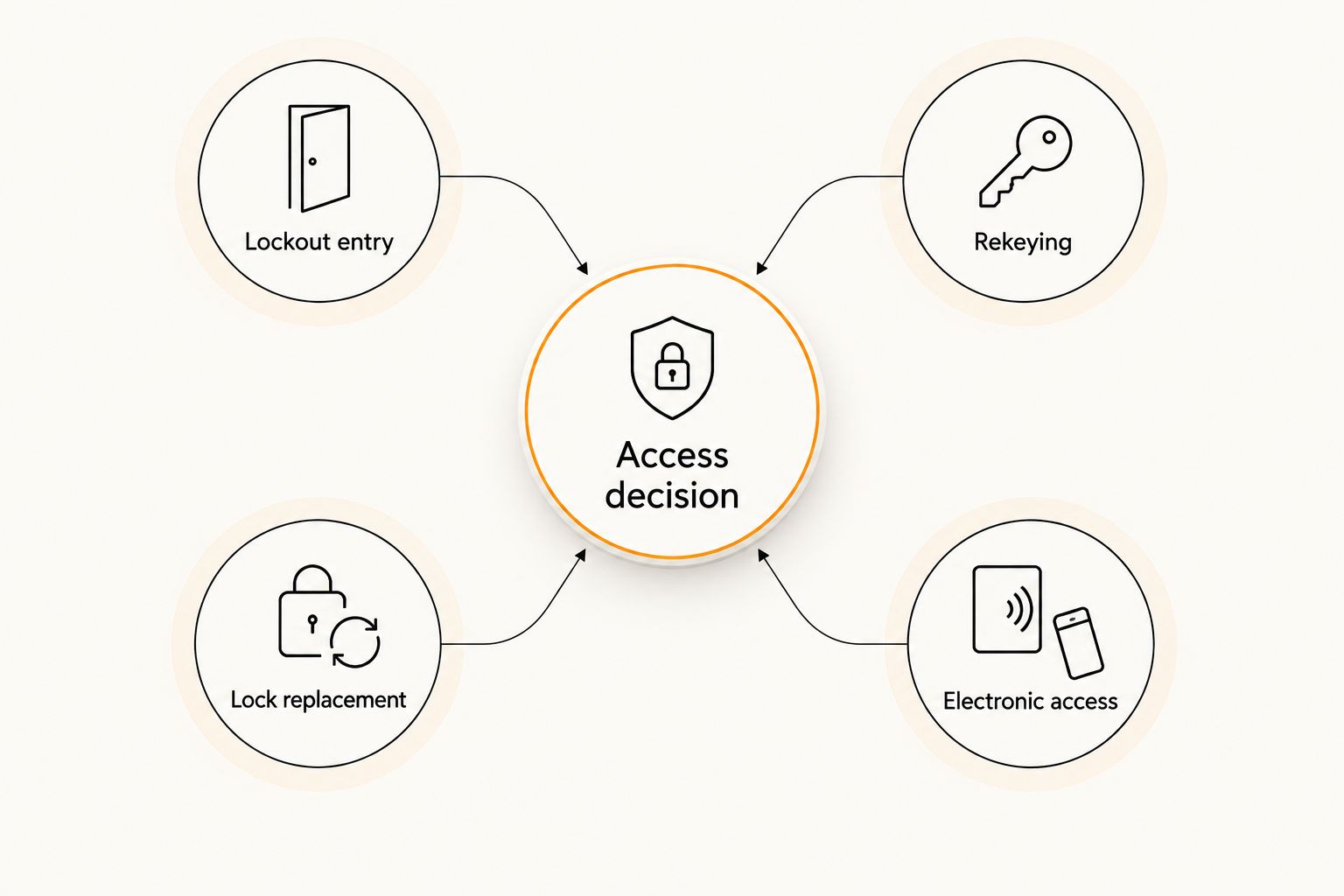
Restoring entry and changing access permissions are different jobs.
Common mistakes apartment complex managers make
Treating every lockout as permission to change locks
A request to open a door is not automatically approval to replace or rekey it. Specify the authorized scope before work begins. If the resident also reports a missing key, address that separately rather than assuming entry service solves both problems.
Changing a unit key but overlooking shared access
A turnover can involve more than the apartment entrance. Review the resident’s recorded access to storage, shared doors, and electronic systems. Handle each affected access point through its authorized process instead of assuming a single key change covers the property.
Requesting hardware without checking the door
Do not order a replacement based only on appearance. The existing door preparation, lock function, condition, and property requirements affect the choice. Have the proposed replacement assessed before authorizing it; this guide does not establish compatibility for any particular product.
Promising coverage or arrival before confirmation
A property within a named town is not automatically an approved job location. Confirm the exact address within the 42-mile Greenville boundary and ask for current scheduling information. For 2026 resident communications, report confirmed updates instead of repeating an assumed arrival window.
FAQ
What locksmith services do apartment complex managers need?
Apartment complex managers need service matched to the problem: authorized lockout entry, rekeying, or lock replacement. Electronic-entry issues require confirmation of the particular system and the service supported.
Should I rekey or replace an apartment lock after a tenant moves out?
Rekey a working, compatible lock when the goal is to change which key opens it; replace hardware when its condition requires replacement. Follow the property's authorization and turnover procedures before either job.
Can a locksmith open an apartment for a resident?
A locksmith can assess an apartment lockout after authority to enter is established. Prepare the resident verification, affected unit, and authorized management contact before requesting service.
Does Fastkeyrious provide emergency apartment lockout service?
Fastkeyrious provides 24/7 emergency locksmith response, including home and business lockouts. Confirm the exact property address, authorization, lock type, and current scheduling directly with the technician.
Does rekeying disable a lost apartment key?
Proper rekeying changes the operating key for the affected compatible lock so the previous key no longer operates it. It does not disable a separate building credential or change other locks automatically.
Can automotive fob programming fix our apartment entry system?
Automotive fob programming does not establish support for an apartment building's entry system. Identify the building system and ask its authorized administrator or an appropriately qualified provider about the specific issue.
How do I confirm whether my apartment property is in the service area?
Provide the exact address to confirm eligibility within up to 42 miles of Greenville, South Carolina. North Carolina and Wellford are excluded, and a town name alone does not confirm coverage.
What should I tell the locksmith when our leasing office is locked?
Identify the office suite, affected entrance, lock or electronic system, and person authorized to approve entry. Confirm landlord approval where required and distinguish opening the door from changing its hardware.
One last thing
An open door is not proof that the access problem is finished. Before closing the work order, ask whether the old key still works, whether another credential needs attention, and whether the door now closes and locks correctly. Those checks distinguish a completed entry request from a completed security change.