Fast & Keyrious LLC
Call 821-203-4949
Mobile locksmith services for property managers: complete 2026 guide
Property managers’ mobile locksmith service is on-site help for lockouts, rekeying, and lock replacement, with the aim of restoring authorized access to managed properties. This 2026 guide explains how to prepare the job, separate tenant access from building access, and work with Fastkeyrious without a dispatch-center middleman.
TL;DR
Fastkeyrious mobile locksmith services suit property managers who want direct contact with the arriving technician.
Mobile locksmith services for property managers should separate lockouts, rekeying, and lock replacement before scheduling.
Confirm the exact service address within the approved 42-mile Greenville boundary before arranging work.
Document authorization, identify the affected door, and reconcile keys after every property turnover.
Why mobile locksmith services matter for property managers
A property lockout is not just a locked door. You need to establish who can authorize entry, which space the person can access, and whether the problem involves a physical lock or an electronic credential. An apartment entrance, an office suite, and a shared building entrance require different instructions.
Your 2026 access plan should distinguish urgent entry from longer-term key control. Opening a door does not invalidate a missing key. Rekeying changes which key operates a compatible lock; replacing a lock changes the hardware itself.
Fastkeyrious mobile locksmith services suit property managers who want to speak directly with the arriving technician. That direct conversation lets you explain the door, authorization, and access problem without passing the details through a call center.
Service coverage still needs an address check. The approved area extends up to 42 miles from Greenville, South Carolina, excludes North Carolina and Wellford, and does not automatically include every address in a named town. Confirm the exact property location before scheduling.
How to arrange mobile locksmith service for managed properties
Establish who can authorize the work
Start with your own records. Check the management agreement, tenant information, and building contact list before asking anyone to open or change a lock. A leaseholder requesting apartment access is different from an employee requesting entry to a restricted office.
Identify the person who can approve the specific work. Permission to open a suite should not become permission to change a shared entrance or remove building hardware. For commercial properties, establish whether the tenant, property manager, owner, or another authorized building representative controls that door.
In your 2026 property file, keep authorization separate from key possession. Someone holding an old key does not establish their current right to enter. Likewise, a person requesting help should not be treated as authorized solely because they know the address.
Ask what verification the technician requires before the visit. Keep sensitive tenant documents in your approved records system rather than sending entire files when a narrower confirmation will do.
Name the person authorized to approve entry or lock changes.
Identify whether the door serves a unit, suite, or shared area.
Confirm who will meet the technician and present verification.
Record any landlord or building-management approval needed.
Identify the door and the actual problem
Inspect what you can safely observe without forcing entry. Note whether a key is locked inside, missing, broken, or no longer turning. For an office entrance, distinguish a mechanical lock problem from a keypad, badge reader, or building-system issue.
Give the technician four details: the exact address, the specific door, the symptom, and the authorization contact. A street address alone is not enough when a property has several buildings, entrances, or numbered suites. Explain where the technician should meet your representative.
Separate entry from repair. A tenant locked out with a working key inside needs a different conversation from a tenant whose key turns but the door will not open. Describe the symptom rather than deciding in advance that the lock must be replaced.
Do not use improvised tools or force a door while arranging service. If the lock operates but the door binds against the frame, report that distinction. Hardware work alone should not be treated as the answer to a door-alignment problem.
Record the building, unit or suite, and entrance location.
Describe whether the key is present, missing, broken, or ineffective.
Note visible damage without dismantling the lock.
Identify any keypad, badge reader, or electronic credential involved.
Provide safe parking and meeting instructions where needed.
Choose entry, rekeying, or lock replacement
Use a simple decision before arranging work: do you need access restored, old keys invalidated, or damaged hardware addressed? These are separate outcomes. Choosing the wrong one leaves the underlying problem unresolved.
A lockout service addresses entry. Rekeying changes the internal keying of a compatible lock so a different key operates it. Lock replacement removes the existing hardware and installs different hardware. Whether rekeying is appropriate depends on the lock’s condition and construction.
For 2026 turnovers, treat an unaccounted-for key as a key-control issue, not merely a shortage of spare keys. A returned key does not establish whether copies exist. Review the affected access points and ask which locks require a change.
You can prepare this decision manually using your key log and a door inspection. Fastkeyrious provides mobile lockout and rekeying services; discuss lock replacement needs and the specific hardware with the technician before authorizing work. The lock rekeying services comparison provides related reading on that distinction.
Request entry when an authorized person cannot access the space.
Discuss rekeying when working hardware needs different key access.
Discuss replacement when the hardware is damaged or unsuitable.
Identify every door affected by a missing or compromised key.
Confirm the proposed work before the technician changes anything.
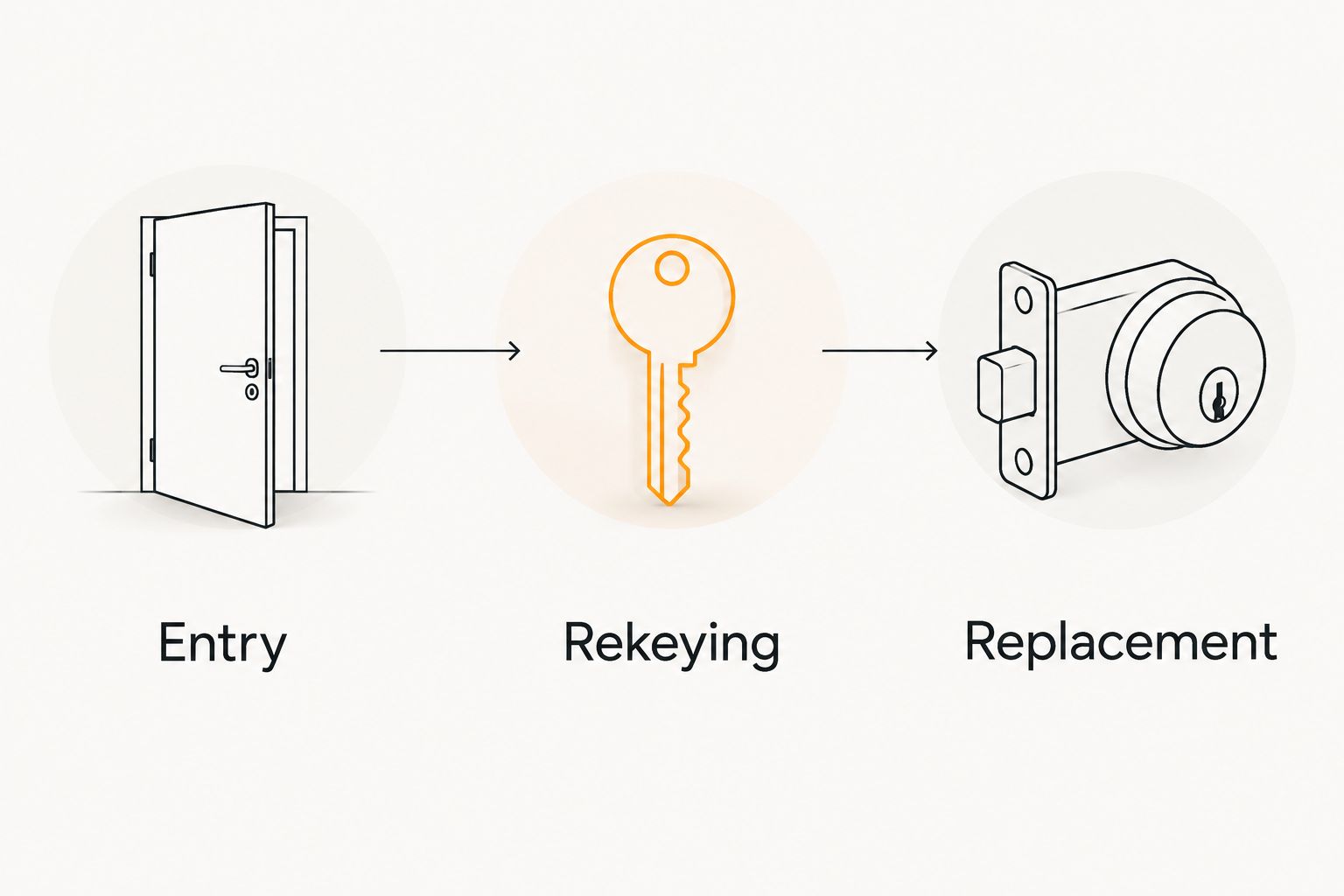
Restoring entry and changing key access are different jobs.
Plan the handoff around occupants and building rules
Use your existing scheduling system first. Arrange an authorized representative, explain which entrance the technician should use, and tell affected occupants what access will change. For planned work, coordinate any notice required by your lease, management agreement, or applicable rules.
A vacant apartment and an occupied office need different handoffs. At an office, a suite door can sit behind a shared lobby entrance controlled by building management. Opening the suite will not solve a separate lobby-access problem.
For emergencies, the business offers service 24 hours a day, 7 days a week. That describes availability, not a promised arrival time. Ask the technician about the actual job and location rather than planning around an assumed response window.
Keep emergency safety separate from routine lock service. If someone faces immediate danger, contact emergency services rather than waiting for a locksmith. Once the situation is safe, clarify who can authorize entry and what work is needed.
Arrange a named representative to meet the technician.
Confirm access through gates, lobbies, and shared entrances.
Coordinate occupant notice and building approval where required.
Separate emergency entry from any later rekeying decision.
Request an arrival estimate without treating it as a guarantee.
Check the completed work before closing the job
Stay for the handoff or assign someone who can inspect the result. Ask the technician to explain what changed: entry only, cylinder rekeying, or hardware replacement. The property record should describe the actual work rather than use a broad label such as lock repair.
Test each newly issued key in the affected lock. Check operation with the door open and then closed, without forcing it. Confirm that the door closes and latches as intended, and report any remaining binding or unusual resistance before treating the job as complete.
For a rekeying job, arrange an appropriate check that the previous key no longer operates the changed lock. Do not test an old key in unrelated locks or assume that changing one cylinder changes every door on the property.
For electronic-access concerns, distinguish what the technician addressed from what still requires the building’s access-system administrator. A working mechanical key does not establish that a badge, code, or remote permission has been removed.
Test every newly issued key on its assigned lock.
Check door closure and latch operation.
Confirm exactly which cylinders or hardware were changed.
Document unresolved door or electronic-access issues.
Record who accepted the completed work.
Update the key log and turnover record
Close the administrative gap after the physical work. Update your existing spreadsheet or property-management record with the affected door, completed service, and people who received keys. Keep the information specific enough that another manager can understand it without calling you.
Keep your 2026 key log tied to doors, not just tenant names. A tenant can move between units, and an office can have several access points. Records organized only by occupant make it harder to identify which lock a missing key affects.
Store spare keys securely and control who can release them. Avoid labels that expose a complete property address to anyone who finds the key. Keep the identifying information in the controlled record instead.
Review shared-door access separately from private-unit access. If an outgoing occupant held a common entrance key, changing the apartment lock alone does not resolve that shared-key question. Record the decision and its authorization rather than leaving it implicit.
Record the property, door, service performed, and completion date.
Log each issued key and its authorized recipient.
Remove outdated assignments from active records.
Store spare keys with controlled access.
Document shared-door decisions separately from unit work.
Discuss your property’s access problem
Speak directly with the technician about authorization, the affected door, and the exact service address.
Compare your property access options
Choose the option that solves the access problem, not the one that merely gets someone through the door. A controlled spare key can resolve a straightforward lockout, but it cannot invalidate a missing key. A hardware change addresses a different need from an electronic credential update.
Authorized spare-key handoff
Best for: A lockout where a controlled, working spare exists
Main benefit: Uses your existing access process
Key limitation: Does not address missing-key security or faulty hardware
Fastkeyrious mobile lockout service
Best for: Authorized managers needing on-site entry assistance
Main benefit: Direct communication with the arriving technician
Key limitation: Entry alone does not invalidate old keys; exact address needs confirmation
Rekeying
Best for: Changing key access on suitable, working locks
Main benefit: Retains suitable existing hardware while changing the operating key
Key limitation: Depends on lock condition and construction; does not repair a binding door
Lock replacement
Best for: Damaged or unsuitable lock hardware
Main benefit: Changes the physical hardware
Key limitation: Requires agreement on suitable hardware and the affected door
Building access-system administrator
Best for: Badge, code, or account-permission problems
Main benefit: Addresses electronic permissions through the responsible system
Key limitation: Does not resolve a separate mechanical lock or door problem
For mixed problems, define separate tasks. An office employee can lose both a suite key and a building badge. The mechanical key and the electronic credential need separate decisions, even when the incident has one cause.
Common mistakes property managers make
Treating tenant access as building-wide authorization
A tenant’s apartment or suite access does not automatically authorize changes to shared doors. Confirm control of the specific entrance before arranging work. This matters when an office suite sits behind a landlord-controlled lobby or corridor.
Closing a turnover file after collecting keys
Collecting keys documents a handoff; it does not prove that no copies exist. Review the property’s key-control policy and decide whether rekeying is required. Record that decision alongside any shared-entrance access that remains active.
Sending the technician an incomplete location
An address without a unit, suite, entrance, or meeting contact creates avoidable confusion. Add the exact door and confirm the service boundary. Do not assume every address in a nearby city qualifies because another property there received service.
Combining mechanical and electronic access into one request
A failed badge reader and a jammed cylinder are different problems. Describe both, identify who administers the electronic system, and confirm the technician’s supported work. Do not assume lockout service includes access-control installation or credential administration.
Replacing hardware before identifying the fault
A door that sticks is not automatically a failed lock. Report whether the key turns, whether the latch moves, and whether the door binds. Let the inspection inform the scope instead of ordering replacement as the default answer.
FAQ
What do mobile locksmith services for property managers include?
Mobile locksmith services for property managers address on-site lockouts, rekeying, and specific lock replacement needs. Identify the door, authorization, and desired outcome before scheduling, and confirm the exact work with the technician.
Should I rekey or replace locks after a tenant moves out?
Rekeying changes the operating key on a suitable lock; replacement changes the hardware. Review key control, lock condition, and property requirements before choosing the work.
Can a locksmith open an office suite for an employee?
Office-suite entry requires appropriate authorization for that space. Confirm the authorized contact, any landlord approval, and whether the problem involves the suite door or a separate shared entrance.
Does a lockout service make a lost key stop working?
No, restoring entry alone does not invalidate a lost key. Discuss rekeying or other appropriate access changes separately, including any shared doors the key operates.
Does Fastkeyrious offer emergency service for managed properties?
Fastkeyrious offers 24/7 emergency locksmith response for residential and commercial customers. Confirm the exact service address and discuss the job directly with the technician; availability is not a guaranteed arrival time.
Is every property near Greenville inside the service area?
No, the exact address must be confirmed within the approved area up to 42 miles from Greenville, South Carolina. North Carolina and Wellford are excluded, and a town name alone does not establish coverage.
Can a mobile locksmith fix an office badge or keypad system?
Do not assume that mobile lockout service includes electronic access-system work. Identify whether the problem is mechanical or electronic, then confirm the supported service and involve the building’s system administrator when needed.
One last thing
Ask what the old key still opens. That question catches a gap that a successful apartment or suite rekey can leave behind: shared-door access. Your 2026 turnover record should answer it explicitly, with the affected doors and the person who approved the decision.