Fast & Keyrious LLC
Call 821-203-4949
Rekeying services for landlords: complete 2026 guide
Landlord rekeying is the process of changing a lock’s internal key configuration to control rental-property access without replacing serviceable hardware. This guide to rekeying services for landlords explains how to handle tenant turnovers, separate access changes from repairs, and document who receives each new key.
TL;DR
Rekeying services for landlords should start with authorization, a door inventory, and a decision about hardware condition.
Fastkeyrious suits landlords seeking mobile rekeying and direct contact with the arriving technician.
Rekeying changes which key operates a compatible lock; lock replacement changes the hardware.
Confirm the exact service address within 42 miles of Greenville; a town name alone does not establish coverage.
Why rekeying matters for landlords
A returned key does not establish that every copy has been returned. Rekeying changes access at the lock, rather than relying on a former tenant, contractor, or manager to surrender every duplicate. That distinction matters when you take possession of a rental after an authorized turnover.
Landlords also have more to manage than the front door. A rental can have a separate deadbolt, side entrance, garage access door, and shared entry. Changing one lock does not automatically address the others. Your access plan needs to identify which doors belong to the unit and which serve other occupants.
Fastkeyrious provides mobile residential and commercial rekeying, with direct contact with the technician rather than a dispatch-center middleman. Service locations must be confirmed within the approved boundary of up to 42 miles from Greenville, South Carolina. North Carolina and Wellford are excluded; do not assume every address in a named town qualifies.
For your 2026 turnover process, treat rekeying as an access decision—not a substitute for door repairs, legal possession, or tenant notice. A working lock, an authorized appointment, and a documented key handoff are separate requirements.
How to plan a rental-property rekey
1. Confirm authorization
Start with your lease, management agreement, and turnover records. Establish who controls the property, whether the tenant has surrendered possession, and who can authorize work. If occupancy or possession is disputed, resolve that issue before arranging an access change.
Never use rekeying to force an occupied tenant out. Ownership alone does not answer every question about lawful entry, notice, or possession. Check applicable requirements and get qualified legal guidance when the situation involves an eviction, abandoned belongings, or conflicting claims to the unit.
For a 2026 appointment, put the authorized contact’s name and the unit identifier in the work request. Tell the technician whether you will attend or whether a property manager will meet them. Ask what documentation is needed before anyone travels to the property.
Confirm who can authorize the lock work.
Establish the unit’s occupancy and possession status.
Check required notice and entry procedures.
Identify the person meeting the technician.
Ask which ownership or management documents to bring.
2. Inventory doors
Walk the property before requesting service. Use a paper checklist or a simple spreadsheet to record each door, its lock hardware, and its role. Keep 1 written turnover checklist per unit so a shared entrance does not get confused with a private rental entrance.
Distinguish the door itself from the locks installed on it. A knob and deadbolt on the same door are separate mechanisms. Also note whether a key turns smoothly, whether the latch catches, and whether you have to push or lift the door to lock it.
Photographs help explain the job, but they do not establish that every lock can be rekeyed. Capture the inside and outside hardware without showing readable key cuts or access codes. Ask the technician whether any additional details are needed.
Update your 2026 inventory when hardware changes. An old record that says every entrance uses the same key can create the wrong scope for the next turnover.
List unit entrances separately from shared entrances.
Record knobs, deadbolts, and other keyed locks.
Note sticking keys, loose hardware, and latch problems.
Photograph hardware without exposing keys or codes.
Identify doors that other occupants still need to use.
3. Choose the work
Use the inventory to separate access changes from hardware problems. Rekeying changes which key operates a compatible lock; replacement changes the lock hardware. A healthy lock with an unwanted key in circulation presents a different problem from a damaged lock or a door that will not latch.
You can prepare this distinction yourself without buying anything. Mark each lock as an access concern, a hardware concern, or both. Leave the final assessment of rekeying compatibility and repair needs to the technician.
Fastkeyrious is best for landlords who want mobile rekeying and direct contact with the arriving technician. That direct conversation lets you describe the existing hardware and ask about the appropriate service before arranging access. It does not establish compatibility with every lock or include electronic-access installation by default.
If you want multiple locks to use the same key, ask whether the existing cylinders are compatible. Do not assume different lock brands or key systems can be combined. A master-key arrangement is also a separate discussion, not an automatic part of ordinary rekeying.
Mark locks that only need an access change.
Flag damaged hardware for a replacement assessment.
Ask whether existing cylinders can share a key.
Separate electronic credentials from mechanical keys.
Confirm the requested work before authorizing it.
4. Schedule access
Coordinate the appointment with possession, cleaning, inspections, and the next tenant’s move-in. A calendar and a short written work order are enough to begin. State when the property can be entered lawfully and who will provide access.
Do not treat a lockout and a rekey as the same request. If nobody can enter the unit, explain that first. Opening a locked door restores access; rekeying changes which key operates the lock afterward. The technician needs to know whether the job involves one service or both.
For a 2026 turnover, confirm the exact address and unit—not just the city. Coverage extends only to approved locations within 42 miles of Greenville, subject to the stated exclusions. Ask the technician to confirm the location and appointment details directly.
For multi-unit buildings, coordinate common entrances and keep occupied units outside the work scope unless separately authorized. The mobile locksmith guide for property managers addresses the broader management context.
Provide the exact street address and unit identifier.
Confirm coverage with the technician.
Explain whether entry is available or a lockout exists.
Identify the on-site contact and authorized doors.
Coordinate contractor access and the tenant handoff.
5. Test each lock
Test the completed work before accepting the keys or leaving the property. Start with the door open so a problem does not leave you locked out. Check the inside controls as well as the exterior key operation.
Use 2 test keys—the new key and an old key, if available. Confirm that the new key operates each cylinder included in the job and that the old key no longer operates those cylinders. If no old key is available, record that limitation rather than marking an old-key test as completed.
Next, check the door in its closed position. A cylinder can turn correctly while the latch or deadbolt still binds against the frame. Rekeying does not correct every alignment problem. Ask the technician to identify whether any remaining issue concerns the lock, the strike, or the door.
For electronic locks with a mechanical backup, keep the tests separate. Changing a cylinder does not itself remove an electronic code. Do not assume code management or electronic troubleshooting was included in the appointment.
Test the new key with the door open first.
Test the previous key where available.
Check inside locking and unlocking controls.
Confirm the latch and deadbolt engage when closed.
Record unresolved hardware or electronic-access issues.
6. Record key handoffs
Create the access record before the next tenant receives keys. A basic spreadsheet works: identify the unit, the date, the doors serviced, the authorized requester, and each person receiving a key. Store that record securely rather than posting it in a shared maintenance area.
Count the keys issued at handoff and note their purpose. Distinguish tenant keys from management keys, contractor keys, and shared-entry keys. Do not label a physical key with the property’s complete address; use an internal identifier that only authorized staff can interpret.
For 2026 turnovers, close temporary access deliberately. If a contractor received a key after the rekey, your access record should still show that key as outstanding until it is returned or otherwise addressed. Finishing the locksmith appointment does not finish the access-management process.
Keep the invoice or service record with the unit’s maintenance history. It should help the next manager understand what changed without exposing sensitive key or code information.
Record the service date and doors included.
Log each key recipient and authorized purpose.
Use internal identifiers on physical key tags.
Track contractor-key returns separately.
Store service records with restricted access.
The complete process is authorization, inventory, scope, access, testing, and handoff. Keeping those stages separate prevents a routine turnover from becoming an unclear request to change every lock on the property.
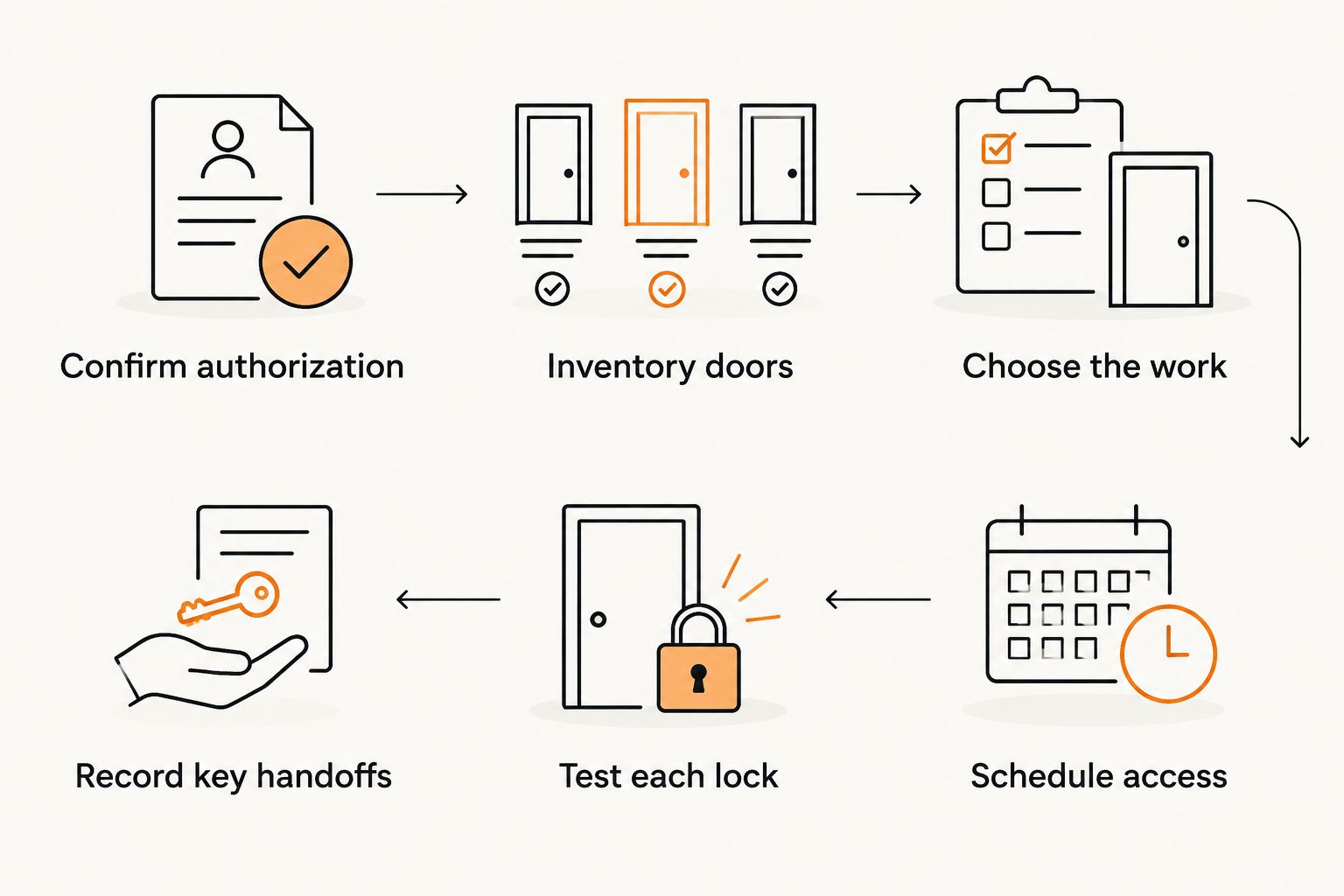
Define the authorized scope before scheduling work, then test the locks before handing over keys.
Compare rental-property access options
Choose the work by the problem, not by the label on the request. Rekeying, replacement, and credential changes solve different access issues. None should be treated as a universal fix.
Rekeying
Best for: Landlords with compatible, serviceable keyed locks
Main benefit: Changes the working key while retaining existing hardware
Key limitation: Does not repair damaged hardware or remove electronic codes
Lock replacement
Best for: Landlords with damaged hardware or a needed hardware change
Main benefit: Replaces the lock rather than retaining the existing mechanism
Key limitation: Requires assessment of door fit and hardware suitability
Code reset
Best for: Landlords managing an existing electronic lock they are authorized to administer
Main benefit: Changes electronic access without issuing another physical key
Key limitation: Does not necessarily change mechanical backup-key access
Key duplication
Best for: Landlords issuing authorized copies after the access plan is settled
Main benefit: Provides additional copies of a working key
Key limitation: Does not invalidate keys already in circulation
Start with your current hardware and authorization. Ask the technician to confirm the mechanical work supported. For electronic credentials, follow the existing system’s instructions or coordinate with its authorized administrator; mobile rekeying does not imply support for every electronic system.
Discuss your rental rekey
Speak directly with the technician to confirm your address, lock details, and authorized scope.
Common mistakes landlords make
Treating returned keys as complete access control
Collecting keys is part of a turnover, but it does not account for undisclosed copies. Decide whether the rental’s working key needs to change before the next tenant takes possession. Record the decision instead of treating a returned key ring as proof.
Rekeying only the front deadbolt
A separate keyed knob, rear entrance, or garage access door can remain on the previous key. Use the door inventory to define the full authorized scope. Do not extend that scope to shared entrances without checking other occupants’ access.
Replacing sound hardware without checking the actual problem
An unwanted key in circulation does not automatically require a new lock. Conversely, rekeying is not a cure for a damaged mechanism. Ask for an assessment that separates access control from hardware condition.
Changing shared access without a handoff plan
A common entrance affects more than the vacant unit. Coordinate authorization, notices, and replacement-key distribution before changing it. Keep shared-entry work separate from the departing tenant’s private doors.
Assuming a new key removes every credential
A rekeyed mechanical cylinder does not automatically clear keypad codes, app permissions, or separately administered building credentials. Identify each access method and assign responsibility for changing it. Do not mark the turnover complete while an authorized access review remains unfinished.
FAQ
What do rekeying services for landlords actually change?
Rekeying changes the internal key configuration of a compatible lock so a different key operates it. The existing lock hardware remains in place, and the previous working key should no longer operate the rekeyed cylinder.
Should I rekey or replace the locks between tenants?
Rekeying fits an access change when the existing locks are compatible and serviceable; replacement addresses hardware that needs to change. Have the technician assess damaged, sticking, or unsuitable hardware before choosing the work.
Can all the locks on my rental use the same key?
One key can operate multiple locks only when their key systems and cylinders are compatible with that arrangement. Ask the technician to assess the existing hardware rather than assuming every brand or lock can be combined.
Can I rekey a rental while a tenant still lives there?
Do not rekey an occupied rental to exclude the tenant. Establish lawful authorization, follow applicable entry and notice requirements, and obtain qualified legal guidance if possession or access is disputed.
What should I have ready before the locksmith arrives?
Have the exact address, unit identifier, authorized contact, door inventory, and available keys ready. Ask the technician which ownership or management documents are required and explain whether anyone can currently enter the property.
Does rekeying erase smart-lock codes?
Mechanical rekeying does not itself erase electronic codes or permissions. Treat code changes and mechanical backup-key changes as separate tasks, and confirm who is authorized and able to handle each.
Does Fastkeyrious serve my rental property?
Fastkeyrious serves confirmed locations within the approved boundary of up to 42 miles from Greenville, South Carolina, excluding North Carolina and Wellford. Confirm the exact property address directly; a city or county name alone does not establish coverage.
How do I check that a rekey was completed correctly?
Test the new key in every cylinder included in the job and test an old key if one is available. Begin with the door open, then check closed-door latch and deadbolt operation and the inside controls.
One last thing
The last person to receive a key matters as much as the first. If you rekey before cleaning and repairs, then issue contractor keys, you have created another handoff to track. Settle that access before the incoming tenant receives possession.
Make your 2026 turnover record end with a confirmed handoff, not merely a completed invoice. For Fastkeyrious rekeying, discuss the doors, authorized scope, and exact service location directly with the technician before arranging the visit.