Fast & Keyrious LLC
Call 821-203-4949
How long does it take to rekey an entire office?
There is no reliable whole-office rekeying time without checking the locks, available access, and the new key plan. Your appointment also needs to cover authorization, working-key checks, and a final handoff—not just changing the key configuration inside each lock.
TL;DR
How long does it take to rekey an office? The door list, lock condition, and key plan determine the estimate.
Count keyed cylinders, not just doors, before requesting an office rekeying appointment.
Physical rekeying does not revoke employee badges, keypad codes, or app access.
Fastkeyrious provides commercial rekeying; confirm the exact address and job scope directly with the technician.
For an office rekeying request, Fastkeyrious lets you speak directly with the technician rather than a dispatch-center middleman. Have your address, door list, and approval details ready so the conversation establishes what the appointment actually includes.
How long does it take to rekey an entire office?
Get a scope-based time estimate, not a blanket promise for an “entire office.” A suite entrance, private offices, storage rooms, and a shared building entrance do not necessarily belong to the same job. The estimate needs to identify which locks you control and which ones the technician will service.
Use this sequence before reserving time on your office calendar:
Confirm authority. Identify who can approve changes to the suite and any landlord-controlled locks.
List the locks. Record each door and its keyed cylinders, including separate deadbolts where present.
Set permissions. Decide which staff members need access to which rooms.
Arrange access. Make the affected doors accessible and identify the person meeting the technician.
Test and hand off. Check the agreed key permissions and document who receives the new keys.
These steps separate hands-on work from the coordination surrounding it. Ask the technician whether the estimated appointment includes the full sequence or only the rekeying itself.
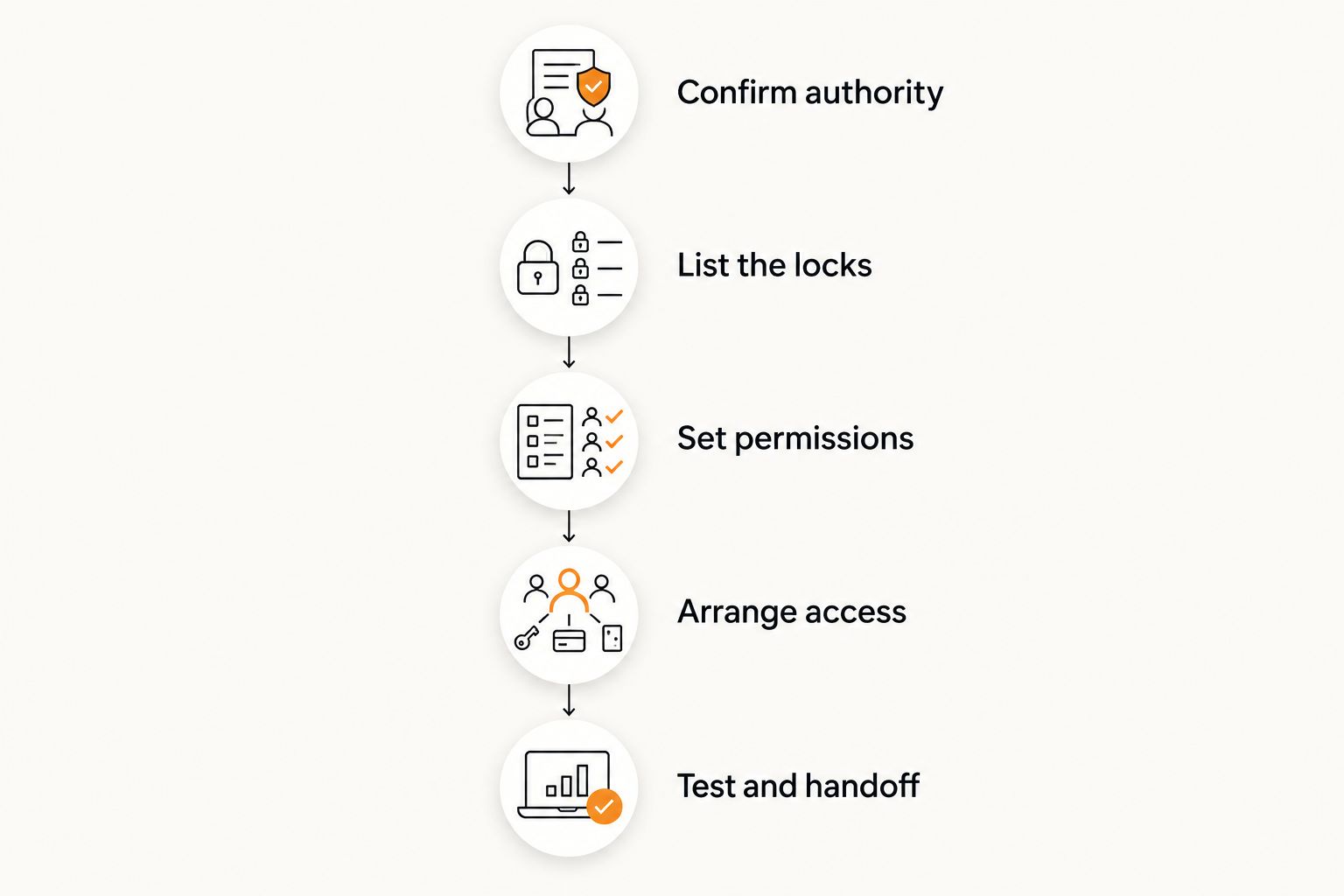
Define access and approval before setting aside time for the work.
Why this matters
An office rekey is an access change, not just a maintenance appointment. A new key should work where intended, while a superseded key should no longer open a rekeyed cylinder unless the approved key plan intentionally retains that access.
The practical question is when your office can operate under the new access arrangement. That includes getting keys to authorized staff and handling any separate electronic credentials. A finished cylinder is not the same as a finished access handoff.
Why office rekeying time varies
The useful drivers are specific to your building and the work you authorize:
Keyed-cylinder count. A door can have more than one keyed lock. A door count alone leaves the scope unclear.
Hardware condition. A sticking lock, damaged cylinder, or poorly closing door needs assessment rather than an assumption that rekeying will fix it.
Existing key access. Tell the technician whether you have working keys and whether any affected rooms are locked.
Key permissions. Giving everyone the same access is different from preserving separate access for managers, staff, and restricted rooms.
Building coordination. Landlord approval, shared entrances, and unavailable rooms affect when work can proceed.
Completion requirements. Key copies, permission checks, and a documented handoff belong in the agreed scope.
Send clear photos of the hardware if the technician requests them. Photograph the lock and door hardware, not the cuts on your keys, and avoid sharing sensitive access information in public messages.
Are you asking for rekeying, replacement, or an access reset?
These jobs address different problems. Choose the task based on what needs to change, not on the assumption that any lock service will solve the whole access issue.
Physical rekeying
Best for: Changing who can use keys when existing hardware is suitable
What changes: The cylinder's key configuration
Limitation to resolve: Does not repair every hardware fault or remove electronic credentials
Lock replacement
Best for: Addressing unsuitable or failed hardware
What changes: The selected lock hardware
Limitation to resolve: Requires hardware assessment and approval; compatibility needs checking
Electronic credential change
Best for: Removing badge, code, or app permissions
What changes: The relevant electronic access permissions
Limitation to resolve: Does not automatically change a separate mechanical key cylinder
Lockout entry
Best for: Regaining authorized access to a locked office
What changes: Access to the locked space
Limitation to resolve: Does not by itself establish a new key arrangement
Rekeying is the right task when you need to change mechanical key access and the existing lock is suitable for the work. It is not a substitute for repairing a door that will not latch or disabling a former employee's badge.
For the security distinction, see whether rekeying is as secure as replacing a lock. Ask the technician to assess the actual hardware before choosing either route.
Prepare a door list that supports a useful estimate
A useful door list identifies the location, access restrictions, and known problems at each opening. “All office doors” is too vague when a building contains private suites, shared corridors, and landlord-controlled areas.
For each affected door, record:
Door identity: A clear description such as suite entrance or records room.
Keyed hardware: Separate keyed locks on the same door.
Current access: Whether the door opens and a working key is available.
Required permissions: Who should have access after the work.
Known faults: Sticking, loose hardware, or trouble closing and latching.
Approval owner: Your business, the property manager, or another authorized party.
Do not include alarm codes or employee credentials in a general door list. Keep sensitive information with the authorized contact and share it only through an appropriate channel when necessary.
Mark any door that cannot be taken out of normal use without coordination. Staff entrances, delivery access, and occupied rooms need a work sequence that preserves required access and does not compromise emergency exits.
Confirm who can authorize the work
Being able to enter an office does not automatically give you authority to change its locks. An employee arranging service should identify the business representative who approves the work and any property manager whose approval is required.
Before the visit, ask:
Does the lease place restrictions on lock changes?
Is the suite part of a building key system?
Does the landlord need an approved access arrangement after rekeying?
Are shared entrances or common-area doors outside your authority?
Who will approve a scope change if unsuitable hardware is found?
Have the approving contact available during the appointment. Ask the technician what documentation is needed rather than assuming a business card or an employee's verbal request will be enough.
Decide the key plan before work starts
“New keys for everyone” does not explain who should open which doors. Your key plan should distinguish general office access from restricted rooms and any access that the building owner must retain.
Using the same key across suitable locks reduces the number of keys staff carry, but it also gives that key access to every lock in that group. Separate keys preserve distinct permissions but require more careful distribution and labeling.
A master-key arrangement is another scope, not an automatic part of an office rekey. If your office already uses one, tell the technician before work begins and coordinate with whoever controls that system. Do not assume that every existing cylinder can support your proposed arrangement.
Approve the permission map before approving the work. Changing the plan during the visit changes what needs to be completed and tested.
Separate mechanical keys from electronic access
An office entrance can have a keypad, badge reader, or other electronic access equipment alongside a mechanical key cylinder. Rekeying that cylinder changes its physical key access; it does not automatically delete a badge, change a code, or remove an app user.
Identify who manages each system. That might be your business, the landlord, or a separate access-system provider. Confirm responsibility for electronic changes rather than assuming a locksmith appointment includes them.
After an employee departure, review both routes into the office. Collecting a physical key does not disable an electronic credential, and disabling a credential does not address a retained mechanical key.
What should the estimate and appointment include?
Ask for a clear description of the work before agreeing to the visit. The description should identify the doors and cylinders, the intended key arrangement, and the checks included at completion.
Clarify these points directly:
Does the estimate include any entry work needed before rekeying?
Are new keys and the requested copies included in the scope?
What happens if a cylinder is unsuitable or damaged?
Are repairs or replacement hardware separate from rekeying?
Who approves additional work before it begins?
Does the appointment estimate include final testing and handoff?
Distinguish the arrival estimate from the expected working time at the office. Neither is a guarantee that every unresolved hardware or authorization issue will be completed within the same visit.
Fastkeyrious is best for local office customers seeking mobile commercial rekeying with direct technician communication. Exact-address coverage, hardware suitability, and the requested key arrangement still need confirmation; the service description is not a promise that every commercial lock system is supported.
Can employees keep working during an office rekey?
Employees can keep working only where the agreed work sequence preserves authorized access and safe exit. Identify affected rooms, deliveries, and staff movements before the technician starts.
Choose a business contact who can keep doors accessible and communicate changes. Do not improvise by wedging secured doors open or interfering with exit hardware to avoid interruptions.
Does losing the office key change the job?
A lost office key adds an access question before rekeying begins. Tell the technician whether the affected doors are locked, whether another authorized key exists, and whether the missing key presents an immediate security concern.
Opening a locked office and changing its key access are separate tasks. Confirm both in the scope rather than assuming a rekeying request automatically includes lockout entry.
How do you know the office rekey is complete?
The job is complete when the agreed locks operate correctly, the key permissions match the approved plan, and the authorized contact has received the keys. Test before the technician leaves.
Check each serviced door from the appropriate sides, confirm normal closing and latching, and test each intended key relationship. Where a superseded key is available, verify that it no longer operates the affected cylinder unless that access was intentionally retained. Record any separate electronic-access work still outstanding.
FAQ
How long does it take to rekey an office with several rooms?
The time depends on the keyed cylinders, hardware condition, access, and approved key plan—not the room count alone. Give the technician a door-by-door list and ask for an estimate covering testing and handoff.
Can I schedule an office rekey without the original keys?
Tell the technician that the keys are missing before scheduling. Locked-door access and the specific hardware need assessment, and any entry work should be included in the agreed scope.
Will rekeying stop a former employee's badge from working?
Physical rekeying does not revoke a badge, keypad code, or app credential. Have the authorized system administrator handle electronic permissions separately.
Can every office door use the same new key?
A shared key requires suitable, compatible locks and an approved access plan. It also gives the keyholder access to every lock in that group, so restricted rooms need separate consideration.
Do I need landlord permission to rekey my office?
Confirm your authority under the lease and building rules before authorizing changes. Shared doors and building key systems require coordination with the responsible property representative.
Should I replace a sticking office lock instead of rekeying it?
A sticking office lock needs assessment before you choose rekeying or replacement. Changing the key configuration does not correct every cylinder, latch, or door-alignment problem.
Does Fastkeyrious provide office rekeying near Greenville?
Fastkeyrious provides commercial rekeying for confirmed service locations up to 42 miles from Greenville, South Carolina, excluding North Carolina and Wellford. Confirm the exact address and hardware scope directly with the technician; a city name alone does not establish coverage.
One last thing
Write down who gets each key before distributing it. A completed rekey loses its access-control value if new keys immediately circulate without an owner or permission record. Keep the handoff list secure and make someone responsible for updates.