Fast & Keyrious LLC
Call 821-203-4949
Can a locksmith make a key for an older car model?
Yes, a locksmith can make a key for an older car when the vehicle’s lock and key system is supported, even if the original key is missing. A metal key may only need cutting, while a transponder key also needs the vehicle to recognize its chip. Confirm the model year, key type, and any replaced locks before arranging service.
TL;DR
Can a locksmith make a key for an older car? Yes, when the vehicle’s key system is supported.
Older cars can have transponder keys; cutting the blade alone does not always restore starting.
Missing every key is a different job from duplicating a working spare or unlocking a door.
Fastkeyrious provides mobile car key replacement; confirm your exact vehicle and service address with the technician.
Why this matters
An older car does not automatically use a simple metal key. Its key can combine a cut blade, an electronic chip, and remote buttons. Those parts perform different jobs, so a replacement that opens the door is not necessarily ready to start the engine.
Tell the locksmith whether you have a working spare, a broken key, or no key at all. If every key is missing, start with the guide to making a car key without the original. That situation needs a different assessment from copying a usable key.
Can a locksmith make a key for an older car model?
Yes, provided the locksmith supports the specific vehicle and can obtain or produce the correct key. The useful question is not simply how old the car is. It is whether the replacement needs mechanical cutting, electronic programming, or both.
Use this sequence when you call:
Identify the vehicle. Give the make, model, model year, and exact location. Mention whether it is an imported model or has a replacement ignition.
Describe the key situation. Explain whether a key is lost, broken, locked inside, or still available as a working spare.
Confirm the key system. Describe the blade, plastic head, remote buttons, and any separate remote. A photo can help identify the key, but appearance alone does not confirm compatibility.
Confirm the job scope. Ask whether the technician can cut the key, program it if required, and test the functions you need.
Prepare ownership documents. Ask which identification and vehicle documents the technician requires before work begins.
Keep an existing key available, even if it no longer works correctly. Explain its symptoms rather than assuming the blade or chip is the only problem.
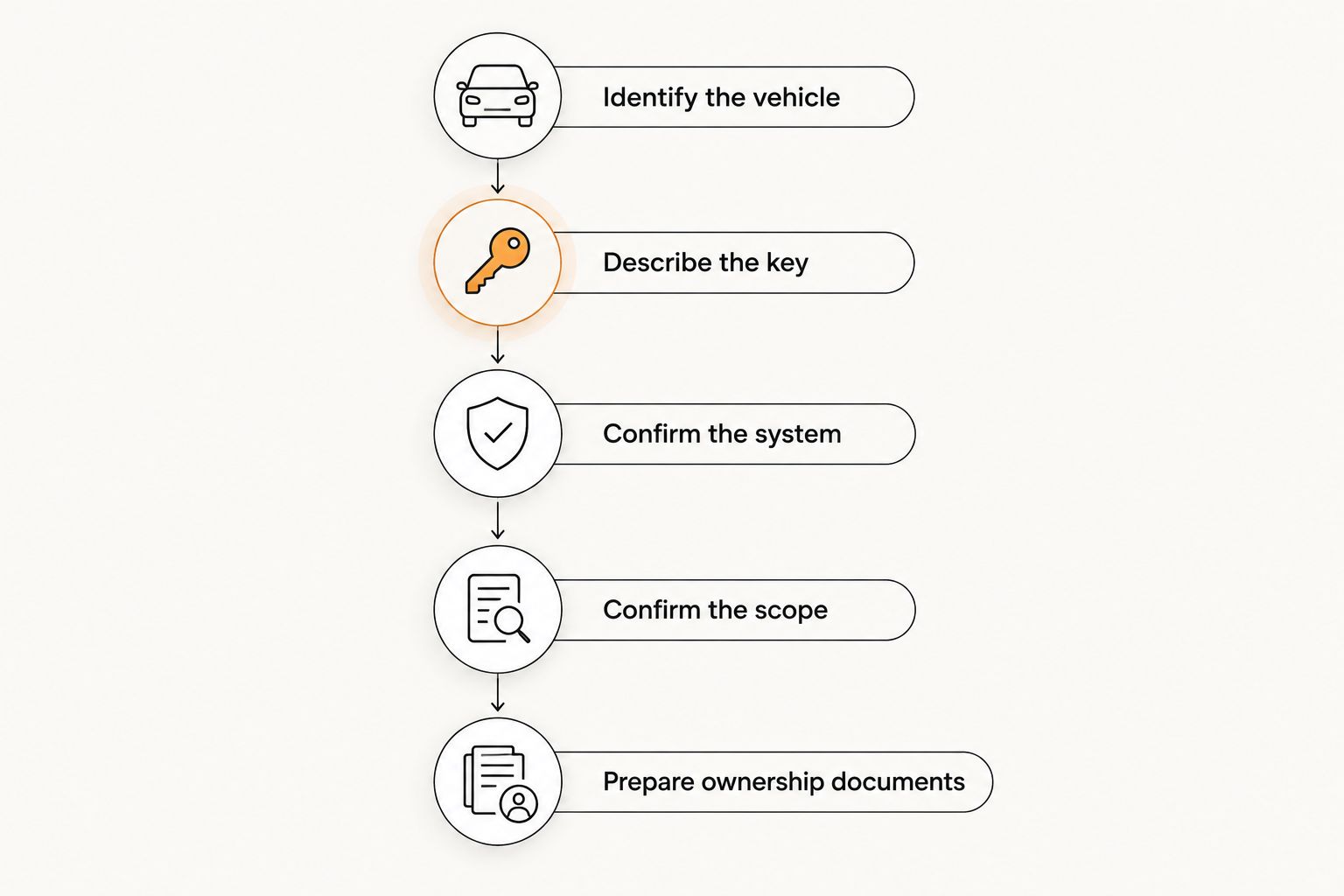
Confirm the vehicle and key system before arranging replacement service.
Mechanical keys: cutting restores the physical key
A mechanical key works through the shape cut into its blade. When no electronic authorization is required, a correctly made key can operate the matching locks and ignition without chip programming.
Best for: a confirmed mechanical-only key system. The advantage is that electronic pairing is not part of the replacement. The limitation is that the blade still needs to match the actual lock, not merely the vehicle description.
A worn original also deserves attention. Ask whether the replacement will reproduce the original key’s intended cuts rather than simply copy its worn edges. If the ignition or door lock was replaced previously, tell the technician; the car’s original key information may no longer describe every lock.
Transponder keys: cutting alone is not enough
A transponder key includes a chip that communicates with the vehicle’s security system. Its blade can fit the ignition while the engine still refuses to start because electronic authorization is missing.
Best for: a vehicle confirmed to require a transponder key. A properly matched and programmed replacement addresses both the mechanical and electronic requirements. The limitation is vehicle-specific support: a locksmith must confirm the correct chip and programming procedure.
Do not choose a replacement solely because its head and blade resemble your old key. Similar-looking keys can have different electronics. Also say whether every working key is missing, because adding a spare and replacing all lost keys can require different procedures.
Remote-head keys: separate starting from button functions
A remote-head key combines a blade with remote-control buttons in the same housing. The remote buttons and the engine-start authorization serve different purposes, even when they share one case.
Best for: replacing a confirmed compatible key with integrated remote functions. The benefit is restoring the functions in one key. The limitation is that cutting, starting authorization, and button operation all need separate confirmation.
A car can also use a separate metal key and remote. If only the remote stopped working, explain whether the existing key still starts the engine. Replacing an entire key is not automatically the right response to a button problem.
Mechanical key
Best for: A confirmed mechanical-only system
What the job involves: Matching and cutting the blade
Main limitation: Replaced or worn locks can complicate matching
Transponder key
Best for: A vehicle requiring chip authorization
What the job involves: Cutting plus electronic programming
Main limitation: Correct blade shape alone does not restore starting
Remote-head key
Best for: A supported integrated key and remote
What the job involves: Cutting, required programming, and button testing
Main limitation: Starting and remote functions need separate checks
Why older-car key replacement varies
An older vehicle’s history matters as much as its age. These details help the technician determine what the job actually requires:
Key system: A mechanical blade, transponder chip, and remote each add different requirements.
Existing key: A usable spare provides different starting information from an all-keys-lost situation.
Lock history: Replacement door locks or an ignition change can make original vehicle records incomplete for the current setup.
Key condition: A bent, cracked, or heavily worn blade needs assessment before it becomes the pattern for another key.
Vehicle condition: Battery or ignition problems can affect testing and should not automatically be treated as key failures.
Parts and equipment: The technician must confirm the correct blank, electronics, and supported procedure for the vehicle.
Describe known modifications before the visit. A previous owner’s ignition change is useful information, not a minor detail to save until the technician starts testing.
What should you prepare before calling?
Gather the vehicle details, your identification, and whatever ownership documents you have. Ask about the required documents in advance, especially if the registration is locked inside the car or the vehicle was recently purchased.
Have the vehicle identification number ready if accessible. On standard modern vehicles, the VIN contains 17 characters, but much older vehicles can use different identification formats. Give the identifier exactly as recorded rather than trying to fill in missing characters.
Also prepare a short description of the failure:
The key opens the door but will not turn in the ignition.
The key turns, but the engine will not start.
The engine starts, but the remote buttons do not work.
The key broke, and part of it remains in the lock.
Every key is missing.
The keys are visible inside the locked car.
These are different service requests. Keys locked inside call for an access assessment; missing keys call for replacement planning. If a child, vulnerable person, or animal is in immediate danger, contact emergency services rather than waiting for routine locksmith service.
What should a replacement estimate include?
Ask for an estimate tied to your specific vehicle and situation. “Older car key” is not enough information to establish the complete scope.
Confirm whether the estimate includes:
Travel to the confirmed service address.
Vehicle entry if the car is locked.
The correct key blank and any required electronics.
Blade cutting and required programming.
Removal of a broken fragment, if needed and supported.
Testing of starting, door operation, and agreed remote functions.
Ask what findings would change the estimate and how the technician will obtain your approval before additional work. Do not assume a replacement key also includes ignition repair, replacement locks, or remote troubleshooting.
If the missing key was stolen, say so. Making another working key does not by itself establish that the missing key can no longer operate the vehicle. Ask which security changes are supported for your specific car.
Can a locksmith make a key if the ignition was replaced?
Yes, a locksmith can assess replacement options, but a changed ignition can prevent the original vehicle key information from matching the current lock. Tell the technician whether your door and ignition already use different keys.
Bring every relevant key you still have. A key that opens only the trunk or a door can help explain the car’s current arrangement, even though it is not a working ignition key.
Does an older car key always need programming?
No, a mechanical-only key does not need electronic programming. A supported transponder or electronic key system does require the appropriate authorization process, so age alone is not a reliable test.
Ask the technician to identify the system before you buy a replacement online. A matching-looking shell does not establish that the blade and electronics suit your car.
What if the new key turns but the car will not start?
A turning key proves only that the blade can operate that lock. It does not confirm chip recognition, a healthy vehicle battery, or a working ignition system.
Stop repeated attempts if the key binds or feels wrong. Describe any security light, unusual resistance, or change in symptoms so the technician can separate a key problem from another vehicle fault.
Getting local mobile key help
Fastkeyrious is best for local car key replacement customers who want to speak directly with the arriving technician. There is no dispatch-center middleman. Explain the vehicle and symptoms directly, then confirm whether the technician supports that exact job.
Fastkeyrious provides mobile car key replacement and fob programming, but that does not mean every older model or key system is covered. Service addresses must be confirmed within up to 42 miles of Greenville, South Carolina; North Carolina and Wellford are excluded.
Use Fastkeyrious to request an assessment. Provide your exact address rather than relying on a town name, and confirm compatibility before arranging the visit.
Check the replacement before the job ends
Test the functions included in your agreed scope before the technician leaves. Keep another way to access the vehicle during testing so you do not accidentally lock the replacement inside.
Confirm the key inserts and turns without forcing it.
Test the door locks the replacement is intended to operate.
Confirm the engine starts normally.
Test agreed remote buttons separately from starting.
Ask whether any previously working keys remain usable.
Review the invoice so it identifies the completed work.
If the door and ignition use different keys, confirm that arrangement explicitly. A successful ignition-key replacement does not necessarily mean every lock now shares one key.
FAQ
Can a locksmith make a key for an older car without a spare?
Yes, when the locksmith supports the vehicle’s lock and key system. Confirm the model year, whether every key is missing, and whether the ignition or door locks have been replaced.
Can a locksmith use my VIN to make an older car key?
A VIN can help identify the vehicle and applicable key information, but it does not guarantee a working replacement. Changed locks, vehicle records, and electronic programming requirements still need assessment.
Does a plastic key head mean my car has a transponder?
A plastic key head alone does not confirm a transponder. Have the technician identify the key system rather than choosing a replacement by appearance.
Should I buy an older car key online before calling?
Confirm compatibility with the technician before buying a key online. Ask whether the exact blade and electronics are suitable and whether the technician accepts customer-supplied keys.
Can a locksmith help if my key broke in the ignition?
A locksmith can assess a broken key and the ignition before recommending the next step. Explain whether a fragment remains inside, and do not force another key into the occupied opening.
What documents do I need for an older car key replacement?
Ask the technician which identification and ownership documents are required. Mention registration locked inside, a recent purchase, or any mismatch between your documents and the vehicle owner’s name.
Will a replacement key stop a lost key from working?
A replacement key alone does not establish that the lost key has been disabled. Ask separately about supported electronic authorization changes and physical lock security for your vehicle.
One last thing
Tell the technician if your old car already needs different keys for the door and ignition. That detail can change the replacement plan before any cutting begins. The goal is not simply a new piece of metal—it is a key whose agreed functions work on your actual vehicle.