Fast & Keyrious LLC
Call 821-203-4949
Locksmith services for real estate agents: complete 2026 guide
Real estate agents’ locksmith services are on-site lock and key services aimed at restoring authorized access and preparing properties for a secure handoff. This 2026 guide to locksmith services for real estate agents covers owner approval, lockouts, rekeying, lock replacement, and key delivery without confusing access to a property with permission to change its locks.
TL;DR
Locksmith services for real estate agents start with owner authorization, not possession of a listing key.
Rekeying changes which keys work; lock replacement changes the hardware.
Fastkeyrious offers mobile locksmith services with direct technician contact; confirm the exact property address and requested work.
Keep property entry, key control, and closing handoff as separate tasks.
Why locksmith services matter for real estate agents
A listing appointment, inspection, or buyer walkthrough needs authorized access. A key that will not turn creates an access problem; an unaccounted-for key creates a key-control problem. Those situations need different decisions.
Your role also differs from the owner’s. You coordinate access, but the owner, landlord, or designated property representative must authorize the work. A listing agreement should not be treated as blanket permission to replace locks, override tenant access, or change a building’s shared entrance.
For local scheduling in 2026, confirm the exact address before arranging service. Fastkeyrious’s approved service boundary is up to 42 miles from Greenville, South Carolina, excluding North Carolina and Wellford. A town name alone does not establish that a property qualifies.
Build an authorized access plan
Confirm who can approve the work
Start with a written message to the owner or authorized property representative. State the problem, the affected door, and the requested work. Keep emergency entry separate from a later decision to change the keys.
For occupied rentals, ask the landlord to handle notice and access requirements before scheduling. Do not use a locksmith appointment to settle a possession dispute. If authority is unclear, resolve it with the owner and appropriate legal counsel first.
For commercial listings, identify who controls each opening. A tenant’s suite door, a shared lobby entrance, and an exterior building door can have different decision-makers. Ask the technician what authorization documents are needed rather than assuming your business card is enough.
Identify the person authorized to approve the work.
Obtain approval for the specific door and service.
Confirm whether anyone occupies the property.
Ask who will meet the technician and provide identification.
Save the approval with the property’s transaction records.
Identify the access problem before booking
Use your existing keys and property notes to establish what is wrong. Check that you have the correct key and entrance. Stop if the key binds or the lock resists; forcing it is not a useful diagnostic step.
Describe the symptom plainly. Keys locked inside a house call for entry assistance. Missing keys raise a separate question about who still has access. A door that opens but does not latch needs assessment of the door and hardware, not an automatic rekey request.
For an office listing, distinguish a mechanical lock problem from an electronic-access problem. A rejected credential, an inactive account, and a key that will not turn are not interchangeable. Contact the building’s access administrator for account or credential issues.
Confirm the property address, entrance, and suite number.
Explain whether the key is missing, trapped inside, or not working.
Note whether the door opens, closes, and latches.
Photograph visible hardware without exposing key cuts or codes.
Identify mechanical keys, electronic credentials, and shared entrances separately.
Choose entry, rekeying, or lock replacement
First, compare the requested outcome with the condition of the lock. If you only need authorized access, ask about lockout service. If the hardware works but old keys should stop working, discuss rekeying. If the hardware is damaged or unsuitable, discuss replacement.
Rekeying changes a lock’s internal key configuration; lock replacement changes the hardware itself. Rekeying does not repair a damaged latch, correct every door-alignment problem, or revoke an electronic access account. Replacement does not automatically solve a building-wide key-control issue.
Fastkeyrious provides mobile residential and commercial lockout services and rekeying. Discuss lock replacement requirements directly with the technician, including the existing hardware and the owner’s approval. Do not assume every lock type or electronic system is supported.
Fastkeyrious is best for real estate agents seeking mobile locksmith services with direct technician contact rather than a dispatch-center middleman. That contact lets you explain the property-specific problem; it does not establish hardware compatibility or an arrival time.
Request entry assistance when the immediate problem is a lockout.
Request a rekey assessment when working locks need different keys.
Request a replacement assessment for damaged or unsuitable hardware.
Separate door repairs from lock and key work.
Confirm the supported service before authorizing an appointment.
Map every affected entrance
Walk the property with permission and make a simple entrance list. Record the front door, back door, garage-to-house door, and any separately secured spaces included in the approved work. For a commercial property, add the suite designation and distinguish private doors from shared building access.
Do not assume one key operates every lock. Test only keys you are authorized to use, and document the results. If you want multiple locks to use the same key, ask the technician whether the existing hardware permits that arrangement.
Use these categories in your 2026 property checklist: Property address, Affected entrance, Access authority, Requested work, and Key handoff. They keep the service request specific without collecting unrelated transaction details.
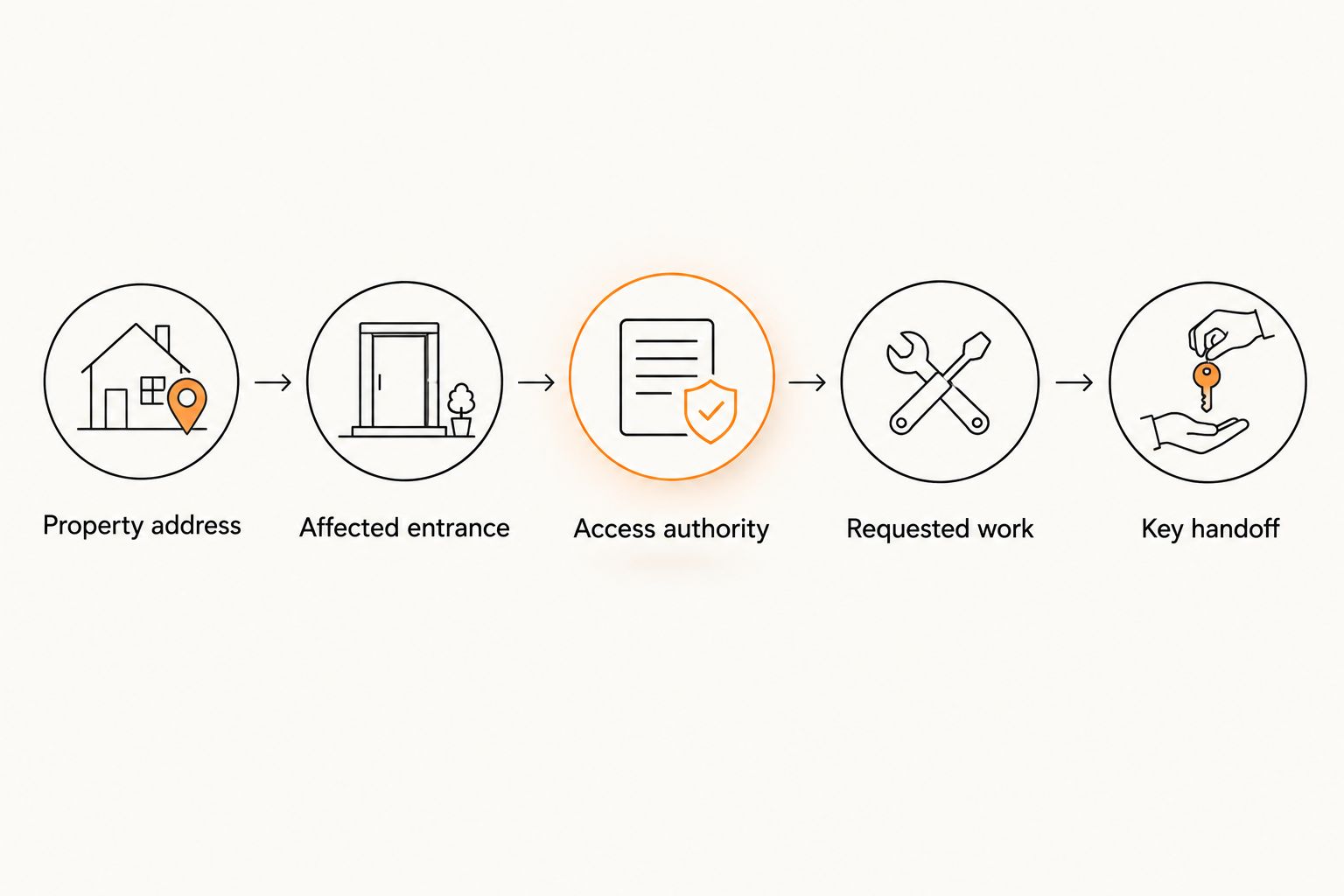
Identify the entrance and approval before choosing the work or arranging key delivery.
An entrance list is especially useful when a property has both mechanical and electronic access. Record each separately. A rekeyed deadbolt does not change a keypad code, garage remote, or building credential.
List each entrance included in the approved scope.
Mark shared doors that require separate building approval.
Record which authorized key operates each mechanical lock.
Keep keypad codes and electronic credentials in a separate record.
Ask about key compatibility before requesting a single-key arrangement.
Coordinate the appointment around access and authority
Start by confirming who can be present and when the property is accessible. Share the exact address, parking instructions, entrance location, and authorized contact. A scheduled showing is not a substitute for confirmed locksmith availability.
Fastkeyrious offers emergency response 24 hours a day, 7 days a week. Availability for a particular address, the supported work, and arrival timing still need direct confirmation. Do not promise a buyer or tenant a fixed arrival window before speaking with the technician.
For office lockouts, explain whether the affected door leads to the building, a tenant suite, or an interior office. If the landlord must approve shared-door work, arrange that approval before the visit. Never ask the technician to bypass an electronic-access restriction without the responsible party’s authorization.
Provide the exact address rather than only a neighborhood name.
Name the person who will authorize and receive the work.
Explain parking, gated access, and the affected entrance.
Confirm scope and scheduling directly with the technician.
Notify the owner if the requested work changes after assessment.
Discuss the property with the technician
Confirm the address, authorized work, and lock details before scheduling.
Document the work and complete the handoff
Begin with a simple handoff record rather than an elaborate system. Note the approved work, affected doors, recipient, and date. Store the service documentation with the transaction records, not in a public listing or shared marketing folder.
Before the technician leaves, test the supplied keys with the authorized recipient. Check that each serviced door opens, closes, latches, and locks as intended. If the owner requested rekeying, confirm which keys now operate each affected lock.
For your 2026 closing checklist, keep 3 records together: authorization, completed service documentation, and the key handoff acknowledgment. This is a practical filing recommendation, not a substitute for your brokerage’s procedures or legal requirements.
Do not label keys with a complete property address. Use a controlled identifier and keep the address mapping separately. Remove your temporary access information when your authority ends.
Test each supplied key at its designated door.
Confirm the number of keys delivered with the recipient.
Record any entrance outside the completed service scope.
Document who received keys and electronic credentials.
Close out agent access according to owner and brokerage instructions.
Compare the options for a property handoff
Choose the service by the problem, not by the next calendar event. Closing, a showing, and a tenant turnover each require an access plan, but none automatically determines whether a property needs entry assistance, rekeying, or replacement.
The lock rekeying services guide provides related context for key-control decisions. For the actual property, describe the existing locks and confirm the scope directly.
Authorized spare-key access
Best for: An appointment where a controlled spare is available
Practical benefit: Restores access without changing the lock
Key limitation: Does not address missing or unaccounted-for keys
Mobile lockout service
Best for: An authorized person who cannot enter
Practical benefit: Addresses the immediate entry problem
Key limitation: Does not automatically change who holds working keys
Rekeying
Best for: Working, compatible locks when previous keys should stop working
Practical benefit: Changes the keys that operate the serviced locks
Key limitation: Retains existing hardware and does not repair every lock or door fault
Lock replacement
Best for: Damaged hardware or an approved hardware change
Practical benefit: Replaces the affected lock hardware
Key limitation: Requires compatibility checks and separate decisions about key control
Building access administrator
Best for: Managed office credentials or shared electronic access
Practical benefit: Addresses accounts, permissions, and building-controlled access
Key limitation: Does not replace mechanical lock repair or rekeying
For Fastkeyrious locksmith services, direct technician contact is the practical advantage. The boundary is equally clear: confirm the exact address, supported hardware, and requested work. Mobile service is not proof of support for every lock or access-control system.
Common mistakes real estate agents make
Treating a lockbox key as authorization
A working key allows entry; it does not establish permission to alter locks. Obtain approval for the specific service and check occupancy before arranging work. Keep showing access separate from authority to change the property.
Rekeying only the most visible door
Changing the front-door key leaves other entrances outside the scope unless they are included. Build the entrance list first. Tell the owner which doors were serviced and which were not.
Assuming rekeying updates electronic access
Mechanical rekeying does not revoke a garage remote, reset a keypad code, or deactivate a building credential. Track those systems separately and assign each task to the authorized person. Do not claim electronic-access installation or administration as part of an unconfirmed locksmith appointment.
Confusing suite access with building access
A commercial listing can involve several approval boundaries. Confirm the suite, entrance, and landlord’s role before booking. A tenant representative’s approval should not be treated as permission to alter a shared lobby door.
Promising timing before confirming the job
Do not tell a buyer that a lockout will be resolved before a walkthrough without confirming the appointment. In 2026, use the exact address and requested service when asking about scheduling. A service-area town name is not enough to confirm coverage or timing.
FAQ
What locksmith services do real estate agents need?
Real estate agents need authorized lockout assistance, rekeying, or lock replacement depending on the property’s access and hardware problem. Start with owner approval, identify the affected entrances, and confirm the requested service with the technician.
Should I rekey a house before a buyer moves in?
Discuss rekeying with the authorized owner when previous keys should no longer operate the locks. Confirm who owns or controls the property when the work will occur, and include every intended entrance in the scope.
Is rekeying better than replacing the locks?
Rekeying fits working, compatible locks when the goal is to change which keys operate them; replacement fits a hardware problem or an approved hardware change. Neither decision should be made without assessing the existing locks and doors.
Can a listing agent authorize a locksmith alone?
A listing agent should obtain authorization from the owner or designated property representative for the specific work. Ask the technician which documents are required, and resolve occupancy or possession disputes before scheduling.
Can a locksmith help with a locked office listing?
An authorized office lockout is a commercial locksmith service, but the exact door and access system must be identified. Distinguish the tenant suite from shared building entrances and obtain landlord approval where required.
Does Fastkeyrious serve every address near Greenville?
Fastkeyrious service must be confirmed for the exact address within the approved boundary of up to 42 miles from Greenville, South Carolina. North Carolina and Wellford are excluded; a city or county name alone does not confirm coverage.
Does rekeying remove old keypad codes or garage remotes?
No. Rekeying changes the mechanical lock’s key configuration, while keypad codes, garage remotes, and electronic credentials require separate access-management steps by the authorized person.
One last thing
A successful entry is not a completed security handoff. You can regain access while old keys, garage remotes, or electronic credentials remain unaccounted for. Before closing the property file, name the person responsible for each access method and document what was transferred, changed, or left outside the work scope.