Fast & Keyrious LLC
Call 821-203-4949
Lost car keys to driving again: complete 2026 workflow
Instead of repeating your story to different providers after losing your car keys, follow a lost car keys replacement workflow: confirm whether the keys are missing or locked inside, identify the vehicle, arrange compatible service, and test the replacement before driving. This 2026 guide shows what to prepare, what to tell the technician, and how to separate door access from a working ignition key.
TL;DR
Fastkeyrious offers mobile car key replacement with direct technician contact; confirm your exact location and vehicle support first.
A lost car keys replacement workflow starts by separating missing keys from keys locked inside the vehicle.
Car key replacement and fob programming are different tasks; confirm which tasks your vehicle requires.
Test entry, starting, and remote functions before treating the replacement as complete.
Why this matters
Opening a locked door does not replace a missing key. Cutting a key does not necessarily authorize it to start the engine. Your service request needs to describe the result you need, not just the fact that you cannot drive.
Fastkeyrious is best for local drivers who want mobile car key replacement and direct contact with the arriving technician. There is no dispatch-center middleman. Vehicle compatibility and the exact service address still need confirmation before arranging the job.
The approved service boundary is up to 42 miles from Greenville, South Carolina, with exact-address confirmation required. North Carolina and Wellford are excluded. A town name alone does not establish coverage, including in Greer and surrounding communities.
Before you start
Prepare vehicle details and authorization. Have the make, model, model year, identification, and ownership or authorized-use documents ready. Ask which documents the technician requires, especially for a rental, company vehicle, or borrowed car.
Locate the vehicle and describe the key. Provide the exact address, parking level, access restrictions, and whether you used a metal ignition key, a remote-head key, or a separate push-button fob. Note whether any working spare exists.
Flag the hidden complication: all keys lost. Replacing the only key is not the same request as duplicating a working spare. Say that no working key remains before service is arranged, and confirm support for that situation.
If a child, vulnerable person, or animal is trapped and in immediate danger, contact emergency services first. Stay somewhere safe while arranging vehicle access; do not attempt roadside troubleshooting beside moving traffic.
Vehicle identification and service request
Establish the problem
Separate missing keys from locked-in keys. Check whether you can see the key inside the vehicle or know where it was left. If the key is inside, request vehicle lockout service. If its location is unknown, explain that you need lost-key replacement.
Identify the vehicle accurately. Record the make, model, model year, and VIN. A standard modern VIN has 17 characters; copy it carefully rather than guessing from memory. Use an ownership document or the visible vehicle identifier when accessible.
Describe the starting system. State whether you insert a key into an ignition or normally start with a nearby fob. Mention a damaged ignition, broken key, or preexisting starting problem separately.
Report any remaining key. A working spare changes the request from an all-keys-lost job to an additional-key job. A remote that unlocks doors but cannot start the engine is not a fully working spare.
Expected result: Your request identifies the vehicle, the missing access functions, and whether a working key remains. The technician can assess the correct job instead of treating every call as a door lockout.
For the distinction between duplication and an all-keys-lost job, read the guide to making a car key without the original. Do not assume every vehicle supports the same replacement process.
Confirm the service route
Choose the route that matches your situation. This 2026 comparison separates suitability from convenience; none of these routes establishes compatibility by itself.
Working spare
Best for: Drivers who still have a fully functioning key
Advantage: Restores access and driving without replacing the missing key first
Limitation: Does not address the missing key or create another backup
Mobile automotive locksmith
Best for: Drivers who need service at the vehicle's location
Advantage: Brings the service request to the parked vehicle
Limitation: Exact location, key system, and all-keys-lost support need confirmation
Vehicle dealership
Best for: Drivers seeking the vehicle manufacturer's service route
Advantage: Provides a route for checking manufacturer-specific requirements
Limitation: Confirm vehicle transport, documents, and the full service scope before arranging the visit
Give the exact service address. Include a garage level, lot entrance, business name, or landmark that identifies the parked vehicle. Ask whether the location falls inside the approved service boundary.
Confirm the exact vehicle support. Ask whether the provider handles your model year, key type, and all-keys-lost condition. Do not treat general automotive service as confirmation for your specific vehicle.
Define the work. Ask whether the request covers entry, key cutting, starting authorization, remote functions, or a combination. Have the technician explain which parts apply.
Confirm authorization requirements. Ask what identification and vehicle documents must be available when work begins. Resolve company, rental, or borrowed-vehicle approval before the appointment.
Expected result: You have a confirmed service route, location, documentation requirement, and description of the intended work. You are not relying on a generic promise to make a key.
Fastkeyrious provides automotive key services, including confirmed Ford Transit lockout and key services. Give the technician the Transit model year and key type before requesting replacement or programming. Do not extend that confirmation to Ford Transit Connect or every Transit key system.
Replacement preparation and technician handoff
Prepare the vehicle
Keep the vehicle accessible. Explain any gate, parking structure, restricted entrance, or building access requirement before the technician arrives. Arrange permission to reach the vehicle when another person controls access.
Keep documents available. If ownership documents are locked inside, say so beforehand. Ask how verification will be handled rather than assuming door entry can begin without it.
Report electrical symptoms. Mention a dead battery, an unresponsive dashboard, or an existing no-start condition. A replacement key does not resolve every reason an engine fails to start.
Stop improvised entry attempts. Do not pry the door, insert tools into the lock, or force the ignition. These actions can create a second repair problem without restoring authorized access.
Expected result: The technician has a clear path to the vehicle, knows the authorization issue, and understands any condition beyond the missing key.
For your 2026 replacement checklist, keep three separate stages in view: Vehicle identification, Replacement preparation, and Function testing. Passing one stage does not establish that the next is complete.
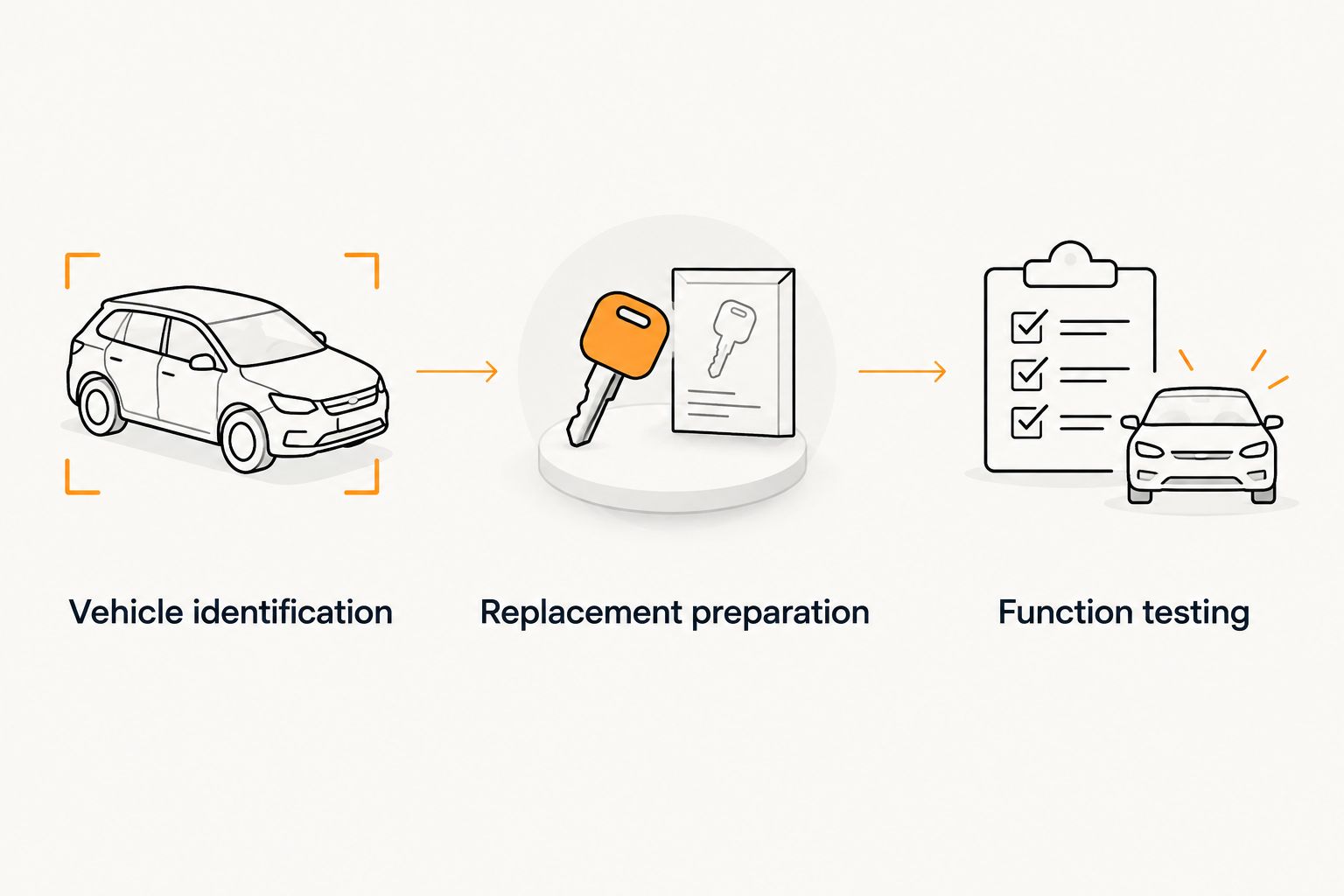
A completed replacement needs function testing, not just a newly cut key.
Keep any recovered original key, damaged key, or old fob available for the technician to inspect. Explain what worked before the loss and what did not; that history prevents an unrelated fault from being mistaken for a replacement-key problem.
Confirm completion criteria
Review the agreed functions. Separate mechanical door access, engine starting, remote locking, and other vehicle-specific functions. Ask which are included in the replacement being supplied.
Let the technician handle cutting and programming. Do not follow generic pairing instructions during the service. Procedures differ by vehicle and by whether a working key remains.
Discuss the missing key. Ask whether the vehicle supports removing the lost key's electronic authorization and whether that work is included. Electronic removal and mechanical lock changes are different tasks.
Record what was completed. Keep the service documentation and any instructions supplied for the replacement. Confirm any unresolved function before the job is closed.
Expected result: You know what the replacement is intended to do, what security work was performed, and what still requires attention.
Function testing before you drive
Test the replacement while the technician is still available. Door access, remote operation, and engine starting are separate checks. A key that passes one check can still fail another.
Test entry. Check the agreed door-access function using the replacement. For a fob with an emergency blade, ask the technician to show its vehicle-specific use.
Test starting. Start the vehicle using its normal procedure. Follow the owner's manual and technician's instructions for fob placement or any backup starting method.
Test remote functions. Check locking and unlocking, plus any additional functions included in the job. Keep the replacement with you so you do not create another lockout during testing.
Check warnings. Report a key-not-detected message, security warning, or inconsistent start before leaving. Do not dismiss a warning simply because the engine started once.
Expected result: The replacement performs the agreed entry and starting functions, and you know how to use it. Any remaining issue has been identified before you drive away.
Second workflow: add a spare while one key still works
A spare-key request starts differently from an all-keys-lost request. Bring the working key and identify it as working; do not describe the job as lost-key replacement if your immediate goal is an additional backup.
Confirm support for your vehicle and the additional key's intended functions.
Ask whether the existing working key must be present during the job.
Test both the existing key and the added key after the work.
Store the spare separately from the everyday key, with access available to someone you trust.
Best for: drivers with one functioning key who want a separate backup. The benefit is a recovery option when the everyday key disappears. The limitation is that storing both keys together defeats that purpose.
A useful 2026 backup plan is to keep 2 working keys in separate locations, where the vehicle supports them. Confirm that both start the vehicle; two objects that look like keys are not necessarily two usable backups.
Troubleshooting
The replacement unlocks the door but will not start
Mechanical access and electronic starting authorization are different. Tell the technician exactly what works and what fails. Ask for the starting function to be checked; do not force the ignition or assume another cut will solve the problem.
The fob buttons work, but the vehicle does not detect it
Remote button operation does not prove the vehicle recognizes the fob for starting. Use the vehicle-specific backup procedure in the owner's manual, and ask the technician to check recognition and the replacement's compatibility.
The vehicle still will not start with a recognized key
Report dashboard behavior, battery symptoms, and any starting fault that existed before the key was lost. Ask the technician to distinguish a key issue from another vehicle fault. Stop repeated attempts when the vehicle's instructions call for stopping.
The ownership documents are locked inside
Tell the provider before arranging service and ask what alternative verification is accepted. Have identification and accessible ownership information ready. For a company or rental vehicle, obtain the responsible party's approval rather than substituting a personal explanation.
The lost key turns up after replacement
Ask whether the recovered key still has electronic authorization. Do not assume it was disabled or that its mechanical blade stopped opening the door. Test or retire it only after understanding what changed during replacement.
Customize your workflow
Save vehicle details somewhere accessible without entering the car. Include the model year, VIN, and key type, plus the ownership contact for a work vehicle. Keep this record private; it contains identifying information.
For a shared vehicle, decide who authorizes locksmith work and who can retrieve the spare. For a business vehicle, document cab access separately from cargo access. A request to recover the ignition key does not automatically authorize opening every compartment.
Fastkeyrious offers 24/7 emergency response, but operating hours are not an arrival-time promise. For a 2026 service request, confirm the exact address, vehicle support, access instructions, and work required directly with the technician.
Confirm your car key service
Discuss your exact location, vehicle, and key type directly with the technician.
FAQ
What is the lost car keys replacement workflow?
Confirm whether the keys are missing or locked inside, identify the vehicle, arrange compatible service, verify authorization, and test the replacement. Door entry alone does not replace a missing ignition key.
Can a locksmith replace my car key without the original?
A locksmith can replace keys without the original for supported vehicles. Confirm your model year, key type, and all-keys-lost situation before arranging service.
Do I need programming as well as a new key?
You need programming when your vehicle requires electronic authorization for the replacement. Key cutting, remote button pairing, and engine-start authorization are not interchangeable tasks.
What should I have ready before the technician arrives?
Have your exact location, vehicle details, identification, and ownership or authorized-use information ready. Ask which documents are required and explain beforehand if they are locked inside.
Can a mobile locksmith help with a Ford Transit?
Fastkeyrious has confirmed Ford Transit lockout and key services. Confirm the model year, key type, and exact task with the technician; this does not establish support for Ford Transit Connect or every Transit key system.
Will replacing my car key disable the lost one?
Replacement alone does not establish that the lost key has been disabled. Ask whether electronic authorization was removed and discuss mechanical door access separately.
Can I drive as soon as the new key opens the door?
You need to verify engine starting before treating the replacement as complete. Test the agreed remote functions and report key-recognition or security warnings before leaving.
Does every address near Greenville qualify for mobile service?
No; exact-address confirmation is required within the approved boundary of up to 42 miles from Greenville, South Carolina. North Carolina and Wellford are excluded, and a town name alone does not confirm coverage.
One last thing
A recovered lost key can remain a security concern after a replacement works. Electronic starting authorization and physical door access are separate. Before closing the job, ask what happened to the missing key's authorization and whether its blade can still open the vehicle.