Fast & Keyrious LLC
Call 821-203-4949
Key fob programming for auto repair shops: complete 2026 guide
Auto repair shop key fob programming is the process of pairing a compatible key or remote with a customer's vehicle so you can return it with verified access and starting functions. This 2026 guide explains how to separate programming from diagnosis, choose a service path, and document the handoff without promising compatibility before you check the vehicle.
TL;DR
Key fob programming for auto repair shops starts with vehicle identification, customer authorization, and the correct key.
Fastkeyrious fits shops seeking mobile automotive locksmith service at confirmed locations within its approved Greenville-area boundary.
Separate remote buttons, engine-start authorization, and mechanical key operation when diagnosing the complaint.
Choose in-house programming, a mobile locksmith, or dealer referral based on the exact vehicle and task.
Why key fob programming matters for auto repair shops
A key complaint can interrupt an otherwise finished repair. Your service advisor needs to establish whether the customer wants another working key, has lost every key, or cannot use an existing remote. Those are different jobs, even when the customer describes each one as a bad fob.
Treat key programming as a defined repair task, not an automatic answer to every no-start complaint. Remote locking, mechanical entry, and engine-start authorization are separate functions. A working remote button does not prove that the vehicle recognizes the key for starting.
For jobs with no working key, review the distinctions in making a car key without the original. Record what is missing before deciding who should handle the work.
Your 2026 intake process should connect the customer's complaint to a specific authorized task. That protects the shop from ordering an unsuitable key, requesting the wrong service, or returning a vehicle with an untested function.
How to handle key fob programming jobs
1. Define the customer's actual problem
Start with a short conversation and a functional check. Ask what changed, which keys still work, and whether the concern affects door access, remote buttons, starting, or more than one function. Write the answers on the repair order.
Distinguish a vehicle lockout from lost-key replacement. If the keys are inside the vehicle, the immediate task is gaining authorized access. If every key is missing, the technician needs to assess replacement and programming requirements. Do not book one service under the other description.
A customer reporting intermittent remote operation also needs a different assessment from a customer whose vehicle will not start. Describe the symptom without turning it into a diagnosis. A failed button press is an observation; a failed immobilizer is a conclusion that needs supporting checks.
Record the complaint in the customer's own terms.
Ask whether any key still starts the vehicle.
Identify whether keys are missing or locked inside.
Note recent key, battery, or vehicle repairs.
List the functions the customer wants restored.
2. Verify the vehicle, key, and authorization
Use the vehicle itself and its documentation to confirm identity. For a modern vehicle with a standard 17-character VIN, check that the recorded VIN matches the vehicle; do not rely on a customer's text message or a previous repair order alone. Record the model year separately.
Inspect the existing key or fob when one is available. Capture readable identifying information and note whether the customer supplied a replacement. Similar-looking housings do not establish electronic compatibility. Before buying or attempting to program a replacement, check the applicable vehicle information and programming requirements.
Obtain authorization from the owner or an authorized representative before proceeding. Fleet vehicles need a clear approving contact. Your 2026 repair order should identify who requested the work and what that person approved, without collecting unrelated personal information.
Verify the VIN and model year.
Record the key type and readable identifiers.
Count the keys available for the appointment.
Identify customer-supplied replacement keys.
Confirm ownership or authorized use.
Obtain approval for the specific work requested.
3. Choose the right programming path
Begin with the resources your shop already has: vehicle service information, the applicable tool instructions, and a technician qualified for the task. In-house work makes sense when your staff can verify support for the exact vehicle and complete the required procedure. Owning a programming tool is not proof of coverage.
For a confirmed local job, mobile service provides another path. Fastkeyrious is best for auto repair shops seeking mobile key fob programming at confirmed local job locations. You speak directly with the technician rather than a dispatch center, allowing you to explain the vehicle, key type, and requested task before arranging service.
The approved service boundary for 2026 is up to 42 miles from Greenville, South Carolina, with the exact address checked. North Carolina and Wellford are excluded. Do not assume every address in a named town qualifies or that every vehicle system is supported.
Check your tool's exact application information.
Confirm technician familiarity with the procedure.
Ask about adding a key versus replacing all keys.
Provide the exact job address for mobile service.
Confirm support before making a customer commitment.
Refer unsupported work through an appropriate service channel.
4. Prepare the vehicle and the work order
Follow the vehicle and tool instructions for the required setup. Confirm the electrical conditions specified for the procedure, inspect relevant faults when appropriate, and address unresolved conditions before starting. Programming should not become a substitute for diagnosing an unexplained no-start.
Make the vehicle accessible to the person performing the work. Tell the technician where it is parked, whether it starts, and whether another vehicle blocks access. Keep every available key together with the repair order rather than leaving one with a porter and another at the service desk.
Explain any expected changes to key registration before the customer authorizes them. Depending on the system and procedure, key handling requirements differ. Ask specifically whether existing keys must be present and whether the procedure changes which keys remain recognized. Do not promise that a missing key will be disabled without confirmation.
Review the applicable setup instructions.
Record relevant faults and current symptoms.
Make the vehicle accessible at the appointment.
Keep available keys with the job paperwork.
Confirm treatment of existing and missing keys.
Agree on the scope before work begins.
5. Test each authorized function separately
Use the required post-programming checks first. Then use a shop handoff checklist that separates starting, remote operation, and mechanical entry where applicable. Test each key individually so you know which key produced the result.
As a practical shop checklist, perform 2 start-and-shutoff cycles with each programmed key where safe and consistent with the vehicle instructions. This is a recommended verification routine, not a universal manufacturer requirement. Keep other keys outside the vehicle's detection range as directed by the applicable procedure.
Include 3 function checks in the handoff record: engine starting, remote operation, and mechanical entry. Mark any function that does not apply to the supplied key. Check a removable emergency blade only when that blade and its intended operation are part of the job.
Test each programmed key separately.
Verify engine starting under the required conditions.
Check the remote functions included in the repair.
Test applicable mechanical entry.
Record faults or incomplete functions.
Compare the results with the original complaint.
6. Document the result and hand off the vehicle
Finish with a record the next service advisor can understand. State what was completed, which keys were tested, and whether any concern remains unresolved. Avoid a broad note such as fob fixed when the work covered only remote-button operation.
Show the customer the functions included in the repair. If the key has a removable mechanical blade, explain its intended use using the vehicle instructions. If an unrelated concern remains, document it separately rather than implying the programming solved every access or starting issue.
For a fleet or business vehicle, return the keys to the authorized contact and record the handoff. Your shop's responsibility includes keeping the key associated with the correct vehicle throughout the job. A completed programming procedure does not replace a controlled return process.
Record the completed programming task.
List the keys returned to the customer.
Save the applicable test results.
Explain unresolved symptoms separately.
Demonstrate the functions included in the job.
Document the authorized recipient.
Compare programming options for your shop
Choose the route by vehicle support and job requirements, not by a general claim that one option handles everything. For your 2026 service process, assign the job only after confirming who can complete the exact task.
In-house programming
Best for: Shops with confirmed tools, information, and trained staff for the vehicle
Practical advantage: Keeps the task within your repair workflow
Key limitation: Coverage and technician capability must match the exact job
Mobile locksmith
Best for: Shops seeking on-site automotive key service
Practical advantage: Brings the service to a confirmed job location
Key limitation: Vehicle support and service-area eligibility require confirmation
Dealer referral
Best for: Jobs requiring a manufacturer-specific service route your shop cannot provide
Practical advantage: Provides an alternative when your available resources do not cover the task
Key limitation: Requires coordination with a separate service provider
Fastkeyrious provides mobile car key replacement and fob programming. Its direct-technician model suits shops that want to discuss the task with the person performing it. The limitation is specific: you must confirm the exact address, vehicle, key type, and requested service before treating the job as accepted.
Use the table to choose a route, then verify its requirements. An in-house tool, a mobile appointment, and a dealer referral are not interchangeable promises of compatibility. The responsible option is the one that can support the documented job.
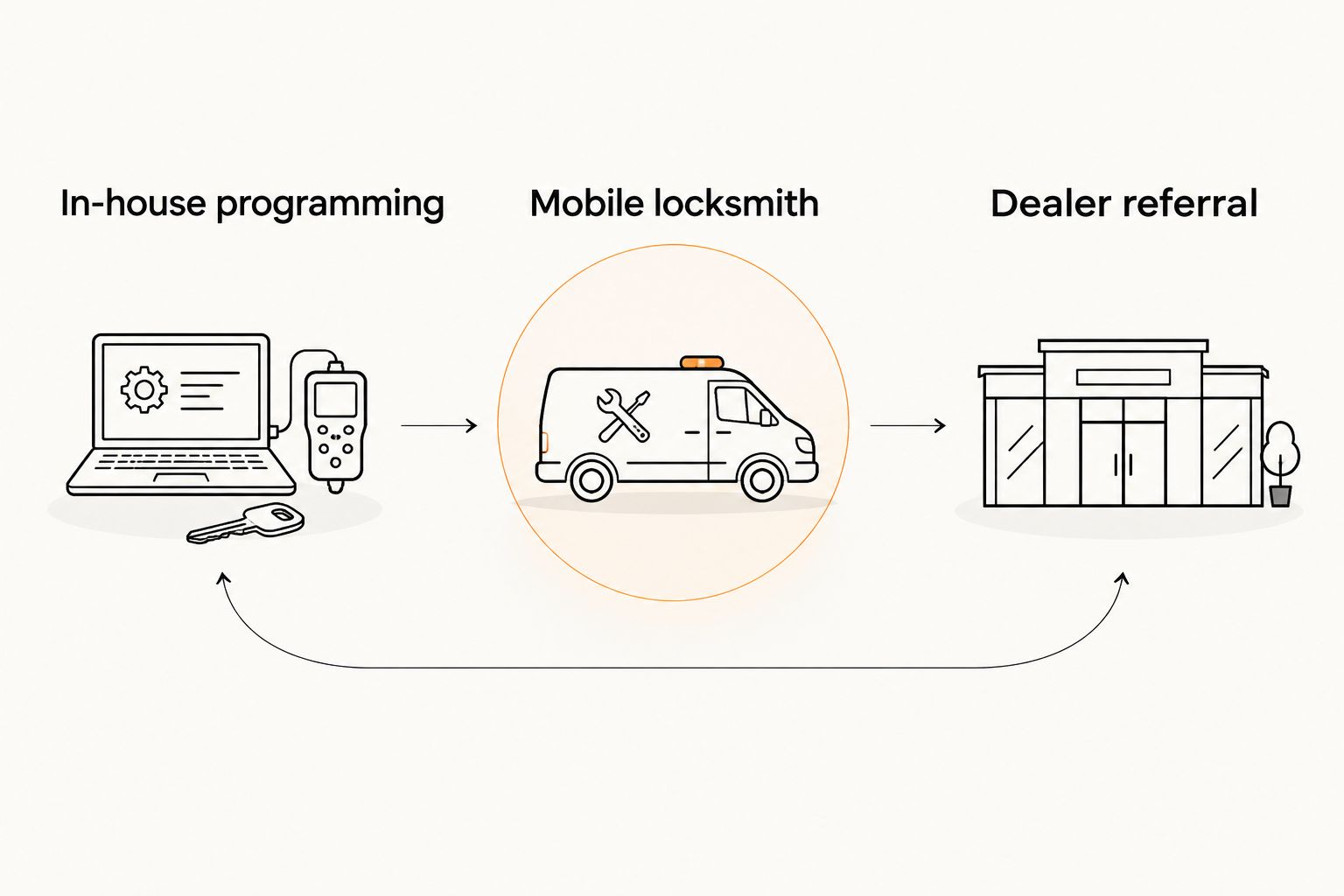
Choose the service path only after confirming support for the exact task.
A customer-supplied fob deserves the same compatibility check as any other replacement. Do not accept its appearance or online description as proof that it can be programmed to the vehicle.
Discuss the vehicle with the technician
Confirm the exact address, vehicle, key type, and requested service before arranging mobile work.
Common mistakes auto repair shops make
The most useful improvement to a 2026 key-service process is clearer job definition. These mistakes create avoidable uncertainty before programming even begins.
Ordering a fob by appearance
A matching shell is not a compatibility check. Verify the relevant identifiers and vehicle application before approving a replacement. If the information is unclear, ask the technician to assess it before your shop commits to using it.
Calling every no-start a programming problem
A no-start condition needs diagnosis. Record what the vehicle does and check the relevant systems using the applicable service information. Request key programming only when the identified task supports that decision.
Quoting the job before confirming its scope
Adding a spare key and replacing every lost key are different requests. Establish the working-key status, replacement-key source, vehicle details, and required functions first. Obtain the customer's approval for the defined task rather than an undefined promise to fix the fob.
Assuming vehicle-family compatibility
Confirmed Ford Transit lockout and key services do not establish support for every model year or key system. They also do not establish Ford Transit Connect support. Confirm the model year, key type, and exact service with the technician before committing to the customer.
Testing only the remote buttons
Locking and unlocking are not proof of successful starting authorization. Verify each function included in the repair and document it separately. If you return a key with an unresolved function, explain that limitation before the customer leaves.
FAQ
What's the best way for an auto repair shop to handle key fob programming?
The best approach is to identify the exact vehicle and key task, then choose a service provider with confirmed support. Use in-house programming only when your tools, information, and technician capability match the job.
Can a mobile locksmith program a key fob at our shop?
A mobile locksmith can handle supported key fob programming at a confirmed service location. Fastkeyrious requires confirmation of the exact address, vehicle, key type, and requested task before you commit to the job.
Do remote buttons working mean the key is programmed correctly?
No. Working remote buttons do not prove that the vehicle recognizes the key for starting. Test remote operation and engine-start authorization separately.
Can we program a fob the customer bought online?
Check the customer-supplied fob's compatibility and programming requirements before accepting it for the job. A matching appearance or seller description is not enough to establish support.
What should we do when the customer has lost every key?
Treat the job as an all-keys-lost assessment, not simply an additional-key request. Confirm the vehicle, customer authorization, replacement requirements, and supported procedure before arranging work.
Does Ford Transit support include Ford Transit Connect?
No. Confirmed Ford Transit lockout and key services do not establish Ford Transit Connect support. Ask the technician about the exact model, year, key type, and requested service.
Where can a local shop request mobile key programming?
Request an address check for a job location within the approved boundary of up to 42 miles from Greenville, South Carolina. North Carolina and Wellford are excluded, and a town name alone does not establish eligibility.
One last thing
The easiest detail to miss is which key actually started the vehicle. When another recognized key is nearby, a casual test can leave you uncertain about the newly programmed key's function. Follow the vehicle's verification procedure and test keys individually under the required conditions.
Make that distinction part of your 2026 handoff checklist. Before requesting Fastkeyrious key fob programming, send a clear job description: the exact location, vehicle identity, available keys, customer authorization, and functions requested. Better intake gives the technician a defined task instead of an ambiguous fob complaint.