Fast & Keyrious LLC
Call 821-203-4949
How much does it cost to rekey a commercial building?
A commercial building rekeying estimate should identify every keyed cylinder, the access changes you need, the keys to be supplied, and who can authorize the work. Ask for entry assistance, replacement hardware, electronic credential changes, and any additional work to be listed separately so you know exactly what you are approving.
TL;DR
A commercial building rekeying estimate needs a cylinder inventory, access plan, authorization, and written exclusions.
Fastkeyrious provides commercial rekeying with direct technician contact; confirm the exact address and job requirements.
Rekeying changes mechanical key access; it does not automatically deactivate badges, codes, or phone credentials.
Approve additional repairs or replacement hardware separately before work begins.
Why this matters
Changing who holds a key is not the same as changing who can enter your building. A former employee might still have a copied key, while a contractor might use a separate code. Your estimate needs to address the access route you actually want to remove.
Fastkeyrious is best for businesses seeking commercial rekeying with direct technician contact rather than a dispatch center. Start with Fastkeyrious and describe the doors, existing keys, and reason for the change. Confirm that the requested work fits the technician’s services before scheduling.
What should a commercial building rekeying estimate include?
A useful estimate describes the finished result, not just a building-wide task called rekeying. Use the following sequence to define the work before comparing proposals or approving a visit.
Door inventory. List the entrances, offices, storage rooms, and other keyed openings included in the job.
Cylinder count. Identify each keyed cylinder, including separate cylinders on the same door. Do not assume the door count equals the rekeying count.
Access plan. State which doors should share a key and which must remain separate.
Key quantities. Specify how many working keys you need and who will receive them.
Written approval. Name the person authorized to approve the work and any changes discovered on site.
Completion checks. Require testing of the agreed key access and normal door operation before handoff.
Record unknown details rather than guessing. Clear photos help describe the hardware, but the technician still needs to confirm its condition and suitability for the requested change.
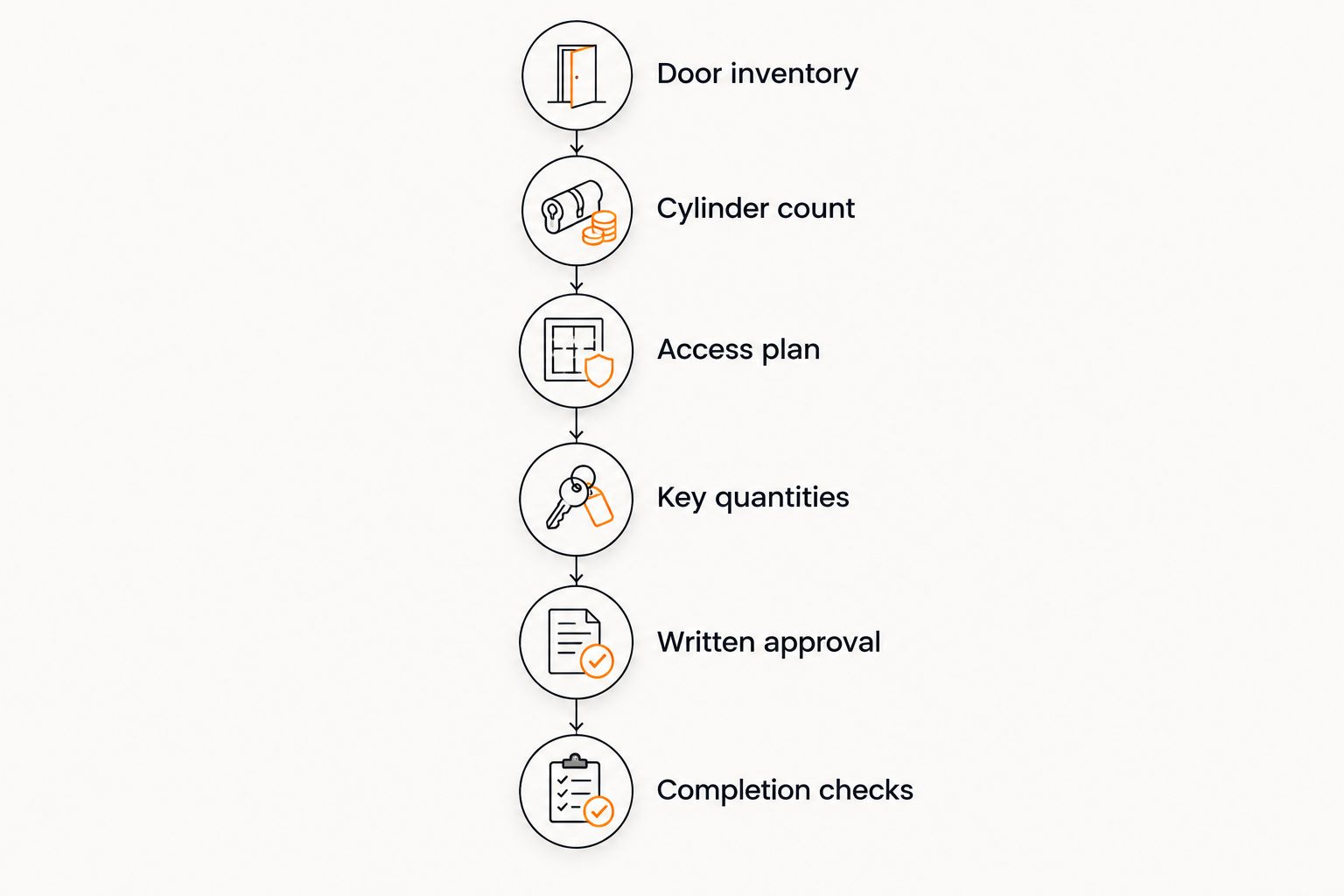
Define the access result before approving the work.
Give each opening a clear identifier
Use labels such as front entrance, rear staff entrance, office door, and supply room. For a shared commercial property, include the suite identifier and distinguish your tenant entrance from the building’s common entrance.
Photograph each relevant lock from both sides when access permits. Include the door label in your notes so the technician can connect the photo to the correct opening. Do not send working access codes or images of key cuts through a general inquiry form.
Describe the problem, not an assumed repair
Tell the technician whether a key was lost, an employee left, a tenant changed, or a lock stopped working. Also report sticking, a broken key, visible damage, or a door that will not latch.
These details separate an access-control decision from a mechanical fault. Rekeying changes which mechanical key operates a suitable lock; it does not straighten a damaged door or correct every latch problem.
Rekeying, replacement, and electronic changes are different scopes
Choose the work that solves the access problem, not a broader label. An estimate can contain different tasks for different doors. Ask the technician to identify them individually instead of treating every opening alike.
Mechanical rekeying
Best for: Removing old-key access while retaining suitable hardware
What it addresses: Changes the cylinder’s key combination
Limitation to confirm: Does not repair every hardware fault or cancel electronic credentials
Lock replacement
Best for: Hardware that needs replacement or a confirmed hardware change
What it addresses: Replaces the specified lock components
Limitation to confirm: Requires agreement on hardware, fit, and installation scope
Electronic credential changes
Best for: Removing access through an existing badge, code, or phone credential
What it addresses: Changes electronic permissions through the responsible system administrator
Limitation to confirm: Is separate from mechanical rekeying; confirm the responsible provider
Lockout entry
Best for: Regaining authorized access when you cannot enter
What it addresses: Addresses the immediate entry problem
Limitation to confirm: Does not automatically change who can use existing keys afterward
A single entrance can have both electronic access and a mechanical backup cylinder. Rekeying that cylinder does not, by itself, change the electronic permissions.
For that distinction, see rekeyed locks and an existing keyless entry system. Confirm electronic requirements with whoever manages the existing system; do not assume a mechanical rekeying visit includes credential administration.
Why commercial building rekeying estimate scope varies
The scope changes when the hardware, access requirements, or working conditions change. These are the details to disclose before asking the technician to define the job:
Cylinder quantity and type. Identify the keyed components rather than using square footage as a substitute for a lock inventory.
Existing key availability. State whether you have a working key and whether you can already enter every affected room.
Hardware condition. Report sticking, damage, loose components, and doors that do not close correctly.
Keying arrangement. Explain whether staff need shared access, separated access, or preservation of an existing master-key arrangement.
Access and scheduling restrictions. Disclose occupied rooms, shared entrances, alarm procedures, and times when work would interrupt business.
Approval boundaries. Identify landlord-controlled hardware, restricted areas, and any changes requiring another person’s authorization.
An estimate based on incomplete information leaves important decisions unresolved. Ask which details are confirmed, which require inspection, and what happens if the actual hardware differs from your description.
Who can authorize commercial lock changes?
Being able to enter an office does not automatically establish authority to change its locks. Identify the owner, property manager, or business representative responsible for approving the requested work, and ask what documentation the technician requires.
If you lease the space, check the lease and obtain any required landlord approval before arranging changes. Shared entrances and building-managed key systems deserve particular attention because your business might not control them.
Give the technician the approving person’s contact details and clarify who can approve additional work. An employee waiting at the door should not have to make an unplanned decision about replacing landlord-owned hardware.
Separate employee access from approval authority
Your receptionist might provide entry, your office manager might distribute keys, and your landlord might control the building entrance. Record those roles separately.
Also arrange access to every included room. A locked records room or absent suite manager can leave part of the agreed work incomplete even when the technician reaches the property.
How should you plan who gets each key?
Start with job roles and doors, not a request to make everything match. State who needs access to the main entrance, private offices, storage areas, and any other included spaces.
If everyone receives the same key, those key holders receive the same access wherever that key works. Separate keys preserve different access groups but require a clearer distribution record. Confirm hardware compatibility before assuming separate locks can all use one key.
What if the building already has a master key?
Tell the technician before authorizing changes. Explain whether a property manager’s key must continue to work and whether individual tenant or department keys must remain separate.
Do not assume an existing master-key arrangement can be preserved or expanded without assessment. Ask the technician to confirm the supported scope and obtain approval from whoever controls the building’s key system.
What should be written into the estimate?
Ask for a written description that lets you match the approved work to the finished job. A useful document identifies the property and suite, included cylinders, intended key arrangement, key quantities, and any separately approved replacement components.
It should also distinguish the service visit from additional tasks. If you need lockout entry before rekeying, or a damaged lock needs replacement, make those separate items rather than assumptions hidden inside a general description.
Ask these questions before approving
Does the described work cover every cylinder on the inventory?
Are the requested working keys included in the scope?
Is entry assistance separate if a room is inaccessible?
What happens if a lock cannot be rekeyed as requested?
Who must approve replacement parts or other additional work?
What testing and handoff are included?
Do not approve an undefined instruction to fix whatever is needed. Ask for an explanation of the problem and the proposed change before expanding the job.
What should you prepare before the visit?
Have available keys, door notes, approval documents, and the authorized contact ready. Arrange access to the relevant rooms and keep the working area clear without compromising normal building security.
Tell the technician about an alarm, a self-locking entrance, or a door that staff must keep using. Coordinate the work so an open entrance is not left unattended and employees know which access route remains available.
Fastkeyrious considers service locations up to 42 miles from Greenville, South Carolina, excluding North Carolina and Wellford. Confirm the exact service address before scheduling; a city name alone does not establish coverage.
Define your commercial rekeying scope
Discuss the address, lock inventory, and required access changes directly with the technician.
How do you check that commercial rekeying is complete?
Use the approved door inventory during handoff. Test each supplied key at the openings it should operate, and check that access remains separated where requested.
Where old-key access was meant to be removed, verify that the relevant old key no longer operates the rekeyed cylinder. Test without forcing the key. Report unexpected operation before the job is treated as complete.
Check that each affected door closes, latches, and operates normally from the appropriate sides. Do not accept a change that interferes with required exit operation; raise any concern with the technician and building manager immediately.
Finally, reconcile the delivered keys with your distribution plan. Record recipients and store spare keys securely. A rekeying job addresses the current key arrangement, but your business still needs a process for issuing and recovering keys.
Can you compare estimates without choosing identical hardware?
You can compare the proposed scope, but different work is not a like-for-like comparison. Check whether each estimate covers the same cylinders, key quantities, access arrangement, testing, and exclusions.
If a proposal recommends replacement where another recommends rekeying, ask for the reason. The useful question is whether the existing hardware can perform the required job, not which proposal has the shorter description.
FAQ
What should I send to get a commercial building rekeying estimate?
Send the exact address, a door and cylinder inventory, available-key details, and the access changes you need. Include clear hardware photos and identify the person authorized to approve the work.
Can all the locks in my business use the same key?
A shared key requires compatible hardware and a suitable access plan. Ask the technician to confirm compatibility, and consider whether every key holder should have access to every included door.
Does rekeying remove an employee’s keypad or badge access?
Mechanical rekeying does not automatically remove keypad, badge, or phone-based access. Have the responsible system administrator address electronic permissions separately.
Do I need landlord approval to rekey my office?
Check your lease and the building’s requirements before arranging lock changes. Obtain any required approval, especially for shared entrances or hardware connected to a building-managed key system.
Can a commercial lock be rekeyed if the key is missing?
Tell the technician that the key is missing and whether the door is accessible. The supported approach depends on the hardware and condition; entry assistance or replacement must be assessed separately.
Should I rekey or replace a damaged business lock?
Ask for the damage to be assessed before choosing the work. Rekeying changes mechanical key access, but replacement or repair addresses hardware problems that rekeying does not solve.
Does Fastkeyrious serve every business near Greenville?
Fastkeyrious requires exact-address confirmation within its approved area up to 42 miles from Greenville, South Carolina. North Carolina and Wellford are excluded; proximity to a named city does not confirm coverage.
One last thing
An unchanged cylinder can leave an old key useful even after other locks are rekeyed. Walk the inventory once more before handoff, especially separate storage rooms and secondary entrances. The final check is not whether new keys work somewhere; it is whether the agreed access changes work everywhere included in the estimate.