Fast & Keyrious LLC
Call 821-203-4949
Broken key extraction to new working lock: complete 2026 workflow
Instead of forcing a broken key or replacing the whole lock immediately, use a broken key extraction and replacement workflow: stop turning, have the fragment and lock assessed, then restore and test access. This 2026 guide separates a replacement key, rekeying, and lock replacement so you can discuss the right repair with the technician.
TL;DR
Broken key extraction and replacement starts with assessing the fragment, cylinder, and original cause of the break.
Fastkeyrious is best for local locksmith customers who want to speak directly with the arriving technician.
Replace a damaged key when the lock works; rekey to change access; replace damaged hardware when necessary.
For vehicle keys, confirm mechanical operation and any required electronic recognition separately.
Why this matters
A broken key does not automatically mean you need a new lock. The key can fail while the cylinder remains usable, or the break can expose an existing problem with the cylinder or door alignment. Removing the fragment answers only part of the question.
Fastkeyrious provides mobile residential, commercial, and automotive locksmith services with direct technician contact rather than a dispatch center. Fastkeyrious is best for local locksmith customers who want to speak directly with the arriving technician. Describe the broken key before requesting a particular repair, and confirm that the technician supports the specific extraction and follow-up work.
The goal is a working, secure opening—not simply an empty keyway. A successful repair also addresses why the key broke and confirms that the replacement works without force.
Before you start
Have your location and authorization ready. Give the exact address, identify the affected door or vehicle, and ask what identification or ownership documents the technician requires. Fastkeyrious's approved service boundary is within 42 miles of Greenville, South Carolina, excluding North Carolina and Wellford. Confirm the exact service address; a city name alone does not establish coverage.
Keep the broken pieces and describe the lock. Save the key head and any loose fragment. Identify a home door, business entrance, vehicle door, or ignition. For a vehicle, provide the make, model, model year, and key type, plus whether a working spare exists.
Check authorization before changing access. A rented home, office suite, or shared entrance can require owner or property-manager approval. The non-obvious problem: an extracted fragment does not mean you can freely rekey a cylinder that belongs to a building's master key system.
If someone is trapped, injured, or at immediate risk, contact emergency services rather than treating the situation as a routine locksmith appointment. Otherwise, stay somewhere safe while arranging access.
Work-area assessment
Identify the opening and preserve the evidence
Stop applying torque. Do not keep turning the key head against the fragment. Avoid pushing another key into the occupied keyway, which can move the fragment farther inside.
Save the pieces. Put loose pieces somewhere secure and show them to the technician. A broken key provides useful information, but it does not guarantee that a usable replacement can be made directly from the fragments.
Describe what happened before the break. Explain whether the key was already bent, difficult to insert, or hard to turn. Mention whether you had to pull, lift, or push the door to operate the lock.
Identify the access problem. State whether the door is open or closed, whether another authorized entrance exists, and whether the vehicle key broke in the door or ignition. Do not assume those locations require the same work.
Expected result: The technician knows which opening is affected, what access is possible, and which symptoms preceded the break. Keep the area unchanged until the next step is agreed.
Set the limits before work begins
For an office, distinguish the suite door from the building entrance. A business owner can have authority over one opening without controlling the other. Identify the person who can approve cylinder changes and any landlord requirements.
For a vehicle, separate cab access from cargo access. A key broken in a driver's door is not automatically a cargo-door or ignition problem. Give the exact location rather than describing the entire vehicle as having a broken lock.
Use this 2026 intake checklist to clarify the request before work begins. Ask the technician to explain the planned extraction, what happens if the cylinder is damaged, and which changes require your approval.
Fragment removal and lock assessment
Arrange extraction without committing to replacement
Confirm the specific work. Ask whether the technician can assess and extract the fragment from your lock or vehicle keyway. Confirm vehicle compatibility before agreeing to ignition-related work.
Let the technician inspect the keyway. The fragment's position, cylinder condition, and access to the opening affect the extraction approach. A visible piece is not proof that pulling it with household tools is safe.
Avoid improvised adhesives or drilling. Glue can contaminate the keyway, and drilling changes the repair. Do not add a lubricant or cleaner unless the technician identifies a suitable product for that lock.
Approve any change in scope. If extraction alone will not restore operation, ask what failed and why another step is needed. Separate the explanation of damage from the recommendation to replace hardware.
Expected result: The fragment is removed if extraction is feasible, and the technician explains whether the cylinder remains usable. Extraction does not establish that the underlying problem is fixed.
Check the cause before ordering a key
Ask the technician to distinguish key wear from cylinder trouble and door alignment. A worn or bent key needs a different response from a cylinder that binds even with a correctly cut key.
For a building door, operation with the door open can help separate cylinder problems from resistance at the strike when the door is closed. Let the technician perform that assessment; do not repeatedly force the lock to reproduce the failure.
Do not accept a new key as the whole repair if the lock still binds. The follow-up should address the observed fault, not just replace the item that visibly broke.
Replacement decision
Choose the repair that matches the failure
A 2026 repair decision should separate mechanical condition from access control. Replacing a key restores an authorized user's key; rekeying changes which keys operate a cylinder; replacing a lock changes the hardware itself.
Extraction and replacement key
Best for: A damaged key with a usable cylinder
What it does: Removes the fragment and restores a usable key
Main limitation: Does not correct a damaged cylinder or misaligned door
Extraction and rekeying
Best for: A usable cylinder when old keys should stop working
What it does: Changes the cylinder's key combination
Main limitation: Does not repair damaged hardware; shared systems need approval
Lock replacement
Best for: Hardware that cannot be restored to proper operation
What it does: Replaces the affected lock components
Main limitation: Requires compatible hardware and any necessary owner approval
Vehicle key replacement and programming, when required
Best for: A broken vehicle key whose mechanical and electronic requirements are confirmed
What it does: Restores the supported key functions
Main limitation: Compatibility depends on the vehicle and key system
These are repair paths, not interchangeable upgrades. The simplest appropriate path is the one that fixes the diagnosed problem and meets your access requirements.
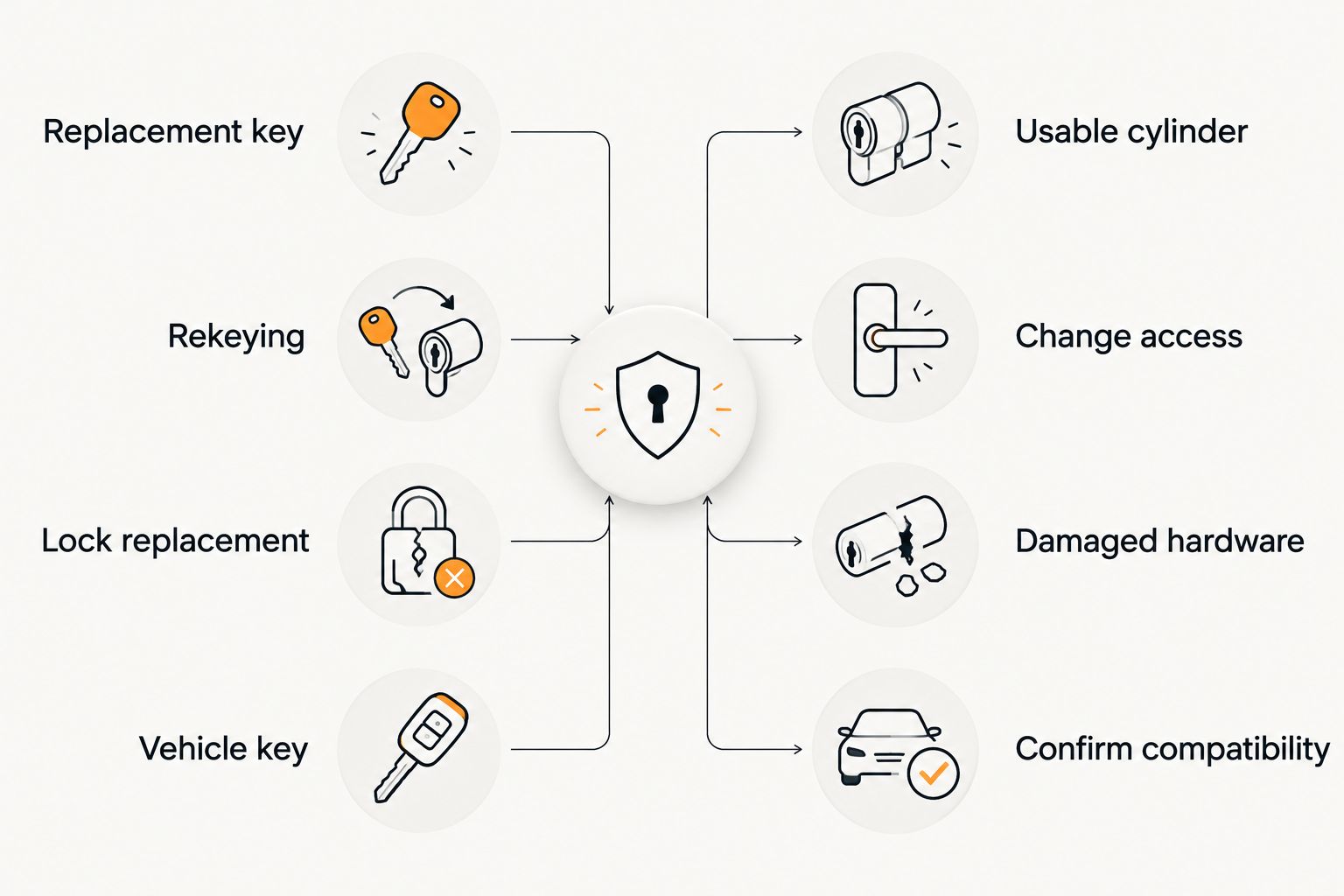
Choose the repair from the diagnosed fault and access requirements.
Authorize the specific outcome
Request the condition finding. Ask whether the key, cylinder, door alignment, or vehicle key system needs attention. More than one issue can be present.
Choose the access policy. If existing authorized keys should keep working, say so. If an old key is missing or held by someone who should no longer have access, explain that before approving a replacement key alone.
Confirm hardware requirements. For a replacement lock, discuss door compatibility, existing key arrangements, and building requirements. Do not assume every replacement preserves a master key system.
Confirm automotive functions separately. Ask which functions the replacement will support: mechanical entry, ignition operation, engine-start authorization, and remote buttons, as applicable. A cut blade and an electronically recognized key are different requirements.
Expected result: You and the technician agree on the repair and the functions that must work at completion. Nothing depends on an assumed feature or an unapproved access change.
Fastkeyrious provides rekeying and automotive key services, but confirm the exact job before arranging service. Direct contact makes it easier to explain the broken-key situation; it does not establish compatibility with every lock or vehicle.
Operation checks and handoff
Test before returning the opening to use
Start with the door open when appropriate. For a building lock, have the technician demonstrate insertion, turning, locking, and unlocking without forcing the key. Keep yourself from being locked out during the initial check.
Check the closed-door operation. Confirm that the latch or bolt engages and releases correctly. Tell the technician if operation changes when the door closes.
Test each agreed vehicle function. Confirm the supported door, ignition, starting, and remote functions separately. Do not treat a working remote button as proof that the vehicle will start.
Confirm the final access arrangement. Identify which keys now work, which should no longer work after rekeying, and whether shared or master-key access remains as authorized.
Expected result: The repaired opening works through the agreed functions, and you understand who retains access. Any remaining resistance or unsupported function is discussed before the handoff.
Use 3 checks for a building door: open-door operation, closed-door operation, and authorized-key operation. For a vehicle, distinguish 2 checks wherever applicable: mechanical operation and electronic recognition. Those checks define the handoff; they are not a guarantee that every vehicle uses the same key system.
When a missing key also changes the workflow
A broken key and a missing key create different security questions. If all pieces are accounted for, the immediate issue is usually mechanical. If another key is missing or held by someone who should no longer have access, a replacement key alone leaves that access question unresolved.
For your 2026 home or business repair, add an authorization review before choosing the final work:
Identify who currently holds keys and who should retain access.
Tell the technician about missing keys or access that must be removed.
Obtain property-owner approval where required, including shared-key requirements.
Confirm whether rekeying or replacement addresses both the mechanical fault and the access change.
Expected result: The repaired lock supports the intended users, not simply the same key arrangement that existed before the break. For vehicles, ask separately what the supported replacement process does about missing electronic keys; do not assume replacement automatically removes them.
Troubleshooting
The fragment is not visible. Stop inserting tools or another key. Tell the technician the key broke inside the keyway and whether any piece was recovered; extraction needs an assessment of its position.
The replacement key works with the door open but binds when closed. Ask for a door-and-strike assessment. Repeatedly cutting keys does not address resistance caused by the door's position.
The key turns, but the vehicle will not start. Report the mechanical result and any dashboard message exactly. Ask the technician to check the applicable key-recognition requirement rather than assuming the blade cut proves complete operation.
The office replacement key changes shared access unexpectedly. Stop distributing keys and contact the authorized building representative. Confirm the approved key arrangement before further cylinder changes.
The new key still requires force. Stop using it and report where resistance occurs: insertion, turning, removal, or closed-door locking. A repair is not complete merely because the fragment is gone.
Customize your workflow
For a home, include every opening that shares the affected key in the discussion. That does not mean every lock needs replacement; it means the technician needs to understand the existing key arrangement before changing one cylinder.
For a business, name the approving person and distinguish suite access from shared entrances. For a vehicle, provide the exact model year and key type before discussing programming. Keep broken-key work separate from keys locked inside the vehicle and lost-key replacement.
Fastkeyrious's mobile locksmith services include home and business lockouts, rekeying, car key replacement, and fob programming. Confirm the exact service address and the specific broken-key work directly with the technician.
Discuss your broken key
Explain the affected lock, exact address, and key type directly to the technician.
FAQ
Do I need a new lock if my key broke inside it?
A broken key does not automatically require a new lock. The technician needs to assess the cylinder after extraction and identify why the key broke.
Can I pull out a broken key myself?
Avoid forcing the fragment or inserting another key into the occupied keyway. A technician can assess its position and the lock's condition before attempting extraction.
Is rekeying the same as replacing a lock?
Rekeying changes which keys operate a cylinder; lock replacement changes hardware. Rekeying does not repair a damaged cylinder or correct door alignment.
Can a locksmith make a replacement from the broken pieces?
Keep the pieces, but do not assume they are sufficient for a working replacement. The technician will assess the key, lock, and available information to determine the appropriate method.
Does a replacement car key need programming?
Programming depends on the vehicle and key system. Confirm the model year, key type, and required functions with the technician; mechanical operation alone does not establish electronic recognition.
What should I tell the locksmith before a broken-key visit?
Provide the exact address, affected opening, symptoms before the break, and whether a working spare exists. For a vehicle, include the make, model, model year, and key type; ask what authorization documents are required.
Does Fastkeyrious serve every address near Greenville?
Fastkeyrious's approved boundary is within 42 miles of Greenville, South Carolina, with North Carolina and Wellford excluded. Confirm the exact address with the technician rather than assuming every address in a named town qualifies.
One last thing
Do not throw away the broken key until the repair is finished. Its wear, bend, and break can help explain the failure, even when it cannot serve as the basis for a replacement. For your 2026 handoff, ask one practical question: “What caused the break, and what was done to address it?”