Fast & Keyrious LLC
Call 821-203-4949
How long does it take a locksmith to unlock a house?
A locksmith’s time to unlock a house depends on the door, the lock’s condition, and the work needed to restore entry; get a job-specific estimate rather than relying on a fixed number of minutes. Travel, access verification, and any repairs are separate from opening the lock, so ask whether the estimate covers the full visit or only the entry work.
TL;DR
How long does it take a locksmith to unlock a house? Ask for separate arrival and entry estimates.
Fastkeyrious provides mobile house lockout service with direct technician communication, not a dispatch-center middleman.
Describe the locked door, explain where your identification is, and confirm who can authorize entry.
Unlocking restores access; rekeying and lock replacement address different problems and require separate approval.
How long does it take a locksmith to unlock a house?
The useful estimate separates getting to your house from getting you inside. A technician needs to understand the lockout before estimating the entry work. A closed door with keys inside is a different job from a door with a broken key or a lock that stopped turning.
For local help, Fastkeyrious provides mobile residential lockout service. Explain what happened before asking for an arrival estimate, then ask what the technician still needs to assess at the door.
Arrival
What needs to happen: The technician confirms the address and travel estimate
What to ask: Does that estimate mean arrival or completed entry?
Authorization
What needs to happen: The technician confirms your authority to enter
What to ask: What proof should I have ready?
Assessment
What needs to happen: The technician checks the locked entrance and its condition
What to ask: Does the door show a lock problem or a door problem?
Entry
What needs to happen: The technician carries out the agreed entry work
What to ask: What changes would require my approval?
Completion
What needs to happen: You check access and the lock’s operation
What to ask: Is the door secure and usable afterward?
Treat an estimate as a description of the expected job, not a guarantee that every door opens on the same schedule. Ask for an update if the assessment changes the work.
Why this matters
When you are standing outside, a time estimate sounds simple. But an arrival estimate does not tell you when the house will be open, and an open door does not necessarily mean a damaged lock has been repaired.
Ask for the next milestone, not just a single finish time. Knowing whether you are waiting for travel, authorization, or an assessment gives you a clearer picture of what happens next. It also helps you explain a delay to a landlord, family member, or caregiver without repeating an unsupported promise.
If someone inside faces immediate danger, call 911 and explain the situation. Do not treat a routine locksmith appointment as a substitute for emergency assistance.
Why house-unlocking time varies
The details that matter are the ones that change the work. Give the technician these facts instead of guessing how easy the door will be to open:
Which locks are engaged. Explain whether the entrance has a locking handle, a deadbolt, or another locking device. Do not assume that describing the handle identifies everything securing the door.
Whether the lock worked normally before the lockout. A door that closed behind you presents a different situation from a key that gradually became harder to turn.
Whether a key is broken or missing. A key fragment in the lock needs assessment. Missing keys also raise a separate question about who can still enter afterward.
Whether the door is damaged or binding. Mention recent sticking, visible damage, or a door that needs pushing or lifting to close.
Whether the entrance uses electronic credentials. Describe the keypad or electronic lock and any mechanical key cylinder. Do not assume physical entry work includes electronic troubleshooting.
Whether access is authorized and practical. Explain gate access, the correct entrance, pets, and who can approve the work. Unclear access instructions leave questions unresolved when the technician arrives.
These details support a useful estimate. They do not establish the entry method before the technician examines the door.
What should you tell the locksmith before arrival?
Start with the exact address and the entrance you need opened. Include the unit number and any gate or building-access instructions. A street address alone does not identify the right door at a duplex, shared property, or divided house.
Then explain the event in plain language. Say whether you left the keys inside, lost them away from home, broke a key, or found that the lock no longer turns. Avoid diagnosing the problem yourself; describe what you saw and what you already tried.
Use this preparation list while you speak with the technician:
Location: Give the exact service address and a reliable callback number.
Door: Identify the entrance, visible locks, and any known sticking or damage.
Keys: Explain whether the keys are inside, lost, stolen, or broken.
Authorization: Say whether you own, rent, or manage the property and who can approve entry.
Conditions: Mention pets, weather exposure, mobility needs, or a gate that affects access.
Scope: State whether you need entry only or also want to discuss securing the house afterward.
A clear photo of the outside lock and door can help describe the hardware if the technician requests one. Do not post your address, identification, or access details publicly to ask for help.
What happens after the locksmith arrives?
A house lockout should have a clear scope before work starts. Ask the technician to explain the proposed approach, what it covers, and what happens if the initial assessment changes.
Confirm location. Point out the correct entrance and explain any shared or restricted areas. Identify an alternative entrance only if you have authority to use it.
Verify access. Provide the information the technician requires to establish your authority to enter. If your identification is inside, say so before the visit and ask what verification is acceptable.
Assess door. Explain the symptoms again at the door, including anything that changed since the call. Ask whether the problem involves the lock, the door’s fit, or both.
Restore entry. Approve the agreed work. If the technician proposes a different method or additional work, ask for the revised scope before proceeding.
Test operation. Once inside, check that the door opens, closes, locks, and unlocks as intended. Address remaining problems before treating the visit as complete.
The goal is not just an open doorway. You also need to understand whether the existing lock remains usable and whether any further work is necessary.
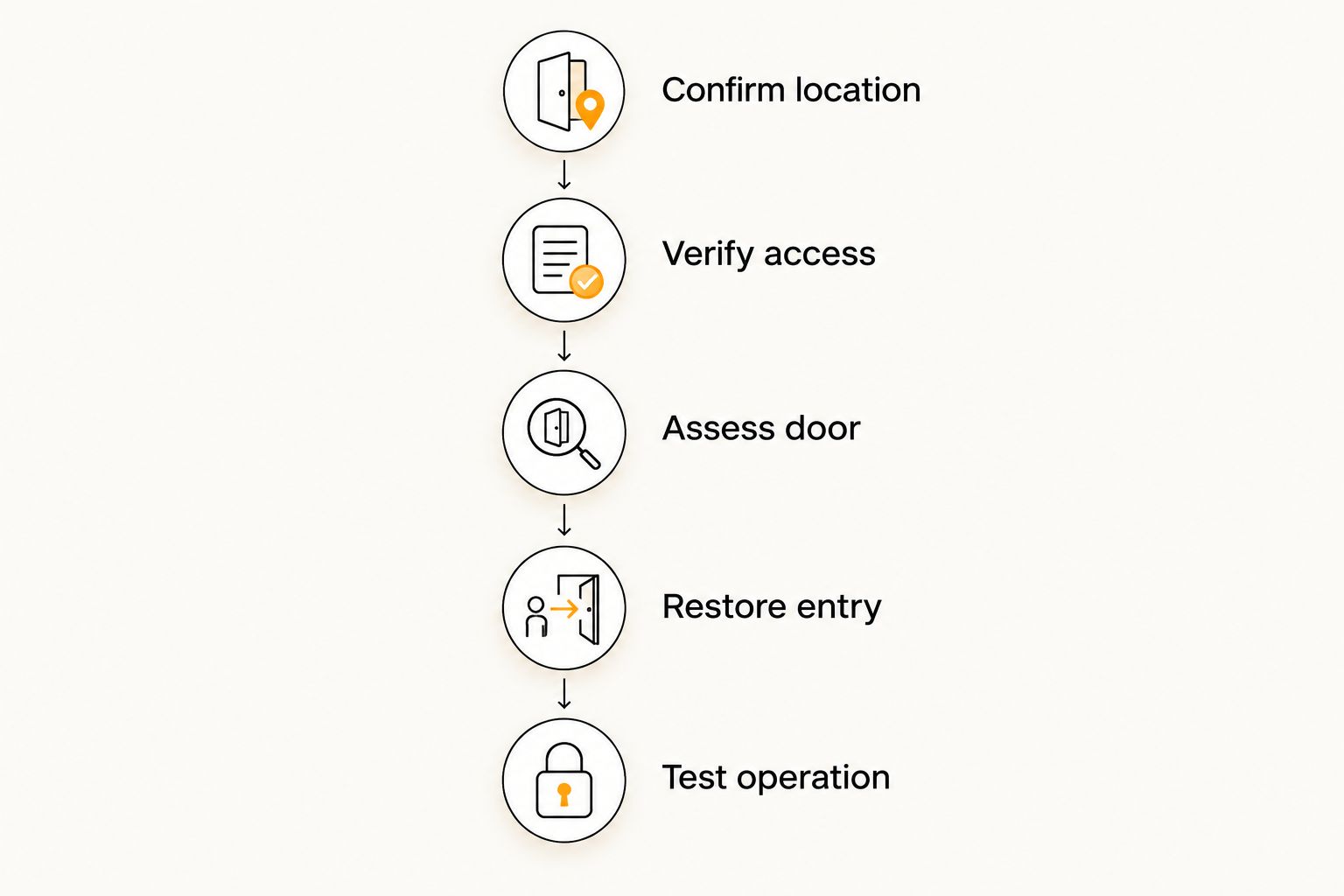
Entry is one part of the visit; authorization and the final operation check matter too.
Will the locksmith need to drill or replace the lock?
Do not assume either damage-free entry or mandatory replacement before the door is assessed. Ask whether the proposed method preserves the existing lock and what circumstances would change that plan. No responsible estimate should hide a possible hardware change inside a vague promise to get you in.
If a method would damage hardware, ask what would need replacing and how the entrance would be secured afterward. Approve that work separately from the original entry request. Do not authorize destruction merely because someone describes it as the only option without explaining the problem.
Avoid forcing the key, prying the frame, or attempting online entry tricks while you wait. Those actions can damage the lock or door and change the repair needed. Tell the technician about any attempts already made so the assessment starts with accurate information.
Does unlocking a house include rekeying or replacement?
Unlocking, rekeying, and replacement solve different problems. Restoring access does not automatically stop a missing key from working. If the keys are lost or stolen, discuss that security concern separately from getting through the door.
Unlocking
Best for: Regaining authorized entry
What it does: Opens the secured entrance
Limitation: Does not by itself change which keys work
Rekeying
Best for: Changing key access while keeping suitable hardware
What it does: Changes a compatible lock to work with a different key
Limitation: Does not repair a damaged door or solve every hardware fault
Lock replacement
Best for: Addressing unsuitable or damaged lock hardware
What it does: Replaces the lock hardware within the agreed scope
Limitation: Requires decisions about fit and does not automatically fix the door or frame
Rekeying is not the same as changing a keypad code or removing an electronic credential. If the entrance combines a mechanical lock with electronic access, ask which part of the system the proposed work affects. Confirm the exact service supported rather than assuming both are included.
For a rental home, separate permission to enter from permission to alter the locks. A tenant’s access problem does not establish authority to replace landlord-owned hardware. Contact the property manager when approval or a required key arrangement is unclear.
What should the estimate include?
Ask for an estimate that identifies the requested service and its boundaries. “House lockout” should not leave you guessing whether the visit includes only entry, an assessment of a faulty lock, or additional work afterward.
Before approving service, ask:
Does the arrival estimate refer to reaching the address or starting the work?
What entry work does the estimate cover?
What circumstances would change the scope?
Are any proposed repairs, rekeying, or replacement separate?
Will you ask for approval before changing the method or adding work?
What documentation will I receive when the job is finished?
Write down the agreed scope or keep the written estimate if one is provided. If the technician finds a different problem at the door, ask for an explanation and an updated estimate before approving it. Urgency is a reason for clear communication, not for leaving the scope undefined.
Can you get a better time estimate before the visit?
You can give the technician better information, but a phone description cannot replace examining the door. Describe the visible hardware, what happened, and any previous trouble with the lock. Ask which parts of the estimate remain dependent on that examination.
Fastkeyrious is best for local house lockout customers who want to speak directly with the arriving technician. Direct communication lets you explain the situation without a dispatch-center middleman; it does not establish a guaranteed arrival or completion time.
Fastkeyrious’s house lockout service area extends up to 42 miles from Greenville, South Carolina, subject to exact-address confirmation. North Carolina and Wellford are excluded. Confirm your address before arranging service rather than assuming every property in a nearby town qualifies.
What should you check before locking the door again?
Test the lock with the door open first, then check its operation with the door closed while you retain access. A lock that turns with the door open but binds when closed needs further assessment; opening the house alone has not resolved that symptom.
Retrieve your keys and confirm that they operate the intended lock. Check that everyone who needs authorized access understands any changes made during the visit. If the key remains missing, decide how to address continued key access before treating the security issue as resolved.
Keep the service documentation and note any recommended follow-up. If additional work is deferred, ask how to leave the entrance secure in the meantime. Do not close yourself outside again until you have confirmed a working way back in.
FAQ
How long does it take a locksmith to unlock a house once they arrive?
The entry time depends on the lock, the door’s condition, and the work required. Ask for an on-site estimate after the technician verifies authorization and assesses the entrance.
Does a locksmith’s arrival estimate include unlocking my front door?
Do not assume the arrival estimate includes unlocking the door. Ask whether it refers to reaching your address, starting work, or completing entry.
Can a locksmith help if my identification is locked inside my house?
Tell the technician before arrival that your identification is inside and ask what access verification is acceptable. Do not assume that having identification indoors removes the need to establish authorization.
Will a locksmith have to replace my house lock to get me inside?
Replacement is not an automatic part of every house lockout. The technician needs to assess the lock and explain the proposed method, including any hardware changes that require approval.
Should I rekey my house after losing the keys?
Rekeying addresses whether the missing mechanical key can still operate a compatible lock. Unlocking alone does not change key access, so discuss rekeying separately if you cannot account for the keys.
Can a renter approve lock replacement during a lockout?
Do not assume permission to enter includes permission to replace the locks. Check your lease and contact the landlord or property manager when authority to change hardware is unclear.
Does Fastkeyrious provide emergency house lockout service near Greenville?
Fastkeyrious provides 24/7 emergency locksmith response within its confirmed service area, up to 42 miles from Greenville, South Carolina. Exact-address confirmation is required; North Carolina and Wellford are excluded.
One last thing
Ask what happens after the door opens. An entry-only job can leave a separate problem unresolved: missing keys still work, a sticking door still binds, or damaged hardware still needs attention. Before ending the visit, confirm both your way back in and your plan for securing the house.