Fast & Keyrious LLC
Call 821-203-4949
Best Padlocks for Storage Units 2026: Disc Lock Wins
Best overall: a disc lock for a compatible roll-up storage-unit door. Best for an exposed hasp: a closed-shackle padlock. Best for an outdoor unit: a weather-resistant padlock with a protected shackle. This 2026 guide compares the best padlocks for storage units by how they fit the door, what they leave exposed, and when each type is the wrong choice.
TL;DR
For the best padlocks for storage units, choose a disc lock when the facility's roll-up latch accepts it.
Choose a closed-shackle padlock for a compatible exposed hasp; check that its body can sit flat.
For an outdoor unit, prioritize a weather-resistant padlock that also fits the latch.
Ask the storage facility which locks its doors accept before buying any padlock.
Why this matters
The strongest-looking padlock is useless if its shackle cannot pass through the latch or its body prevents the door from closing. A lock that fits but leaves a long section of shackle exposed creates a different problem. In 2026, start with the unit's hardware, then choose the lock—not the other way around.
Fastkeyrious is a mobile locksmith serving South Carolina for residential, commercial, and automotive needs. If you are dealing with a lost key or a lockout, confirm with the storage facility who is authorized to handle the unit before arranging work. Storage-unit access rules belong to the facility; owning a padlock does not override them.
What makes the best padlock for a storage unit?
Latch fit. The shackle must pass through the opening without forcing it, and the lock body must clear the door as it closes.
Limited shackle exposure. Less accessible shackle gives someone fewer places to grip or attack. That is a design advantage, not a guarantee against theft.
Door compatibility. Roll-up door latches, exposed hasps, and outdoor gates do not all accept the same lock shape.
Weather suitability. An outdoor unit calls for a lock designed to resist moisture and corrosion. The weather cover must not interfere with the latch.
Usable key access. You need room to insert and turn the key without fighting the door frame or latch.
Facility approval. Some facilities specify accepted lock styles or sell locks designed for their doors. Check the rule before you buy.
Those criteria determine the ranking below. A disc lock takes the top spot for a compatible roll-up latch, not for every door labeled a storage unit. If the latch will not accept a disc lock, choose the best-fitting alternative rather than forcing the top pick.
Best padlocks for storage units at a glance
Disc lock
Best for: Compatible roll-up door latches
Standout feature: Compact shape limits exposed shackle
Key limitation: Does not fit every latch or key-access position
Closed-shackle padlock
Best for: Compatible exposed hasps
Standout feature: Lock body shields much of the shackle
Key limitation: Bulky body can obstruct the hasp
Weather-resistant padlock
Best for: Outdoor units exposed to rain
Standout feature: Materials and covers address weather exposure
Key limitation: A cover does not correct poor latch fit
Long-shackle padlock
Best for: Latches that require extra clearance
Standout feature: Reaches openings a shorter shackle cannot
Key limitation: Leaves more shackle accessible
This table compares lock types, not named models. A model's dimensions, construction, and facility acceptance still decide whether it belongs on your door in 2026. Use the sections below to narrow the type, then check the individual lock against the actual latch.
1. Disc lock: best padlock for a compatible roll-up unit
A disc lock has a round body with a short, curved shackle. That compact shape works well on many roll-up storage-unit latches because it leaves little shackle exposed when the lock sits correctly. A disc lock is the default choice for a compatible roll-up door—not a substitute for checking fit.
Hold the lock against the latch before committing to it. The shackle has to pass through the latch opening, the body must not block the door, and you need access to the keyway after locking it. If any of those checks fail, move to another shape. A disc lock that hangs at an odd angle is not a win just because it is the top-ranked type.
Disc lock pros:
Compact body suits many roll-up latch layouts.
Short exposed shackle gives less room for direct access.
Easy to identify as a storage-unit candidate when asking the facility about accepted locks.
Disc lock cons:
Round body can collide with a recessed or crowded latch.
Key access can be awkward when the door frame sits close to the lock.
Not the right pick for a hasp that needs a longer reach.
Best for: A roll-up storage-unit door whose latch accepts the shackle and leaves the keyway usable.
Verdict: Buy a disc lock if it fits the latch and the facility accepts it. Otherwise, skip it. A securely seated alternative is better than a disc lock installed under strain.
2. Closed-shackle padlock: best for an exposed hasp
A closed-shackle padlock places much of its shackle behind the lock body. On a compatible exposed hasp, that body helps limit direct access to the shackle. It is a different fit decision from a disc lock: the hasp needs enough room for the padlock body to sit correctly.
Check the hasp in both its open and closed positions. The lock must pass through the opening without twisting the hasp, and the body must not hold the door away from its frame. Pay particular attention to where the key enters. A lock that technically closes but cannot be opened comfortably will become a daily nuisance.
Closed-shackle padlock pros:
Shields more of the shackle than an open-shackle design.
Gives exposed-hasp users an alternative when a disc lock will not fit.
Makes shackle access part of the selection decision, not an afterthought.
Closed-shackle padlock cons:
Wider body can block a tight hasp or door recess.
Limited clearance around the keyway can make routine access difficult.
Shackle protection does not fix a loose or damaged hasp.
Best for: An exposed hasp with enough clearance for the lock body and key.
Verdict: Buy a closed-shackle padlock when the hasp accepts it without interference. Hold if you have not checked body clearance; the protected shackle offers no benefit on a door the lock cannot secure properly.
3. Weather-resistant padlock: best for an outdoor unit
If rain reaches the lock, weather suitability becomes a buying requirement. Look for a padlock intended for outdoor use, then judge its shackle exposure and latch fit just as you would with an indoor lock. A cover can help protect a keyway, but it does not make every lock shape suitable for a storage-unit door.
Do not treat weather-resistant as a security ranking. The term addresses exposure, while the door hardware determines fit and the lock design affects how much shackle is accessible. An outdoor unit can still use a disc-style or protected-shackle design if that specific lock suits both the weather and the latch.
Weather-resistant padlock pros:
Better matched to a lock that faces rain or moisture.
Keyway covers can reduce direct exposure when designed for the lock.
Available design choices let you assess weather needs alongside shackle access.
Weather-resistant padlock cons:
A protective cover can get in the way on a tight latch.
Weather claims do not tell you whether the lock fits your door.
Outdoor construction alone does not limit exposed shackle.
Best for: An outdoor storage unit where the lock is exposed to weather and the chosen model fits the latch.
Verdict: Buy an outdoor-suitable lock only after checking fit, key access, and shackle exposure. Skip a model whose cover prevents the latch from closing cleanly.
4. Long-shackle padlock: best only when the latch needs extra reach
A long-shackle padlock can reach a latch opening that a compact lock cannot. That solves a fit problem, but it usually leaves more shackle accessible. It is the fallback for unusual clearance—not the first choice when a shorter, better-protected lock fits.
Before selecting one, check whether the extra reach is truly needed. Close the door fully, inspect how the hasp lines up, and compare the space available for the lock body. If a shorter shackle passes through and permits normal key access, choose the shorter option. Do not use shackle length to compensate for a latch that will not align or close properly.
Long-shackle padlock pros:
Reaches latch openings that sit beyond a compact lock's range.
Can accommodate a hasp layout with limited room for a wider body.
Makes an otherwise inaccessible locking point usable when the hardware is sound.
Long-shackle padlock cons:
More exposed shackle creates more accessible surface.
A loose fit can let the lock move around the hasp.
Does not repair a bent, misaligned, or damaged latch.
Best for: A sound latch that genuinely requires more shackle reach and has no better-fitting protected option.
Verdict: Hold until you confirm the shorter options do not fit. Buy only when the extra reach solves a real clearance issue and the facility accepts the lock.
Match the lock to the door before buying
A storage-unit door presents a physical fit problem first. Use this sequence in 2026, whether the unit is in Greer, Clemson, Mauldin, Spartanburg, or elsewhere in South Carolina:
Identify the latch. Is it a roll-up door latch, an exposed hasp, or another arrangement? Do not choose from a product photo alone.
Ask the facility about restrictions. Confirm which lock styles it accepts and whether it needs access under the rental agreement.
Check the closing position. The lock has to fit when the door is fully shut, not just when the latch is loose in your hand.
Check the keyway. Make sure you can insert, turn, and remove the key without pressing against the door.
Inspect shackle exposure. Of the locks that fit and work, prefer one that leaves less shackle accessible.
A lock can pass one check and fail the next. For example, a disc lock's shackle may pass through the latch while its body blocks the keyway. An outdoor cover may clear the opening while preventing the latch from sitting flat. Complete the full fit check before treating a lock as compatible.
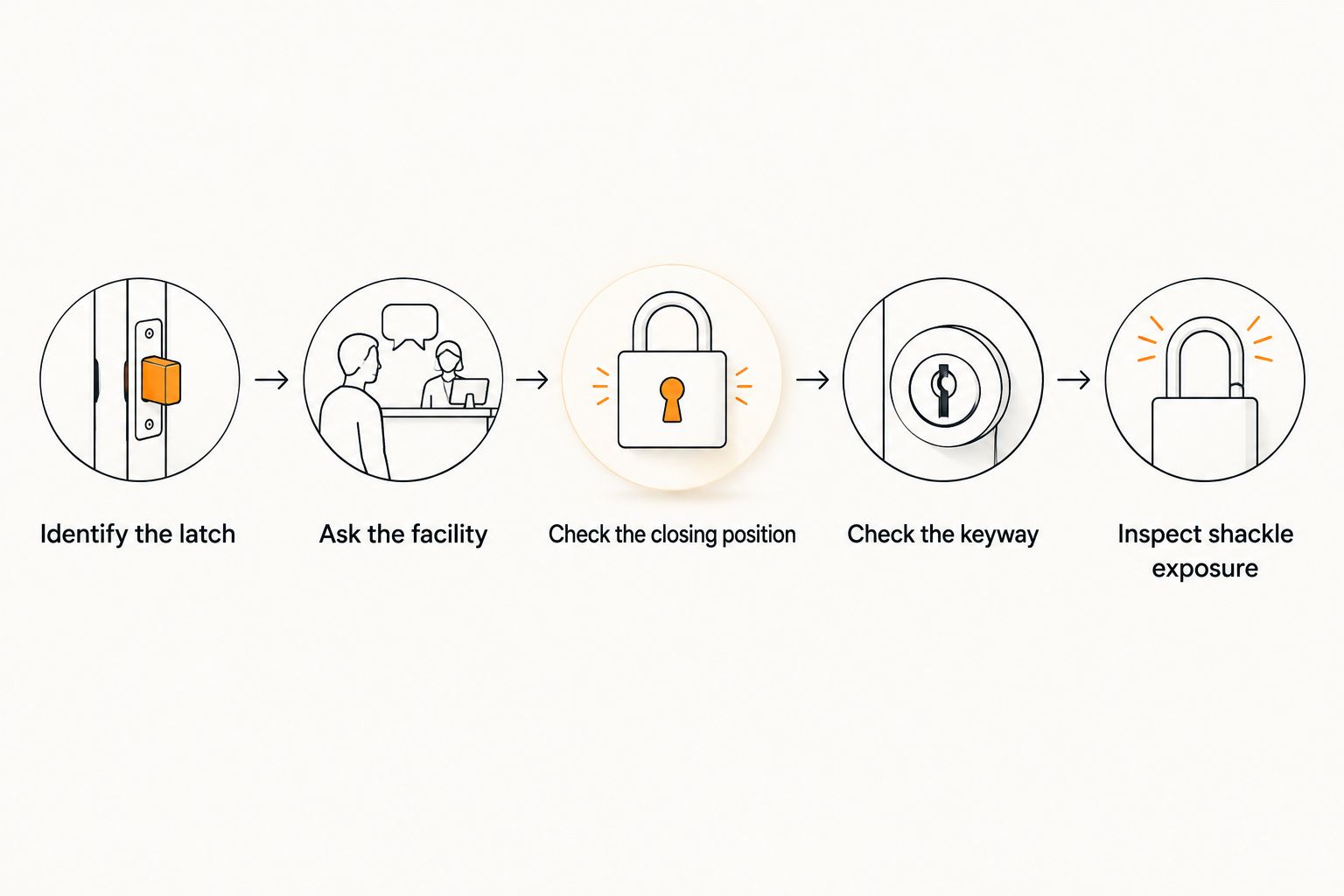
A lock is compatible only when it fits the closed door and remains usable.
Do not force a lock through a misaligned latch. If the door cannot close normally, ask the facility to address its hardware. A more awkward padlock is not a repair. If the lock fits but turns poorly, resolve that problem before leaving belongings behind a door you cannot reliably reopen.
Need help with a lockout?
Speak directly with the technician about your situation and service area.
How we ranked these lock types
The ranking puts latch compatibility first, then shackle exposure, everyday key access, and outdoor suitability. It does not claim that every disc lock beats every closed-shackle padlock. An individual model that fails the fit check loses to a compatible model lower in the table.
That distinction matters for the best padlocks for storage units in 2026. The lock is only one part of the closure; the latch, hasp, door, and facility rules determine what you can use. No padlock makes a damaged latch secure. Ask the facility to deal with door hardware that will not close or align as intended.
Fastkeyrious provides mobile locksmith services, but a storage-facility lockout requires more than picking a lock type. Confirm facility authorization and describe the door and lock when you speak directly with the technician. Do not assume a locksmith can work on a unit without the facility's permission.
Which storage-unit padlock should you choose?
Choose a disc lock if you have a compatible roll-up latch and the facility permits it. That is the default recommendation for an undecided reader in 2026. If the round body will not clear your latch, move to a closed-shackle padlock on a compatible exposed hasp.
For a lock that sits in the rain, select an outdoor-suitable design within the lock type that fits. Use a long-shackle padlock only when extra reach is required and a shorter option cannot do the job. The best padlock for a storage unit is the one that closes properly, leaves limited shackle exposed, and lets you use the key without a struggle.
FAQ
What's the best padlock for a storage unit in 2026?
A disc lock is the best default for a compatible roll-up storage-unit latch in 2026. Check the latch opening, body clearance, keyway, and facility rules before buying.
Is a disc lock better than a closed-shackle padlock?
A disc lock is the better default for a roll-up latch that accepts it; a closed-shackle padlock suits a compatible exposed hasp. Neither type wins when it prevents the door from closing or blocks key access.
Can I use any padlock on a storage unit?
No. The padlock must fit the door hardware and meet the storage facility's rules. Confirm accepted lock styles with the facility before buying.
Are long-shackle padlocks good for storage units?
Long-shackle padlocks are a fallback when the latch requires extra reach. If a shorter, protected option fits, it leaves less shackle accessible.
What type of padlock should I use on an outdoor storage unit?
Use a padlock intended for outdoor exposure that also fits the latch and leaves limited shackle accessible. A weather cover does not make a poorly fitting lock suitable.
What if my disc lock fits the hole but blocks the keyway?
Choose a different lock shape or model. A storage-unit padlock must allow normal key access after the door is fully closed.
Can a locksmith open my storage unit if I lose the key?
Confirm authorization with the storage facility first, then ask the locksmith whether they handle that lock and location. Fastkeyrious provides mobile locksmith services in South Carolina; do not assume storage-unit work is available without asking.
One last thing
Before leaving a unit secured, close the door fully and test that you can unlock it normally. A padlock that looks secure while the door is open can become unusable against the frame. For a 2026 purchase, that final key-access check matters more than choosing the highest-ranked lock type on paper.