Fast & Keyrious LLC
Call 821-203-4949
Best Home Safes for Security: TL-15 Wins in 2026
Best overall: an anchored TL-15 burglary safe for concentrated valuables. Best for paper records: a UL 72 Class 350 fire safe. Best for digital media: a Class 125 media safe. The best home safes for security in 2026 depend on what you need to protect, because burglary, fire and water protection are separate features.
TL;DR
An anchored TL-15 burglary safe is the strongest security-first pick among these home-safe types.
Choose a UL 72 Class 350 fire safe for paper records, not as a substitute for a burglary rating.
Choose a Class 125 media safe for heat-sensitive digital media; check water protection separately.
Fast & Keyrious handles South Carolina home lockouts and rekeying, not the safe selection in this guide.
Why this matters
A safe can perform well against one hazard and poorly against another. A fire label does not establish burglary resistance; a burglary rating does not establish fire protection. In 2026, start with the contents and the threat you need the safe to address, then check the exact model's labels and installation requirements.
Your home's locks protect the rooms around the safe. If your immediate problem is a lockout or rekeying rather than safe selection, Fast & Keyrious provides mobile locksmith service for South Carolina homes. Fast & Keyrious is the locksmith choice for South Carolina homeowners who need help with home access, not a ranked home-safe product.
What makes the best home safe for security
Use these criteria before comparing models. The best home safes for security in 2026 have documented protection that matches their intended contents; a heavy door or a digital keypad alone proves neither burglary nor fire performance.
Burglary rating: Look for an independently verified rating on the exact model. TL-15 refers to a defined 15-minute tool-resistance test, not a promise that every break-in will take that long. A Residential Security Container, or RSC, serves a different security tier; do not treat the labels as interchangeable.
Fire rating: Check the tested class and duration. UL 72 Class 350 is intended for paper records. A stated 1-hour or 2-hour rating matters only when you can identify the test behind it.
Anchoring: Check whether the safe supports installation to a suitable surface and follow its instructions. A safe that can be carried away does not solve a removal risk, regardless of its lock.
Access method: Choose a key, mechanical combination or electronic lock you can use reliably. Confirm the model's documented procedure for a forgotten combination, failed keypad or lost key before you need access.
Water protection: Treat water resistance as its own claim. Neither a fire rating nor a burglary rating automatically establishes protection from water.
Usable capacity: Measure the items you plan to store, including folders or containers. Exterior dimensions do not tell you how much usable space remains inside.
These criteria separate protection from convenience. A keypad can make access easier, while a verified rating tells you what the safe was tested to resist. Neither feature replaces the other.
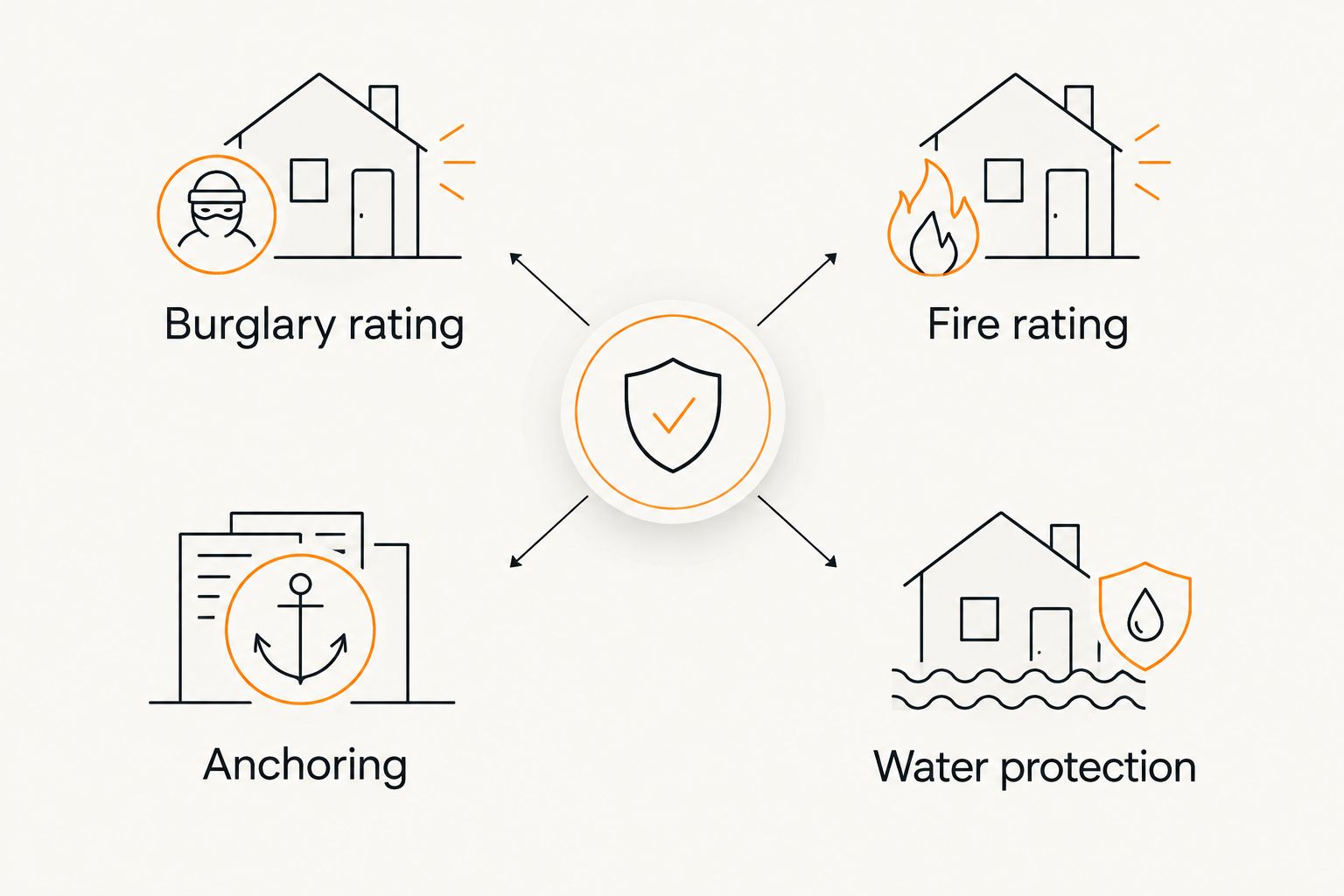
Check each type of protection separately; one rating does not cover every hazard.
Best home safes at a glance
Anchored TL-15 burglary safe
Best for: Concentrated valuables
Standout feature: Independently defined tool-resistance rating
Key limitation: Fire and water protection need separate verification
Anchored RSC safe
Best for: Everyday valuables
Standout feature: Residential burglary-resistance classification
Key limitation: Not equivalent to TL-15
UL 72 Class 350 fire safe
Best for: Paper records
Standout feature: Fire classification suited to paper
Key limitation: Fire protection does not establish burglary resistance
Class 125 media safe
Best for: Heat-sensitive digital media
Standout feature: Fire classification suited to media
Key limitation: Media capacity and water protection vary by model
Portable water-resistant document chest
Best for: Documents you need to move
Standout feature: Portability and a stated water-protection feature
Key limitation: Portability works against theft protection
The rows describe types, not endorsements of unnamed models. Before buying in 2026, confirm the exact safe's certification, lock, dimensions and installation instructions. A category name alone does not certify a product.
1. Anchored TL-15 burglary safe: best for concentrated valuables
Best for: A homeowner whose main concern is theft of valuables kept in one place.
A TL-15 safe is the security-first choice here because the designation refers to a defined tool-resistance test. Buy only after confirming that the exact model carries the stated rating and can be installed as its manufacturer directs. An unrated safe described as heavy-duty is not an equivalent substitute.
The word anchored matters as much as the lock you operate each day. Check the model's mounting instructions and the intended installation surface before choosing a size or location. If fire protection also matters, look for a separate fire classification on the same model rather than assuming the burglary label covers it.
TL-15 burglary safe pros:
The rating gives you a specific burglary-resistance standard to verify.
A fixed location supports a plan to secure the safe against removal.
It suits valuables that do not need to travel with you.
TL-15 burglary safe cons:
The burglary designation alone says nothing about fire or water resistance.
Installation takes more planning than placing a portable chest on a shelf.
A rating on a different model in the same range does not validate the one you buy.
Verdict: Buy a verified, properly installed TL-15 safe when burglary resistance is the priority. Hold if you have not confirmed how the specific unit will be anchored or whether it needs separate fire protection.
2. Anchored RSC safe: best for everyday valuables
Best for: A homeowner who wants a fixed residential safe for items accessed regularly.
An RSC-rated safe gives you a named residential burglary-resistance classification to check. It does not carry the same designation as TL-15, so choose it for its own intended role rather than treating the two ratings as synonyms. Verify that the classification belongs to the exact model offered.
Daily use puts the lock and interior layout under closer scrutiny. Check whether you can reach the contents without repeatedly moving other items, and read the access and recovery instructions. If the safe supports anchoring, plan that installation before it arrives rather than leaving a movable unit in place indefinitely.
RSC safe pros:
An RSC label provides a defined classification to verify.
A fixed installation addresses the risk of someone removing the entire unit.
Lock and interior options let you prioritize access to frequently used contents.
RSC safe cons:
RSC and TL-15 represent different burglary-resistance classifications.
Fire and water claims require their own evidence.
A convenient electronic lock still needs a documented recovery procedure.
Verdict: Buy an RSC-rated safe for routine access when its verified rating matches your security goal. Hold if concentrated valuables call for the stronger burglary-focused option above.
3. UL 72 Class 350 fire safe: best for paper records
Best for: Paper records you intend to keep in a fixed location.
UL 72 Class 350 is a fire-test classification associated with protecting paper. Confirm both the class and the tested duration for the exact model. A 1-hour fire claim and a 2-hour fire claim are different specifications; neither should be inferred from the words fire safe.
Think about the size of the records, not just the outside of the box. A folder that fits flat is easier to retrieve than one you have to bend or unpack. If theft is also a concern, check for an independent burglary rating and an anchoring option instead of relying on the fire classification.
Class 350 fire safe pros:
The classification addresses the heat sensitivity of paper records.
A stated test duration gives you a specification to compare across exact models.
It creates a clear choice for paper rather than treating every safe as interchangeable.
Class 350 fire safe cons:
A fire label alone does not establish burglary resistance.
Paper protection is not the same specification as digital-media protection.
Water resistance requires a separate check.
Verdict: Buy a verified Class 350 safe when paper records are the priority. Skip a model with only a vague fire claim and no identifiable test classification.
4. Class 125 media safe: best for heat-sensitive digital media
Best for: Physical digital media that needs a fire classification suited to heat-sensitive contents.
Class 125 addresses a different storage need from Class 350 paper protection. Check the exact unit's tested class, duration and usable interior before buying. A drive stored in a paper-rated safe is not automatically covered by that safe's paper classification.
Start with the physical objects you need to fit. Include their cases or protective containers in your measurements. Then check water protection separately, especially if the product description emphasizes fire resistance but says little about exposure to water.
Class 125 media safe pros:
Its classification distinguishes digital-media protection from paper protection.
It gives you a specific claim to verify on the chosen model.
It prevents a paper-safe label from standing in for a media-safe label.
Class 125 media safe cons:
The media classification does not establish burglary resistance.
Interior space has to fit the actual media and its containers.
Water protection is not established by the fire class alone.
Verdict: Buy a verified Class 125 unit for physical media when its interior and other stated protections meet your needs. Skip an ordinary paper-rated safe if the media classification is essential.
5. Portable water-resistant chest: best for documents you must move
Best for: Essential documents kept together for quick removal.
A portable chest is a different answer from a fixed burglary safe. Its useful feature is that you can take the contents with you; that same portability makes it a poor default for theft protection. Examine the exact model's water-resistance and fire claims instead of assuming either follows from its shape.
Test the practical fit before relying on it. The documents should fit without folding if flat storage matters to you, and the chest should close with everything inside. Keep a separate list of what it contains so you can tell whether an important record is missing when you need it.
Portable document chest pros:
You can keep documents together for removal.
A model with a documented water-protection claim addresses a separate hazard.
Its role is easy to distinguish from a fixed safe's theft-resistant role.
Portable document chest cons:
A portable container can also be carried away by someone else.
Water resistance does not establish burglary resistance.
Fire protection needs its own verified claim and duration.
Verdict: Buy a portable chest for documents you need to move. Skip it as your sole theft-protection measure for valuables left at home.
How these home-safe types were ranked
The ranking gives burglary resistance priority because the question asks for the best home safes for security. TL-15 comes first as the burglary-focused option with a defined test designation; RSC follows as a separate residential classification. The remaining choices solve narrower problems: paper fire protection, media fire protection and document portability.
This is a ranking of use cases, not a claim that every TL-15 unit is right for every home. For 2026 purchasing decisions, the exact model's rating and installation instructions decide whether it fits your plan. A fire classification, water claim and burglary classification must each be checked on their own terms.
Which home safe should you choose?
Choose a verified, anchored TL-15 safe if theft of concentrated valuables is the deciding risk. Choose an anchored RSC safe when you want a residential burglary-rated option for everyday access. For paper records, start with a verified Class 350 fire safe; for physical digital media, start with Class 125. Keep a portable document chest for a moving-documents job, not as a replacement for a fixed safe.
If your needs cross categories, shop for a model with each protection stated and verified separately. Do not combine claims from different models or assume a lock style supplies a safety rating. That is the shortest route from a 2026 shortlist to a defensible choice.
FAQ
What's the best home safe for security in 2026?
An anchored, verified TL-15 burglary safe is the security-first pick for concentrated valuables. Check the exact model's rating and installation instructions; verify fire protection separately if you need it.
Is a fireproof safe also burglarproof?
No. A fire classification does not establish a burglary rating. Check the exact safe for separate verified claims covering each risk.
Is an RSC safe the same as a TL-15 safe?
No. RSC and TL-15 are different burglary-resistance classifications. Compare the verified designation on the exact model rather than treating the labels as interchangeable.
What's the best safe for important paper documents?
A verified UL 72 Class 350 fire safe is the paper-focused choice. Check its tested duration, interior dimensions and any separate burglary or water claims.
Can I store digital media in a paper fire safe?
Do not assume a paper fire classification protects digital media. Look for a Class 125 media rating on the exact safe when heat-sensitive physical media is the priority.
Should a home safe be anchored?
Anchor a fixed safe when its design and installation instructions support it. Anchoring addresses removal of the unit; it does not replace a verified burglary rating.
Does a fire rating mean a safe is waterproof?
No. Fire and water protection are separate claims. Check the exact model's documentation for water resistance rather than inferring it from a fire label.
Can Fast & Keyrious help if I am locked out of my home?
Yes. Fast & Keyrious provides mobile home lockout service in South Carolina. Its stated residential services also include rekeying and 24/7 emergency response.
One last thing
The easiest safe to carry out is also easy to remove without opening it. In 2026, decide whether your priority is a fixed barrier against theft or a container you can take with you. That single choice eliminates the most misleading comparison in this guide.
Fast & Keyrious handles the surrounding home-access problem: mobile lockout service and rekeying in South Carolina. A safe protects its contents; your entry locks serve a different job.