Fast & Keyrious LLC
Call 821-203-4949
Emergency locksmith in Greenville, SC: what should your estimate include?
An emergency locksmith estimate in Greenville, SC, should identify the exact job, explain which charges and materials are included, and state what requires your approval before work changes. Ask whether the estimate covers mobile service, labor, applicable emergency charges, and any necessary keys or hardware. Getting a door open is a different job from replacing a missing key, rekeying a lock, or replacing damaged hardware.
TL;DR
An emergency locksmith estimate Greenville SC customers can evaluate separates entry, key replacement, rekeying, and hardware replacement.
Fastkeyrious emergency locksmith service suits customers who want to speak directly with the arriving technician.
Confirm included charges, authorization requirements, and approval for additional work before service begins.
Fastkeyrious serves Upstate South Carolina, including Greenville, Clemson and Seneca. Confirm the exact address; North Carolina is excluded.
Why this matters
An estimate is useful only when it describes the result you need. Opening your vehicle does not replace a missing key. Opening an office door does not authorize changing the building's locks. Those distinctions affect the work you approve.
Fastkeyrious provides mobile locksmith service in Greenville with direct technician contact rather than a dispatch-center middleman. Use that conversation to describe the problem, confirm the service address, and establish what the estimate covers before authorizing the visit.
If someone faces an immediate threat inside a locked vehicle or building, contact emergency services first. An estimate discussion should not delay a response to a safety emergency.
Emergency locksmith in Greenville, SC: what should your estimate include?
Your estimate should separate the service visit from the work and materials needed to finish the job. It should also explain how the technician will handle a problem that differs from your initial description.
Use this checklist during the call:
Exact location. Give the street address, building or suite number, and where the locked vehicle or entrance is located. Confirm service eligibility for that address rather than relying on the city name.
Requested result. Say whether you need entry, a replacement key, rekeying, or lock replacement. Describe where the keys are and whether the existing lock still works.
Visit charges. Ask whether mobile service, travel, and any applicable after-hours or emergency charges are included. Ask what happens if you cancel or regain access before arrival.
Labor scope. Confirm which door, lock, vehicle compartment, or key task the estimate covers. Do not assume an office entrance estimate also covers an interior suite door.
Materials. Ask whether necessary keys, replacement hardware, or programming are included. If the technician must inspect the problem first, clarify which items remain unconfirmed.
Change approval. Establish that additional work needs your approval. Ask how the technician will explain a revised scope before proceeding.
Completion checks. Agree on how you will verify the result, including normal locking and unlocking, key operation, and any confirmed programming functions.
Request a written estimate or written confirmation of the agreed scope when available. Keep that confirmation so you can compare the authorized work with the final invoice.
The most useful preparation is a clear description, not a guess about the repair. Tell the technician what happened, what still works, and what you need restored.
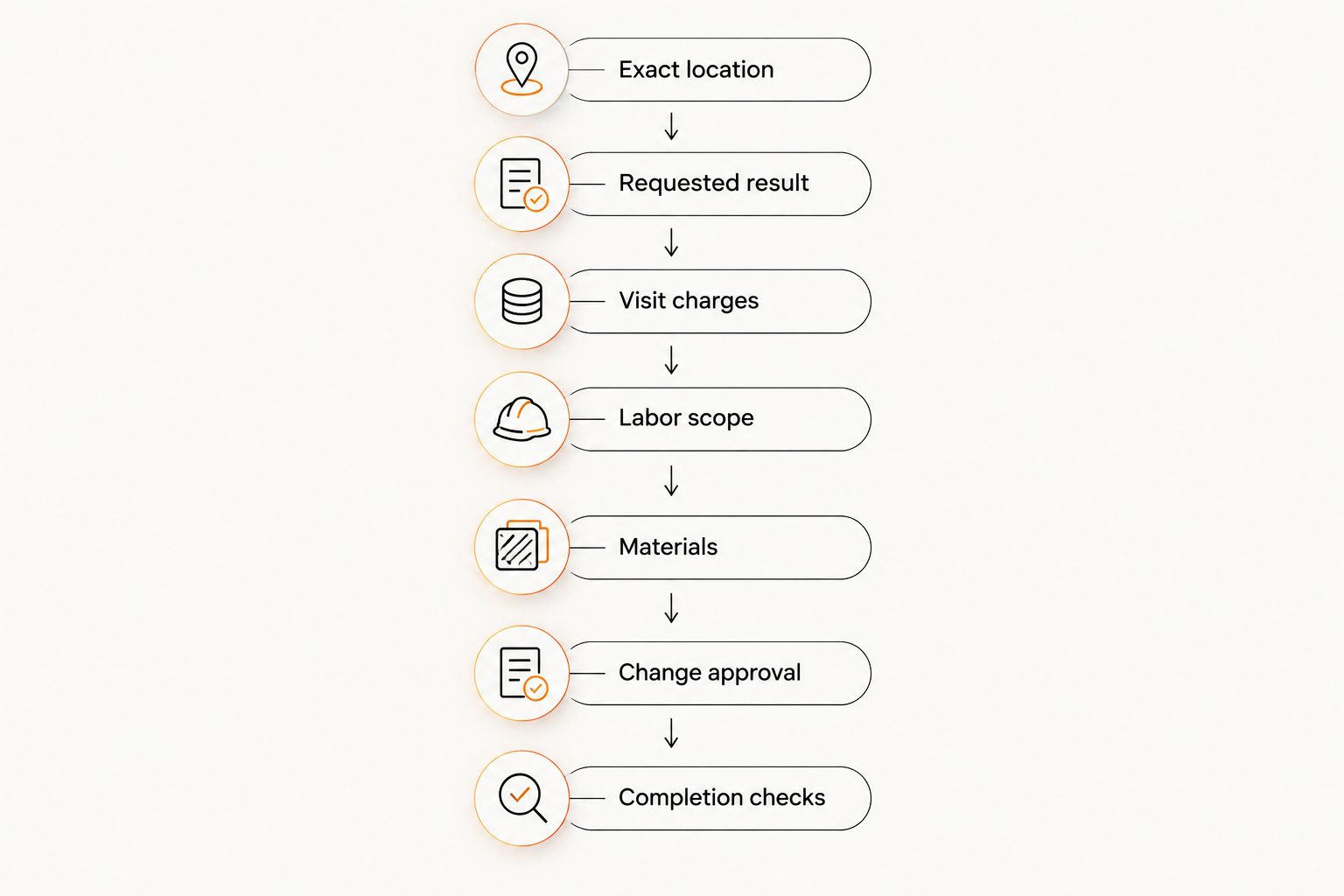
Define the job and the approval process before work begins.
Which service should the estimate cover?
Choose the service by the problem, not by the word emergency. A locked door, a missing key, and an unwanted working key require different outcomes. The table below separates those outcomes without treating them as interchangeable services.
Lockout entry
Best for: Keys are inside and you need access
Useful result: Restores entry to the agreed door or compartment
Limit or separate work: Does not replace missing keys or change who can unlock the door
Car key replacement
Best for: Your vehicle key is lost or unusable
Useful result: Provides a replacement key for a confirmed vehicle and key system
Limit or separate work: Cutting and programming requirements need confirmation
Rekeying
Best for: A working lock needs a different mechanical key
Useful result: Changes which mechanical key operates the lock
Limit or separate work: Does not repair damaged hardware or revoke electronic credentials
Lock replacement
Best for: The existing lock needs replacement
Useful result: Replaces the agreed physical hardware
Limit or separate work: Hardware selection and additional door repairs need separate discussion
These options have different completion checks. For entry, verify access and normal lock operation. For key replacement, verify the functions the technician agreed to provide. For rekeying, verify the new key works and the old mechanical key no longer operates the rekeyed lock.
Vehicle and truck lockouts: specify cab or cargo access
For a vehicle lockout, tell the technician whether the key is visible inside, locked in a separate compartment, or missing entirely. Provide the make, model, model year, and exact parking location. Explain whether the vehicle is in a garage, loading area, or other restricted location.
A truck's cab and cargo area are not the same access request. Identify the compartment you need opened and describe its lock separately. Do not assume a cab-entry estimate includes cargo access, a trailer, or every lock fitted to the vehicle.
For Ford Transit requests, confirm the model year, key type, and exact task with the technician. Fastkeyrious provides Ford Transit lockout and key services, but compatibility still needs confirmation for the specific vehicle. Do not treat Ford Transit Connect as automatically covered.
If the key is missing, review the distinction explained in making a car key without the original. Ask whether the proposed work includes cutting, programming where required, and testing the agreed functions. Entry alone does not solve a lost-key problem.
Home lockouts: separate entry from changing the lock
For a home lockout, identify the entrance and explain whether the key is inside, missing, broken, or turning without opening the door. Mention another lock on the same entrance if it also prevents entry. Describe visible damage without trying to diagnose the mechanism yourself.
Ask what proof of identity and authorization you should have ready. If you rent, confirm whether the requested work is limited to entry or includes a change that needs the property owner's approval. Access to the property and authority to replace its hardware are separate questions.
Rekeying changes the mechanical key that operates a suitable existing lock. Replacement changes the hardware itself. If you are concerned about an old key remaining usable, discuss that concern explicitly rather than assuming opening the door addresses it.
Do not approve replacement solely because you are locked out. Ask the technician to explain the condition of the existing lock and why the proposed work matches your problem.
Office and business lockouts: establish authority first
An office estimate should identify the specific entrance: the building exterior, your suite, or an interior room. State whether the obstruction involves a physical lock, a keypad, a badge reader, or another electronic access system. A physical lockout request does not establish support for electronic-system troubleshooting.
Prepare the name and contact details of the person authorized to approve the work. An employee's permission to enter an office is not necessarily permission to rekey or replace its locks. If the landlord controls the entrance or hardware, resolve approval before authorizing changes.
Explain any second door between the technician and the locked office. Include building-access instructions and the suite location. Those details help define whether the request involves a single entrance or separate access problems.
Changing a mechanical key does not cancel a badge, keypad code, or app credential. If the concern involves a former employee or missing credential, contact the person responsible for that electronic system. Keep that task separate from the physical locksmith estimate.
Why an emergency locksmith estimate varies
The estimate depends on the work requested and what the technician finds. Ask about these factors rather than comparing headline figures that describe different jobs:
The required outcome. Entry, key replacement, rekeying, and replacement involve different tasks. State the outcome you want before discussing the estimate.
The exact location and access. A street address, parking instructions, suite number, and controlled entrance help define the visit. Confirm whether applicable travel charges are included.
The lock's condition. A working lock with keys inside presents a different problem from damaged hardware or a broken key. Explain the symptoms and ask what needs inspection.
The vehicle's key system. Key cutting and programming requirements depend on the specific vehicle. Confirm the model year and key type rather than assuming universal compatibility.
The number of access points. A truck cab, cargo compartment, exterior entrance, and office suite are separate locations. Identify everything you want included.
The time and emergency scope. Ask whether the requested appointment has any applicable emergency or after-hours charge. A 24/7 service offering does not mean every visit has identical terms.
None of these factors justifies unexplained additional work. When the scope changes, ask what changed, what the technician recommends, and what requires your approval.
What should I have ready before requesting an estimate?
Have your exact address, a callback number, and a short description of the problem ready. For a vehicle, include the make, model, model year, and whether the key is inside or missing; for a building, identify the locked entrance and your authority to request service.
Ask which ownership or authorization documents the technician needs. If those documents are locked inside, explain that before the visit so the verification process can be discussed.
Fastkeyrious serves Upstate South Carolina, including Greenville, Clemson and Seneca. North Carolina is outside coverage. Confirm the exact job address and supported work directly with the technician before arranging a visit.
What if the technician finds a different problem?
Pause and review the revised scope before authorizing more work. Ask the technician to explain the finding, the proposed correction, and which parts of the original estimate still apply.
For example, recovering a key from inside the vehicle differs from making a key that no longer exists. If the original request changes, the revised estimate should describe the new result rather than simply adding an unexplained charge.
How do I know the job is complete?
Test the agreed result before the technician leaves. For a lockout, confirm access and normal operation; for rekeying or replacement, test locking and unlocking with the door open before testing it closed.
For a vehicle key, check the specific starting, locking, and remote functions included in the job. Review the invoice against the approved scope and keep the service documentation for your records.
FAQ
What should an emergency locksmith estimate in Greenville include?
An emergency locksmith estimate should identify the exact job, included visit charges, labor, necessary materials, and the approval process for additional work. Confirm whether you need entry, key replacement, rekeying, or lock replacement.
Does a vehicle lockout estimate include a new car key?
A vehicle lockout estimate does not automatically include a replacement key. Tell the technician whether the key is inside or missing, and confirm any cutting, programming, and testing separately.
Can I get an estimate directly from the locksmith technician?
Fastkeyrious connects customers directly with the arriving technician rather than a dispatch-center middleman. Describe the location and problem, then ask which parts of the estimate require an on-site inspection.
Is rekeying the same as replacing a lock?
Rekeying changes which mechanical key operates the existing lock; replacement changes the hardware. Rekeying does not repair damaged hardware or remove electronic access credentials.
Can an employee authorize an office lock change?
An employee should confirm authority before approving an office lock change. Permission to enter the office is separate from permission to rekey or replace locks, and landlord approval may be required.
Does truck lockout service include the cargo compartment?
Cargo access must be specified separately from cab access. Describe the truck, compartment, and lock, then ask the technician to confirm the supported work before approving the estimate.
What area is covered for emergency locksmith requests?
Fastkeyrious serves Upstate South Carolina, including Greenville, Clemson and Seneca, but not North Carolina. Confirm the exact job address and requested work directly with the technician.
What should I ask if the estimate changes after arrival?
Ask what finding changed the scope, what additional work is proposed, and what requires your approval. Review the revised estimate before authorizing the added work.
One last thing
Recovering access and restoring security are different outcomes. If your key is locked inside, entry can address the immediate problem. If a key is missing or held by someone who should no longer have access, opening the door leaves that concern unresolved.
Tell the technician which outcome you need before approving the estimate. That distinction keeps a simple lockout from becoming an unfinished security job.