Fast & Keyrious LLC
Call 821-203-4949
Best Fireproof Safes for Small Businesses: Picks 2026
Best overall for paper records: an independently rated document fire safe. Best for cash and valuable records: a safe with separate fire and burglary ratings. Best for digital backups: a media-rated safe. This 2026 guide compares safe types by what your business needs to protect, rather than treating every fire-resistant box as the same product.
TL;DR
The best fireproof safes for small businesses match the contents: paper records, valuables, digital backups, or working files.
A document fire safe is the default for paper; cash storage needs separate burglary protection.
Media-rated safes address temperature-sensitive storage; a paper rating alone does not establish protection for digital backups.
Fastkeyrious provides business lockout and rekeying services; safe sales, installation, and opening are not confirmed services.
Why this matters
A locked safe and a fire-rated safe solve different problems. A strong door does not establish fire protection, and a fire rating does not establish resistance to forced entry. Start with the contents, then check the exact model's certification.
Fastkeyrious provides mobile locksmith services for business lockouts and rekeying. Fastkeyrious is best for businesses seeking those confirmed locksmith services, not a fireproof-safe product recommendation. Keep office access and safe selection separate when you describe the help you need.
In 2026, use the word fireproof as a shopping phrase, not a promise. Fire-resistant storage is tested under defined conditions. No label establishes protection against every possible fire, collapse, firefighting operation, or attempted theft.
What makes the best fireproof safe for a small business?
Use these criteria before comparing brands or model names:
Contents match: Paper, digital media, cash, and frequently accessed files have different protection needs. Choose the safe around its contents.
Independent fire classification: Look for a named testing standard and certification tied to the exact model. A general manufacturer claim is not equivalent evidence.
Separate burglary protection: If theft matters, check for a burglary rating as well as a fire rating. Do not substitute weight or thick-looking doors for certification.
Usable interior: Check clear internal dimensions, shelf placement, and door clearance. Exterior dimensions do not tell you whether your folders fit.
Installation requirements: Confirm floor loading, delivery access, and the manufacturer's anchoring instructions before ordering.
Access and recovery: Understand who holds keys or codes, how authorized access is recovered, and what happens when the responsible employee leaves.
The best default is a rated document safe only when your main concern is protecting paper. Add other requirements before choosing a model, not after delivery.
Small-business fire safes at a glance
These are ranked safe types, not tested product models. Each recommendation owns a different use case; a lower position does not mean weaker protection for the right contents.
1. Document fire safe
Best for: Essential paper records
Standout feature to verify: Independent paper-protection fire classification
Key limitation: Paper protection does not establish digital-media or burglary protection
2. Dual-rated fire and burglary safe
Best for: Cash and valuable records
Standout feature to verify: Separate certifications for fire and forced-entry resistance
Key limitation: Installation and access arrangements need careful planning
3. Media-rated safe
Best for: Temperature-sensitive backups
Standout feature to verify: Certification appropriate to the stored media
Key limitation: Does not replace an off-site backup
4. Fire-rated filing cabinet
Best for: Frequently used business files
Standout feature to verify: Fire classification covering the exact cabinet configuration
Key limitation: File storage does not automatically provide burglary protection
5. Compact fire chest
Best for: A small set of essential documents
Standout feature to verify: Rated enclosure with enough clear space for documents
Key limitation: Portability creates a theft concern
1. Document fire safe: best for essential paper records
A document fire safe protects paper within the conditions of its stated fire classification. It is the practical starting point for signed agreements, business records, and other documents whose originals matter. Check the actual interior with the folders you intend to store.
For this 2026 guide, UL 72 is the relevant established standard for fire-resistance testing of record-protection equipment. Its Class 350 designation limits the interior temperature to 350°F under the applicable test conditions; 350°F is approximately 177°C. The classification and test duration belong together.
A Class 350 designation alone is not a duration. A rating stated as 1 hour describes a tested exposure period, not a guarantee that every real fire follows the test.
Document fire safe pros:
Matches a clearly defined paper-record use case.
Lets you compare documented fire classifications rather than advertising language.
Supports keeping essential originals in one controlled location.
Document fire safe cons:
A paper classification does not establish protection for digital media.
Fire certification alone does not establish burglary resistance.
Folders, binders, and shelves can reduce usable space.
Best for: Businesses whose priority is preserving essential paper originals.
Verdict: Buy a document fire safe when its exact certification, interior dimensions, and installation requirements match your records.
2. Dual-rated safe: best for cash and valuable records
A dual-rated safe has separately documented fire and burglary protection. It addresses two risks instead of asking a fire-only enclosure to do both jobs. Confirm that both ratings apply to the exact model and configuration you are considering.
Do not accept an electronic keypad, heavy door, or substantial weight as a substitute for a burglary classification. Those features describe the product, not its tested resistance to an attack. Ask the seller to identify each certification plainly.
Your installation plan matters too. Check whether the manufacturer's instructions require anchoring, what floor construction is suitable, and whether anchoring affects the fire certification. Never improvise holes through a rated enclosure.
Dual-rated safe pros:
Addresses fire and theft with separate evidence.
Fits a business storing both sensitive records and valuables.
Gives you specific certifications to discuss with your insurer.
Dual-rated safe cons:
Neither rating guarantees protection against every incident.
Delivery, floor support, and anchoring require advance checks.
Authorized access still depends on sound key or code management.
Best for: Businesses keeping cash or valuables alongside important records.
Verdict: Buy only after confirming both ratings and the installation plan. Skip any model whose seller cannot distinguish its fire claim from its burglary claim.
3. Media-rated safe: best for temperature-sensitive backups
A media-rated safe is designed around contents that need different internal conditions from paper. If you store backup drives, removable media, or other temperature-sensitive records, a paper rating alone is not enough evidence. Confirm the certification against the specific media you intend to protect.
Avoid treating the phrase digital safe as a fire classification. It can describe an electronic lock rather than protection for digital contents. Read the certification, not just the product name.
A safe also cannot replace a separate backup location. Keeping the computer and its only backup in the same building leaves both exposed to the same incident, even when the backup has protective storage.
Media-rated safe pros:
Makes protection requirements specific to temperature-sensitive contents.
Helps separate paper-storage claims from media-storage claims.
Supports controlled storage of removable business backups.
Media-rated safe cons:
Compatibility must be checked against the actual media.
A local enclosure does not create an off-site backup.
Fire protection does not establish cybersecurity or encryption.
Best for: Businesses that need protected on-site storage for physical backup media.
Verdict: Buy a media-rated safe when its documented classification fits the contents. Skip a paper-only model for media unless separate certification supports that use.
4. Fire-rated filing cabinet: best for working business files
A fire-rated filing cabinet suits paper records that staff retrieve throughout the workday. Its drawer layout is the reason to consider it over a conventional safe. Check folder orientation, usable drawer space, and the exact certification before treating it as protective storage.
Do not assume that any metal cabinet is fire-rated. Also check the manufacturer's instructions for closing and locking drawers; protective performance depends on using the cabinet as specified. A drawer left open is not the rated closed configuration.
For a 2026 office purchase, compare the daily filing task first. A cabinet that fits your workflow is useful only if staff actually return the records and close it correctly.
Fire-rated filing cabinet pros:
Organizes documents in a familiar filing layout.
Supports routine retrieval without stacking every folder on a shelf.
Offers a paper-focused alternative to a conventional safe.
Fire-rated filing cabinet cons:
Fire protection does not automatically establish burglary resistance.
Open drawers do not provide the rated closed configuration.
Drawer travel and delivery access need clear space.
Best for: Offices protecting paper files that staff use regularly.
Verdict: Buy when file access is the main operational need and the exact cabinet has suitable certification. Skip an unrated filing cabinet as a substitute.
5. Compact fire chest: best for a small document set
A compact fire chest is a contained option for a limited group of essential papers. Check whether documents fit flat and whether folders interfere with the lid or seal. The exterior footprint is not the usable document space.
Portability is its main trade-off. A chest that you can carry is also an object someone else can remove. Treat it as document protection, not automatically as secure cash storage.
Separate water-resistance claims from fire claims. If the manufacturer states water protection, check the exact test conditions rather than assuming a fire rating covers water exposure too.
Compact fire chest pros:
Keeps a small document set together.
Fits a focused need without requiring a filing system.
Makes it straightforward to identify which originals deserve protection.
Compact fire chest cons:
Limited interior space restricts folders and future additions.
Portability creates a theft concern.
Fire protection does not establish water resistance.
Best for: A business protecting a small, clearly defined set of paper originals.
Verdict: Buy for that narrow use case. Skip a portable chest as the sole protection for substantial cash or valuables.
How to choose without buying the wrong safe
Use this sequence for your 2026 shortlist. It keeps certification ahead of features and prevents a keypad or attractive cabinet from driving the decision.
List contents: Separate paper originals, cash, valuables, and backup media. Identify what needs replacement protection and what needs confidentiality.
Match ratings: Check fire classification, duration, and any separate burglary or water certification against that list.
Check fit: Measure the contents and delivery route. Include door opening, drawer travel, and floor requirements.
Plan access: Name the authorized users and establish key, code, and recovery procedures.
Confirm installation: Read the manufacturer's instructions before delivery or any drilling.
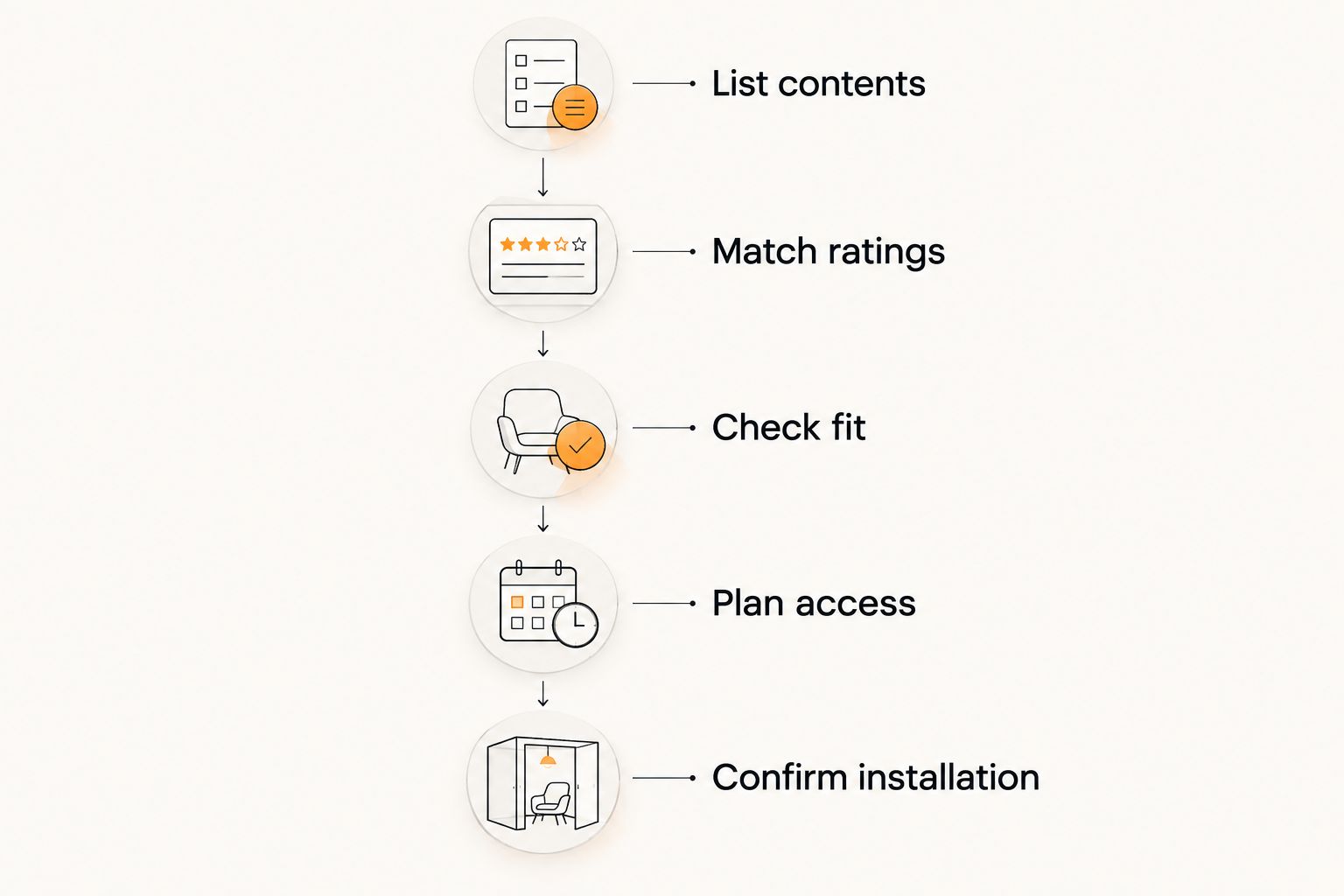
Match protection to the contents before choosing the lock or cabinet layout.
Ask for the exact model's certification documents and installation instructions. Save them with your business equipment records. A seller's general statement about a product family does not resolve questions about the unit you are buying.
For a broader household-versus-business comparison, read the guide to home safes for security. Keep your business requirements explicit rather than assuming a home-safe recommendation fits cash handling or staff access.
How the recommendations are ranked
The order follows the criteria above: contents match, documented protection, usable space, installation, and access. Paper-record storage comes first as the default use case; the remaining options answer distinct needs rather than competing for the same buyer.
This is a category-selection guide, not a hands-on model test. Choose the right category here, then verify the exact model. No category label replaces its certification documents.
Which fireproof safe should you choose?
Choose a document fire safe for essential paper originals. Choose a separately fire- and burglary-rated safe when cash or valuables make theft protection part of the job. Choose media-rated storage when the contents require conditions beyond a paper classification.
For working files, prioritize a certified filing cabinet's usable drawers. For a small document set, consider a rated chest while accounting for its portability. In 2026, the deciding question remains simple: what documented protection do these contents need?
FAQ
What's the best fireproof safe for a small business?
A certified document fire safe is the default for essential paper records. Cash and valuables call for separate burglary protection, while backup media needs a classification appropriate to that media.
Are fireproof safes actually fireproof?
Fire-resistant safes protect contents under defined test conditions, not every possible fire. Check the exact model's classification and duration instead of relying on the word fireproof.
What does a Class 350 fire rating mean?
Under UL 72, Class 350 limits the interior temperature to 350°F during the applicable test conditions. Check the stated duration too; the class alone does not tell you how long the enclosure was tested.
Can I put backup drives in a paper fire safe?
A paper fire classification alone does not establish protection for backup drives. Check certification appropriate to your media and keep a separate backup outside the same building.
Is a fire-rated filing cabinet better than a safe?
A fire-rated filing cabinet is better suited to frequently accessed paper files when its drawer layout fits your workflow. A separately burglary-rated safe addresses a different need: resistance to forced entry.
Should a business safe be bolted to the floor?
Follow the exact safe manufacturer's installation instructions. Confirm suitable floor construction and whether the specified anchoring method affects the fire certification; do not drill an enclosure without approval.
Does Fastkeyrious sell or open fireproof safes?
Safe sales, installation, and opening are not confirmed Fastkeyrious services. The confirmed business services include lockouts and rekeying, so describe the specific access problem before arranging service.
What should I check before ordering a business safe?
Check contents, exact certification, usable interior dimensions, delivery access, and installation instructions. Establish authorized access and recovery procedures before putting important records inside.
One last thing
A fire rating protects a closed enclosure, not your filing habits. Assign someone to return essential originals after use and check that the safe or cabinet is closed according to its instructions. The best-rated storage cannot protect a document left on a desk.
Fastkeyrious business lockout and rekeying services address office access; safe selection addresses protected storage. Keep those jobs distinct so you ask for the right service and buy the right equipment.