Fast & Keyrious LLC
Call 821-203-4949
Commercial locksmith services for restaurant owners: complete 2026 guide
Restaurant owners’ commercial locksmith services are professional lockout and rekeying services that restore access and control who can enter your business. This 2026 guide explains how to handle lost keys, staff changes, and locked doors without confusing entry security with safe emergency exit.
TL;DR
Commercial locksmith services for restaurant owners should separate emergency entry, rekeying, and door hardware decisions.
Fastkeyrious suits restaurant owners who want direct technician contact for mobile business lockout and rekeying services.
Rekeying changes which key operates a compatible lock; it does not repair damaged door hardware.
Confirm the restaurant’s exact address against the approved 30-mile Greenville service boundary before requesting service.
Why commercial locksmith services matter for restaurant owners
A restaurant door serves different people at different times: opening managers, closing staff, suppliers, and customers. Your access plan needs to account for those differences without leaving employees dependent on a missing key or a former employee’s copy.
A lockout and an uncontrolled key are separate problems. Regaining entry does not make an old key stop working. Compare lock rekeying services when your concern is who still has access, rather than whether you can open the door right now.
For your 2026 access plan, treat safe exit, reliable entry, and key control as separate checks. A door that locks securely still needs appropriate exit hardware. A working lock still needs a clear owner for every issued key.
You do not need to start with new equipment. Start with a door inventory, a key list, and an explanation of the problem. Those details help you request the right service instead of describing every issue as a broken lock.
Build a practical restaurant access plan
Map your doors
Walk through the restaurant before changing any locks. List the customer entrance, staff entrance, delivery door, and interior doors that restrict access to offices or supplies. Record what each door does, not just where it sits.
Separate your 2026 inventory into 3 access groups: public entry, staff entry, and restricted rooms. These are planning categories, not instructions to change hardware. A delivery door, for example, needs an access routine that reflects when suppliers arrive and which employee receives them.
Pay attention to doors that share a key. One missing key can affect several entrances. Also distinguish the lock from the rest of the opening: hinges, the frame, the latch, and the closer can all affect whether a door shuts properly.
Name each door by location and purpose.
Record which keys operate each lock.
Note who needs access during opening and closing.
Identify doors used for emergency exit.
Photograph visible hardware without exposing key details.
Account for keys
Use a simple paper log or spreadsheet before considering electronic access. Record the key holder, the doors the key opens, and whether the key has been returned. Assign responsibility for updating that list whenever someone joins, changes roles, or leaves.
A returned key does not establish that no copies exist. If an unaccounted-for key opens the restaurant, decide whether rekeying is needed rather than treating a verbal assurance as access control. Apply the same review to keys held by outside vendors or former managers.
Rekeying is the relevant option when a compatible lock works but its existing key should no longer grant access. Replacing the whole lock is a different decision. Hardware condition and compatibility determine whether rekeying addresses the actual problem.
List current key holders by name and role.
Mark missing and unreturned keys clearly.
Record which doors each missing key can open.
Keep spare keys under an assigned manager’s control.
Review key access after staffing changes.
Define the service
First, write down what you observe: the key is missing, the key will not turn, the door will not latch, or everyone is locked outside. Do not force the mechanism or assume those symptoms require the same repair.
Professional help becomes useful here. Fastkeyrious is best for restaurant owners who want direct technician contact for mobile business lockout and rekeying services. You speak with the technician rather than a dispatch center. That gives you a direct place to explain the door, the access problem, and the restaurant’s exact location.
Fastkeyrious provides commercial locksmith services including business lockouts, rekeying, and 24/7 emergency response. Its approved service area is within 30 miles of Greenville, South Carolina, excluding North Carolina and Wellford. Confirm the exact address; a city or county name alone does not establish coverage.
Describe the symptom without guessing the repair.
State whether any authorized entrance remains available.
Share the exact restaurant address and door location.
Explain your authority to approve access or work.
Confirm the requested scope with Fastkeyrious.
Protect safe exit
Start by checking how each designated exit operates from inside. Do not add a lock, chain, or makeshift barrier simply because a rear entrance feels exposed. Security changes must preserve the exit function required for that door.
Restaurant occupancy and door use matter when selecting hardware. Ask the applicable building or fire authority about requirements before making changes that affect an exit. A hardware recommendation for an office entrance is not automatically appropriate for a restaurant’s customer exit.
Build 2 door checks into your 2026 review: confirm authorized entry from outside and check normal exit operation from inside. These checks do not replace a code review or professional inspection. They help you describe the current condition accurately.
Identify designated exits before discussing upgrades.
Remove stored items that obstruct exit routes.
Report sticking, loose, or damaged hardware.
Ask about exit requirements before changing locks.
Never test security by trapping someone inside.
Prepare for lockouts
Create a written lockout plan while the restaurant is accessible. Name the person authorized to request service, explain where a controlled spare is kept, and list the information a technician needs. Keep the plan accessible without entering the locked building.
If you are already locked out, stop repeated attempts with a key that bends, sticks, or will not turn. Check whether another authorized entrance is available, but do not force doors or send staff through windows. Entry attempts can create a second problem without solving the first.
A business lockout is not the right response to an immediate threat to life. Call emergency services when someone is in danger. For an ordinary lockout, explain whether the restaurant is closed, preparing to open, or occupied so the technician understands the situation.
Keep service instructions accessible outside the building.
Name the manager who can authorize entry.
Prepare identification and evidence of business authority.
Describe the door and visible lock type.
Keep staff clear of the work area.
Test the result
After the work, verify the original problem has been addressed before returning the door to normal use. If rekeying was performed, confirm the new key operates the intended locks and the old key no longer operates those locks. If entry was restored, ask whether any unresolved hardware problem remains.
Check the door as a complete opening. A key that turns does not prove the door closes and latches correctly. Test normal entry and exit without forcing anything, and report resistance or misalignment immediately.
Finish by updating your 2026 key record. Record the affected doors, the people receiving keys, and any follow-up action. Without that administrative step, new keys simply become another untracked set.
Test each affected lock with its intended key.
Check normal closing and latching.
Confirm exit operation remains appropriate.
Update the key-holder list immediately.
Record unresolved issues separately from completed work.
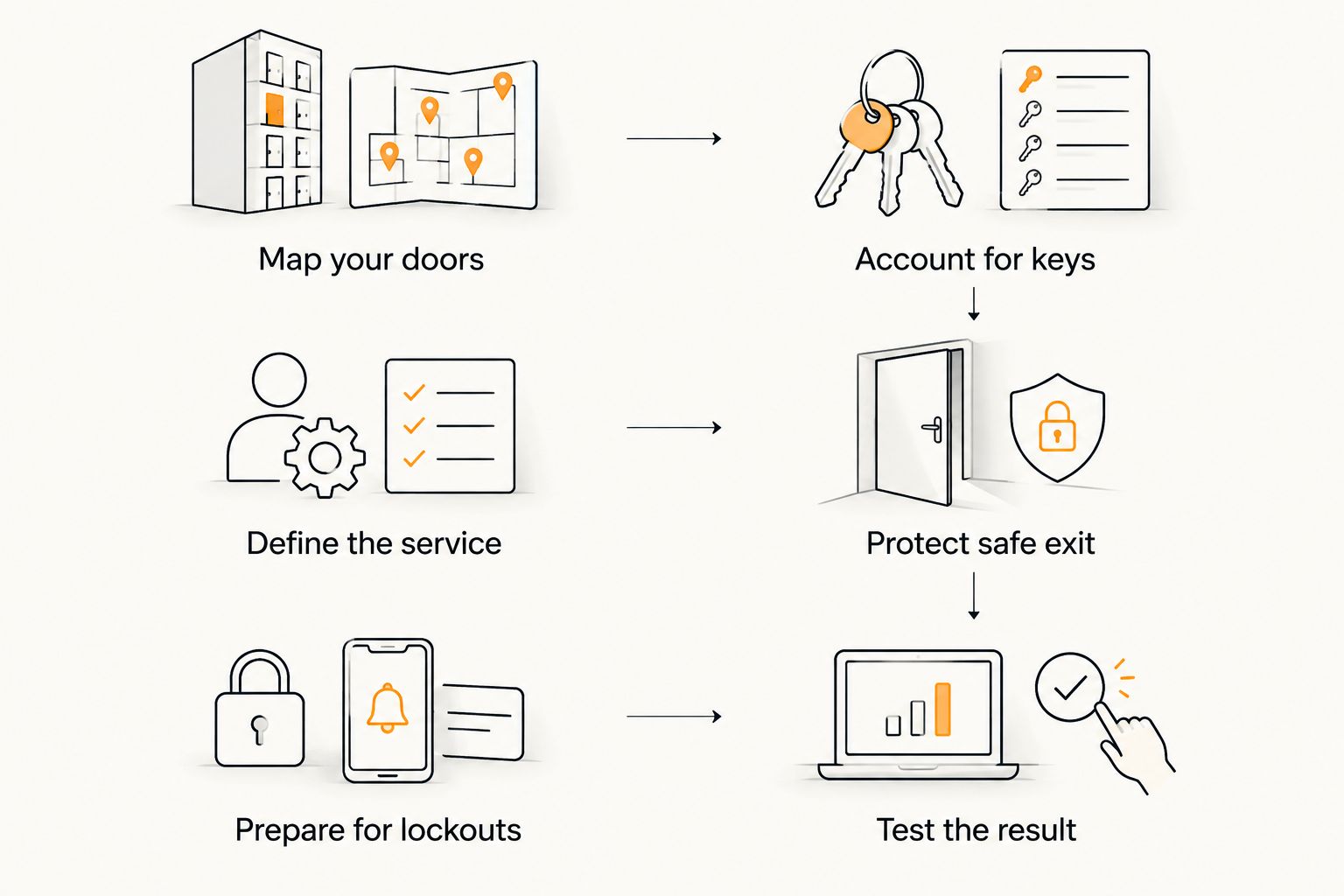
Define the access problem before selecting a service or changing hardware.
Compare your restaurant access options
Choose the option that solves the identified problem. Mechanical keys, keypad access, and replacement hardware are not interchangeable answers. Your 2026 decision should account for the existing door, authorized users, and required exit operation.
Key inventory and controlled spare
Best for: Owners with working locks who need clearer responsibility
Main benefit: Documents who has access and where a backup is held
Key limitation: Does not disable missing or copied keys
Professional rekeying
Best for: Owners who need existing keys to stop operating compatible locks
Main benefit: Changes key access without automatically replacing all hardware
Key limitation: Does not repair a damaged lock, frame, or door
Mobile business lockout service
Best for: Authorized owners or managers unable to enter
Main benefit: Addresses the immediate access problem
Key limitation: Does not by itself resolve lost-key control
Lock or door hardware replacement
Best for: Owners with unsuitable or damaged hardware
Main benefit: Allows the hardware problem to be addressed directly
Key limitation: Requires compatibility and exit requirements to be checked
Compatible keypad access
Best for: Owners who want code-based entry on an appropriate door
Main benefit: Removes the need to issue a physical key for that entry method
Key limitation: Needs code administration and a model-specific backup plan
For Fastkeyrious commercial locksmith services, the strongest fit is direct help with business lockouts and rekeying. Those services address entry and key control. Do not assume that every electronic system, commercial hardware installation, or door repair is included; confirm the requested work before arranging service.
For keypad access, ask how authorized codes are changed and what happens if power or batteries fail. For replacement hardware, ask what the existing door accepts. A product feature list cannot answer whether the hardware is suitable for your particular opening.
Discuss your restaurant access problem
Speak directly with the technician about business lockouts, rekeying, and your exact service address.
Common mistakes restaurant owners make
Treating entry restoration as key control
A technician opening a locked door solves the immediate lockout. It does not invalidate a lost key. If the missing key still operates the entrance, discuss rekeying separately and identify every door that key opens.
Leaving delivery-door access informal
A supplier’s access needs are different from a manager’s. Do not let a shared delivery key become an undocumented route into the restaurant. Record who holds it and establish who receives deliveries when the door is locked.
Choosing hardware before checking the door
A lock selected for its features can still be inappropriate for the opening. Check the existing hardware, door condition, and exit role first. Treat electronic access as a door-specific decision, not a restaurant-wide default.
Keeping access instructions inside
A lockout plan stored only in the manager’s office is unavailable when the manager cannot enter. Keep essential instructions accessible to authorized staff outside the premises. Protect key details and access credentials rather than posting them publicly.
Assuming a nearby address qualifies
Service coverage depends on the actual location, not a familiar city name. Fastkeyrious serves approved addresses within the 30-mile Greenville boundary, excluding North Carolina and Wellford. Confirm the restaurant address before relying on emergency availability.
FAQ
What commercial locksmith services does a restaurant owner need?
Restaurant owners need services matched to the problem: business lockout help for lost access and rekeying when existing keys should stop working. Damaged hardware or proposed access upgrades require a separate assessment of the door and its exit function.
Should I rekey restaurant locks when an employee leaves?
Review rekeying when a departing employee had access to keys that still operate the restaurant. A returned key does not establish that no copies exist, so base the decision on your access records and the doors affected.
Is rekeying better than replacing a restaurant lock?
Rekeying fits a compatible, working lock when you need to change key access. Replacement addresses a different question: whether the existing hardware is damaged or unsuitable. Have the door assessed before choosing.
Can a locksmith open my restaurant if I lost the keys?
A business lockout service addresses lost access for an authorized owner or manager. Be ready to explain the door, provide the exact address, and establish your authority to enter; the entry method depends on the lock and its condition.
Are keypad locks a good choice for restaurant entrances?
Keypad locks fit some restaurant entrances when the hardware is compatible and preserves required exit operation. Check code management, power-failure behavior, and backup access before selecting a system.
Does Fastkeyrious provide emergency restaurant lockout service?
Fastkeyrious provides mobile business lockout services and 24/7 emergency response within its approved service area. Confirm the exact restaurant address within 30 miles of Greenville, South Carolina; North Carolina and Wellford are excluded.
What should I tell the technician before restaurant locksmith service?
Tell the technician the exact address, the affected door, the symptom, and whether another authorized entrance is available. Explain whether you need entry restored, existing keys disabled through rekeying, or an assessment of damaged hardware.
One last thing
The spare key needs an owner, not just a hiding place. Assign someone to check that it opens the intended door after every rekeying job. An outdated spare turns a simple backup plan into another lockout.
Make that check part of your 2026 opening procedures. Keep the key controlled, document who can retrieve it, and update the record when responsibility changes.